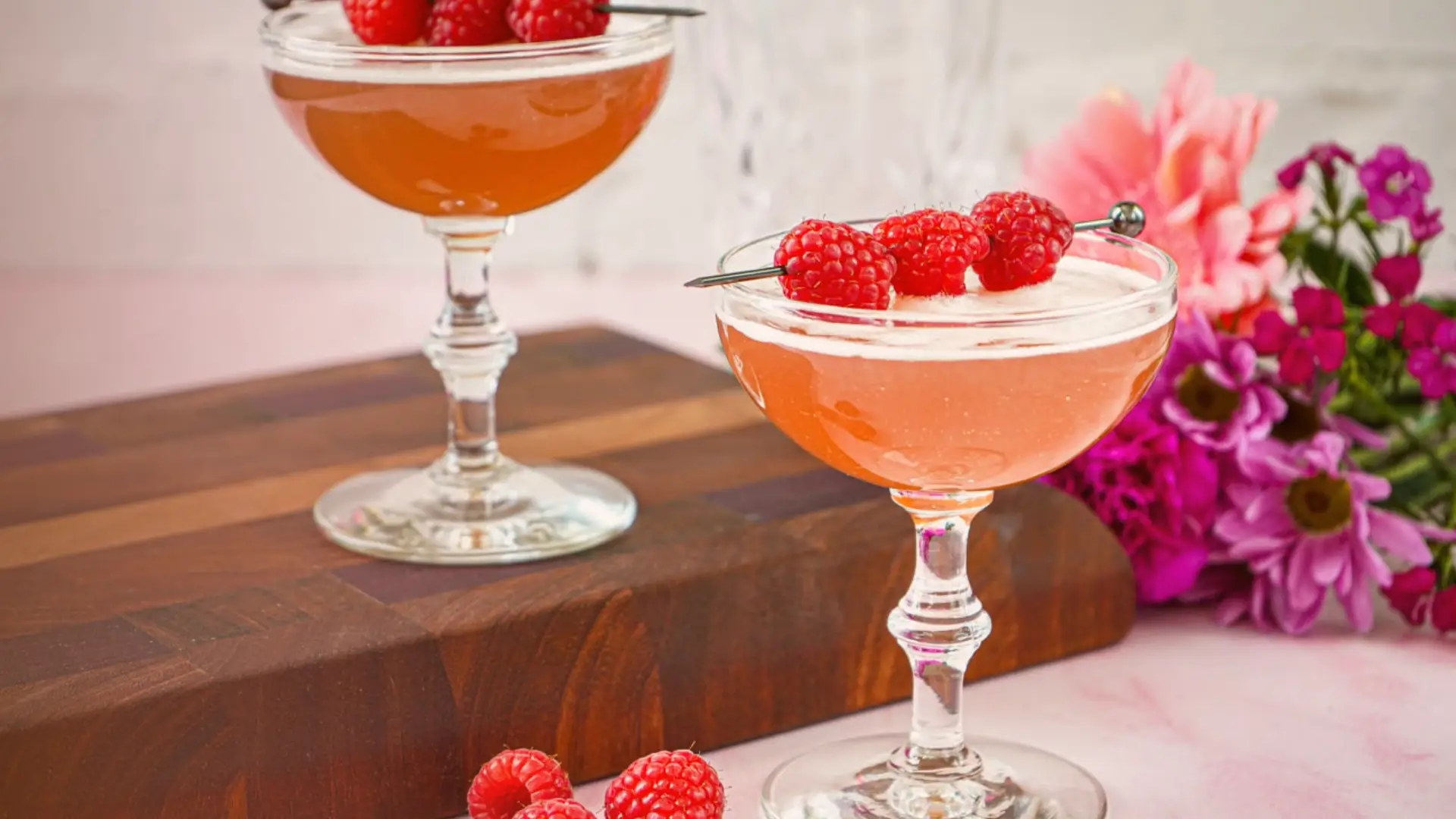
Despite its title, the French Martini shares little with the classic Martini beyond its glassware. It contains no vermouth and does not follow the spirit-forward logic associated with traditional stirred cocktails. Instead, it belongs to a category that emerged in the late twentieth century, where the Martini name became a signifier of style rather than structure.
This shift reflects broader changes in cocktail culture during the 1990s. Drinks were no longer defined solely by historical templates. They were shaped by consumer preference, presentation, and the desire for flavours that were both familiar and refined. The French Martini stands at the centre of this transformation, bridging bar tradition with contemporary taste.
A Martini in Name, Not in Structure
By the mid-1990s, New York’s bar scene was entering a new phase. The rigid revival of pre-Prohibition classics had not yet fully taken hold, and a different kind of experimentation was unfolding. At venues associated with Keith McNally, particularly Pravda and later Balthazar, cocktails began to shift toward approachability, visual appeal, and fruit-driven balance. Within this context, the French Martini emerged, not as a reinterpretation of a classic, but as a defining expression of a new era.
Its combination of vodka, pineapple juice, and raspberry liqueur introduced a profile that was soft, aromatic, and immediately accessible. More importantly, it redefined what the term “Martini” could represent, moving it away from strict historical lineage and toward a broader cultural identity.
Chambord and the Role of Liqueur
The defining ingredient of the French Martini is Chambord, a black raspberry liqueur associated with France. Known for flavours of black raspberry, citrus, vanilla, and honey, Chambord introduces both sweetness and aromatic depth.
Its inclusion is more than decorative. Chambord functions as a multi-dimensional sweetening agent, replacing simple syrup while adding fruit complexity and texture. The liqueur’s richness integrates with vodka’s neutrality, creating a base that supports the brighter acidity of pineapple juice.
This approach reflects a broader trend in late twentieth-century cocktails, where liqueurs became central to flavour construction rather than secondary modifiers.
Pineapple Juice and the Mechanics of Foam
The visual signature of the French Martini lies in its pale pink colour and its fine layer of foam. This foam is produced through the shaking of pineapple juice, which contains compounds that can trap air, creating a stable surface.
Unlike egg white foams, which are often used for structure, pineapple foam is lighter and more aromatic. It carries the scent of the drink, shaping perception before the first sip. This detail is not incidental. It contributes to the cocktail’s identity as a textural and sensory experience, not just a flavour combination.
The acidity of pineapple also plays a crucial role. It provides balance against the sweetness of Chambord, ensuring that the drink remains structured rather than cloying.
Vodka and the Framework of Neutrality

Vodka forms the structural backbone of the French Martini, allowing the other ingredients to define the drink’s character. Its neutrality creates space for fruit and liqueur to interact without interference.
Expressions such as Absolut Vodka, produced in Åhus and linked to Swedish distilling heritage from the late nineteenth century, offer a clean and consistent base, while Ketel One Vodka, distilled in Schiedam, provides a slightly fuller mouthfeel.
These differences, though subtle, influence the cocktail’s texture and finish. In a drink built on balance, even minor variations in spirit profile can shape the overall result, reinforcing the idea that vodka, while neutral, remains a critical structural element.
New York Origins and Global Expansion
The French Martini’s emergence in New York reflects a moment when the city’s bar culture was redefining itself. The drink is strongly associated with Keith McNally’s hospitality world and with Dale DeGroff, who helped give it wider visibility by placing it on the menu at Pravda in 1996. Its later appearance at Balthazar in 1997 helped move it further into New York’s broader cocktail culture.
From there, the drink spread rapidly, becoming a staple in bars across Europe and beyond. Its popularity was driven not only by flavour but by presentation. The Martini glass, the foam, and the colour combined to create a drink that was visually distinctive and easy to recognise.
Cultural Shift and the Flavoured Martini Era
The French Martini played a central role in the rise of the “flavoured Martini,” a category that dominated cocktail menus throughout the 1990s and early 2000s. While many of these drinks were short-lived, the French Martini endured, largely because of its balanced composition and technical coherence.
Unlike more extreme variations, it maintains a clear relationship between its components. Each ingredient serves a purpose, contributing to a structure that remains stable even as trends change.
The International Bartenders Association lists the French Martini among its New Era Drinks, placing it within the modern cocktail canon rather than the historical Martini family. That distinction matters because the drink’s importance lies not in classical lineage, but in how it captured a specific moment in late twentieth-century bar culture.
Contemporary Relevance and Bar Interpretation
In modern bars, the French Martini has undergone a quiet reassessment. While it is sometimes associated with an earlier era of cocktail culture, its structure aligns with contemporary principles of balance and ingredient-driven design.
In contemporary cocktail programmes, the principles behind the French Martini remain relevant: controlled sweetness, proper aeration, clean structure, and careful management of fruit acidity. The cocktail does not require a direct link to any single modern bar to explain its continued presence. Its value lies in the way it shows how a fruit-led drink can remain coherent when proportion and texture are handled with precision.
The cocktail’s continued presence demonstrates that even within a category often dismissed as trend-driven, some examples achieve lasting structural integrity.
Details That Continue to Define the Drink
The French Martini’s balance depends heavily on proportion. Too much liqueur results in excessive sweetness, while insufficient pineapple reduces both acidity and foam. The drink requires precise shaking to achieve the correct texture and dilution.
Another often overlooked factor is juice quality. Fresh pineapple juice produces a more stable foam and brighter flavour, while processed alternatives can flatten the drink’s profile.
Even its name reflects a broader cultural moment. The use of “French” evokes sophistication through its association with Chambord, while “Martini” signals style and presentation. Together, they capture a period when cocktails became as much about identity as composition.

Renowned international hospitality consultant, founder of Barpartners, and IBA Vice President of Classic Mixology, bringing over 25 years of luxury hotel bar operations.

In partnership with International Bartenders Association
The International Bartenders’ Association stands at the crossroads of exchange between new and established generations of professionals.
Bar
In the heart of Mayfair, behind the storied façade of The Connaught Hotel, stands the Connaught Bar —…
Cocktail
The French Martini is a vibrant and elegant cocktail, celebrated for its balance of fruity sweetness and smooth…
Spirit
Chambord Black Raspberry Liqueur
Chambord Black Raspberry Liqueur is a premium, berry-flavored liqueur crafted from the finest black raspberries handpicked in the…
Spirit
Absolut Vodka is a distinguished Swedish vodka produced in Åhus, a town in southern Sweden that has a…
Spirit
Chambord is a luxurious French black raspberry liqueur renowned for its exquisite flavor profile and striking packaging. This…
Spirit
Ketel One 325th Anniversary Vodka
Ketel One 325th Anniversary Vodka represents a significant milestone in the rich heritage of the Nolet family, reflecting…
Bars and Cocktails
Hospitality and Cocktail Culture: The Foundation of Bartending
A well-made cocktail may earn attention, but hospitality determines the meaning of the exchange. It begins before an order is taken, in the way a guest is acknowledged, understood and given a place within the room. Bartending becomes hospitality when technical skill is directed towards another person rather than displayed for its own sake. Service […]
September 29, 2026
Partnership
Illegal Cocktail: The Mezcal Cocktail That Reframes the Daiquiri Structure
The Illegal cocktail follows a familiar outline, but the result is distinctly different. Built around mezcal, lime, falernum, maraschino, simple syrup, and a measure of Jamaican overproof rum, it takes the logic of a sour and shifts it into a drier, more aromatic profile. The drink is credited to Italian bartender Samuele Ambrosi, with its […]
September 24, 2026
Partnership
IBA Tiki: Codifying Tropical Structure Within Modern Cocktail Standards
Tiki has never been a single drink, but in this case the name points to one specific modern cocktail. The IBA Tiki is not a broad label for tropical classics such as the Mai Tai or the Zombie. It is a defined drink connected to the International Bartenders Association, Cuban bartending culture, and a recent […]
September 17, 2026