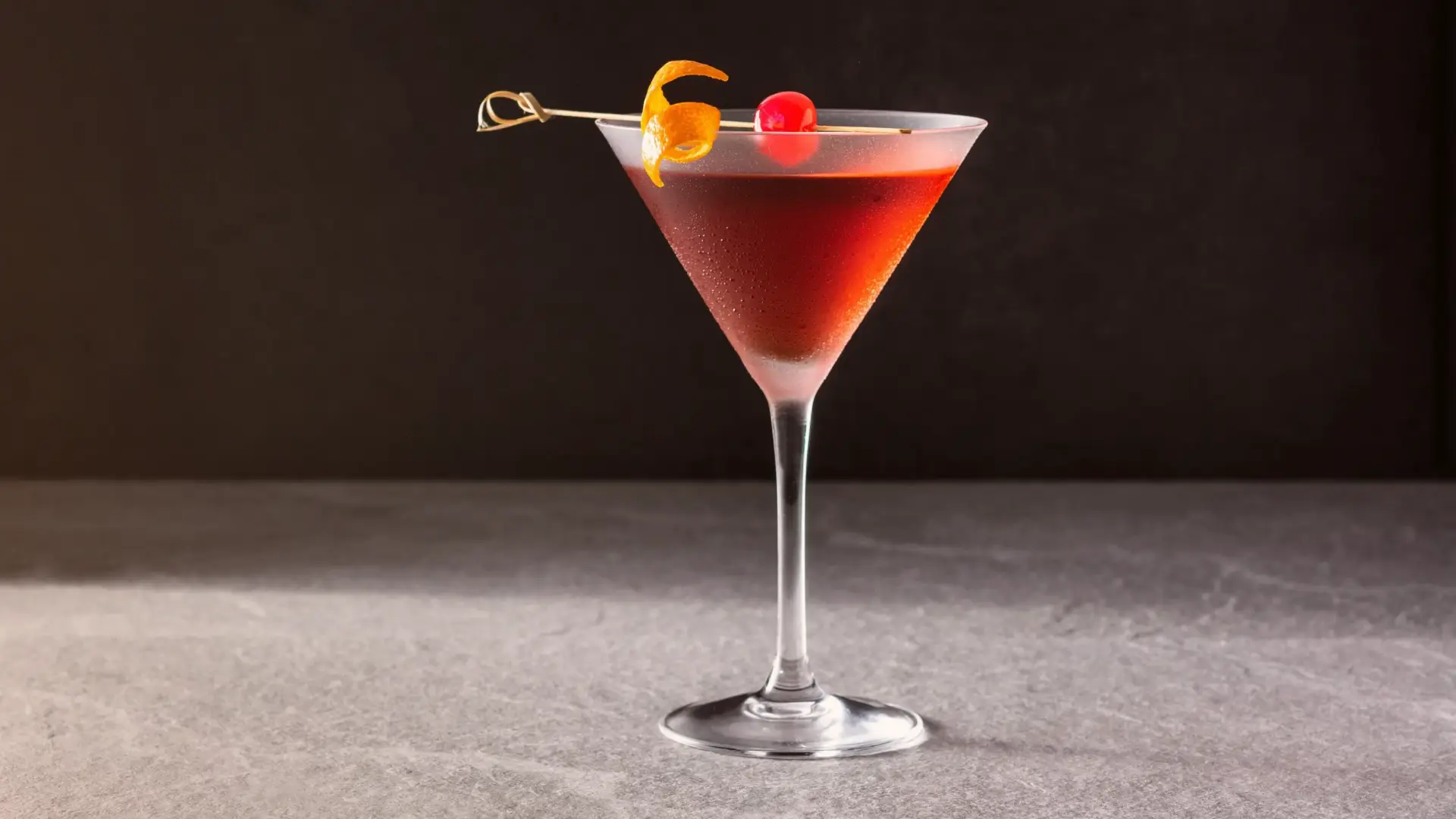
The Manhattan cocktail emerged from a city learning how to display power. During the closing decades of the 1800s, New York was becoming richer, larger, and more divided. Railways, banking, shipping, property, newspapers, and industry created fortunes on a scale the country had rarely seen. Private clubs multiplied, hotels grew more elaborate, and dining rooms became stages on which influence could be observed as clearly as it could be exercised.
The cocktail that took the city’s name belonged to that environment. Whiskey provided an unmistakably American foundation, while vermouth brought the influence of European wine culture into the glass. Bitters linked the drink with an older American understanding of the cocktail, built around spirit, sugar, water, and aromatic seasoning.
No reliable document identifies one inventor or one decisive evening. That uncertainty is not a weakness in the story. It tells us that the Manhattan cocktail probably developed through the working culture of bars, clubs, hotels, and restaurants rather than appearing fully formed through one celebrated act of invention.
Its history is therefore less about a secret recipe and more about a changing city.
A Cocktail for a City in Motion
The period later called the Gilded Age transformed New York’s physical and social landscape. Wealth moved uptown, commercial districts expanded, immigration reshaped neighbourhoods, and new fortunes challenged families whose status had rested on inheritance.
Public life became more organised, but it also became more guarded. Hotels, restaurants, saloons, and private clubs offered different degrees of access, from crowded public bars to rooms controlled by membership, recommendation, and reputation.
Cocktails fit this world neatly. They were prepared quickly, named memorably, and capable of carrying associations with places, people, theatres, clubs, or political events. A name could move faster than the story behind it, especially when bartenders adapted successful combinations from one establishment to another.
The Manhattan belonged to this urban movement. It carried the name of the island and, by extension, the confidence of the city growing upon it.
The Manhattan Club and a Useful Legend
The Manhattan Club was founded in 1865 as a political and social organisation associated with prominent Democrats. Its members included lawyers, financiers, officeholders, and party figures, among them Samuel J. Tilden, who became governor of New York and later contested the presidential election of 1876.
Such a club provides an attractive setting for a famous cocktail. It brings politics, wealth, dining, and exclusivity into one room, which is probably why the traditional origin story has proved so durable.
According to that account, the drink was created at a banquet honouring Tilden, supposedly hosted by Jennie Jerome, later Lady Randolph Churchill. A bartender often identified as Iain Marshall is then credited with devising the cocktail for the occasion.
The details do not fit comfortably with the documentary record. Jerome’s known movements make her role in the event highly implausible, while the named bartender and banquet lack the contemporary evidence expected from such a celebrated gathering. The club may still have helped popularise the drink. That is entirely possible. Popularity, however, is not the same as invention, and the two should not be confused.
Whiskey Meets Vermouth
The Manhattan appeared at a moment when American bartending was becoming more international. Whiskey was already deeply established in the United States. Rye held particular importance in the northeastern states, while bourbon and other regional styles circulated through expanding transport and distribution networks.
Vermouth introduced something different. It was a fortified and aromatised wine associated particularly with European producers, and its increasing presence in American bars gave bartenders a new way to modify spirits without simply adding sugar.
The combination changed the structure of the cocktail. Instead of relying only on spirit, sweetening, water, and bitters, the drink could use vermouth to bring wine, herbs, bitterness, sweetness, and dilution together in one ingredient.
This was not a small adjustment. It reflected a more connected drinks trade in which imported European products could be combined with American whiskey and proprietary bitters inside a recognisably New York form. The Manhattan looked local, but its ingredients spoke several commercial languages.
The First Printed Recipes
The most dependable early evidence appears in 1884. That year, O. H. Byron included versions of the Manhattan in The Modern Bartender’s Guide, while Charlie Paul printed another in American and Other Drinks. Their recipes do not present one fixed formula.
Different vermouth styles appeared. So did different whiskies, bitters, sweeteners, and additional flavourings. Some early versions gave vermouth a far larger role than later standards would allow. This variation is important because it shows the drink was still being negotiated. Bartenders recognised the name, but they had not yet agreed on one final structure.
The Manhattan was therefore less rigid during the 1880s than later histories often suggest. Its identity rested on the relationship between whiskey, vermouth, and bitters, but the balance between them remained open to interpretation.
That flexibility helped the drink travel. A bartender could preserve the name while adjusting the contents to available products, house practice, or customer expectation.
Clubs, Hotels, and the Organisation of Taste
The Gilded Age bar did not operate outside social hierarchy. It helped express it.
Private clubs offered members controlled environments in which politics, finance, dining, and personal alliances could overlap. Hotels served travellers, businessmen, performers, politicians, and wealthy residents who used public hospitality as part of city life. Saloons ranged from polished establishments to neighbourhood rooms serving workers and local communities.
Bartenders moved through this varied economy. Their skill was not limited to combining ingredients. They needed speed, memory, judgement, discretion, and an understanding of the expectations attached to different settings. Printed manuals gave that work a more visible professional form. Drinks could be recorded, compared, repeated, and carried between cities. A cocktail no longer belonged entirely to the bar where it first gained attention.
The Manhattan benefited from this system. Its name linked it with the country’s most ambitious city, while its structure made it suitable for the increasingly organised culture of American bartending.
Power, Access, and Exclusion
The private club is often romanticised as a polished setting of carved wood, formal dining, and discreet service. It was also an institution built around exclusion.
Membership determined who could enter, who could make connections, and who could participate in conversations where business and politics were shaped. Women were generally excluded from ordinary membership, while race, religion, ancestry, and social standing could all affect access.
Manhattan’s association with this world gave it status, but that status should not be mistaken for universal participation. The social spaces of the Gilded Age of New York did not welcome everyone equally.
At the same time, cocktail culture was not confined to elite clubs. Recipes moved through hotel bars, restaurants, saloons, manuals, newspapers, and travelling bartenders. The drink’s name became public even when the rooms linked with its legend remained private.
That movement is part of its significance. The Manhattan could carry the prestige of elite New York while circulating far beyond the institutions that helped create that prestige.
A City Name Becomes a Cocktail Family
The success of the Manhattan encouraged bartenders to treat its structure as a starting point.
Changing the base spirit, vermouth, bitters, or additional modifiers produced new drinks that retained some relationship with the original. The Rob Roy, associated with Scotch whisky, and later New York names such as the Brooklyn, reveal how easily the Manhattan became a reference within cocktail language.
This influence did not depend on one standardised 19th century recipe. It depended on a recognisable idea: whiskey shaped by aromatised wine and bitters.
By the early 1900s, the Manhattan had become established enough to survive changing fashions and inconsistent ingredients. Prohibition disrupted the bars, supply chains, and professional culture that had sustained it, but the name endured through manuals, hotels abroad, private service, and post Repeal bartending.
Its survival owed much to structural clarity. The drink could change around the edges without losing its identity.
What the Manhattan Represented
The Manhattan was modern in a particularly Gilded Age sense.
It joined the American industry with the European import culture. It connected professional bartending with the club society. It carried the name of a city whose power rested on finance, transport, property, immigration, political organisation, and relentless commercial growth.
Yet the cocktail also resisted complete ownership by that elite world. No club successfully contained it, no bartender securely claimed it, and no single recipe settled its form during the period when it first became known.
The drink belonged to New York because New York supplied the market, the name, the social theatre, and the bartending networks through which it spread. Its origin remains uncertain, but its environment does not. The Manhattan should not be reduced to the disputed story of one banquet at one private club.
Its deeper history lies in the city around that story. Gilded Age New York created spaces where wealth, politics, hospitality, and professional bartending met, though access to those spaces was carefully controlled.
Within that world, American whiskey encountered European vermouth and an older bitters tradition. Bartenders adjusted the combination, printed manuals recorded competing versions, and the name travelled beyond the rooms that may have first made it fashionable.
The Manhattan became enduring because it captured the contradictions of its city. It was American and international, exclusive and widely copied, structured yet flexible, attached to political society but impossible for one institution to own.
The drink did not define Gilded Age of New York by itself. It did something more convincing. It reflected the city’s appetite for power, recognition, and reinvention in a form that could be repeated far beyond Manhattan.

Cocktail
The Amaretto Tea is a warm, comforting cocktail that elegantly combines the nutty sweetness of amaretto with the…
Cocktail
Apple Cider Punch is a festive beverage that highlights the crisp and comforting flavors of apples, making it…
Cocktail
The Manhattan is one of the most distinguished and enduring cocktails in history, often placed alongside the Martini…
Spirit
Ryelaw Fife Single Grain Scotch Whisky
Ryelaw Fife Single Grain Scotch Whisky represents a groundbreaking approach in the world of Scotch, combining traditional craftsmanship…
Partnership
Boban Lazarević: Built in a Training Room, Proven on a World Stage in 20224
Before Boban Lazarević won the title, before the stage lights, there was repetition. In Belgrade, bartending doesn’t always begin behind a busy counter. For many, it begins in a classroom. Inside Bar Central Belgrade, run by the Bartenders Association of Serbia, drinks are broken down long before they are served. Recipes are practised until they […]
August 17, 2026
Partnership
Jigger and Pony: The Craft of Hospitality Behind Asia’s Most Consistent Cocktail Bar
Energy carries the room at Jigger and Pony. Not noise, not spectacle, but a steady, deliberate rhythm shaped by people who understand that a bar lives or dies by how it makes guests feel. Set within Amara Singapore in Singapore, the bar has built its reputation not on a single defining drink or concept, but […]
August 15, 2026
Trends and Innovations
International Beer Day 2026: The History of the World’s Most Social Drink
On the first Friday of August, International Beer Day brings breweries, bars, restaurants and beer drinkers together around one of the world’s oldest fermented beverages. The celebration itself is relatively recent, having been established in Santa Cruz, California, in 2008 by Jesse Avshalomov and a group of friends. It was initially held on 5 August […]
August 7, 2026