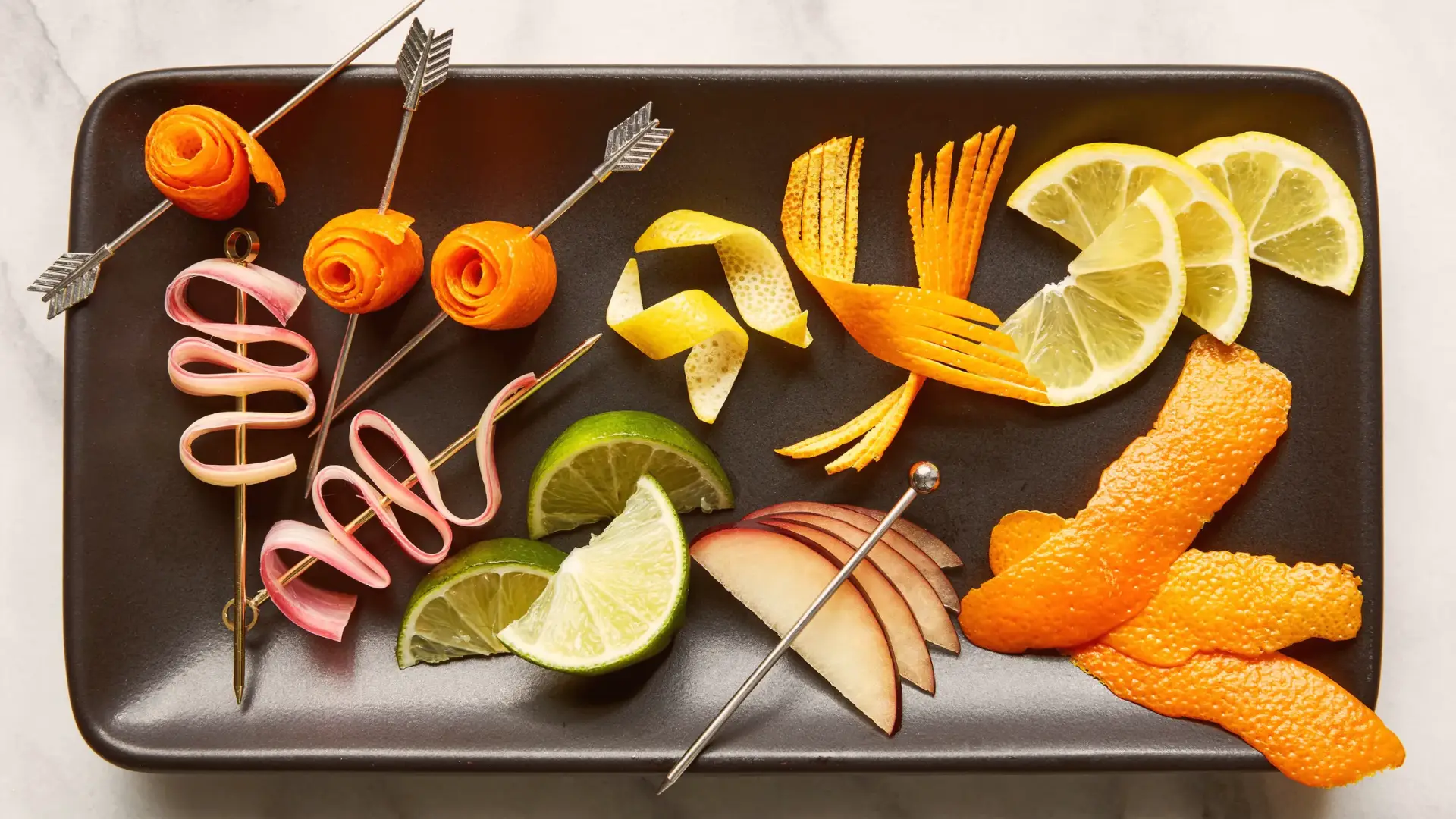
The Garnish arrives at the end of preparation, yet it often leads the guest’s first impression. Before the drink reaches the palate, the eye registers colour and form while the nose encounters aroma rising from the glass. Garnish therefore belongs to the sensory language of the cocktail. It can clarify identity, prepare expectations, and complete the presentation, but only when it has a reason to be there.
The distinction between decoration and garnish is essential. Decoration may create visual interest without changing the drink’s meaning. A functional garnish contributes aroma, texture, symbolism or practical information. It may signal the presence of citrus, herbs or savoury ingredients, identify a traditional style, or connect the drink to a particular cultural setting.
Aroma gives garnish much of its influence. Research on orthonasal smell shows that aromas perceived before tasting can shape expectation and affect how flavour is interpreted. Garnish is therefore not separate from taste; it participates in the way taste is understood.
Classic Cocktails and Garnish
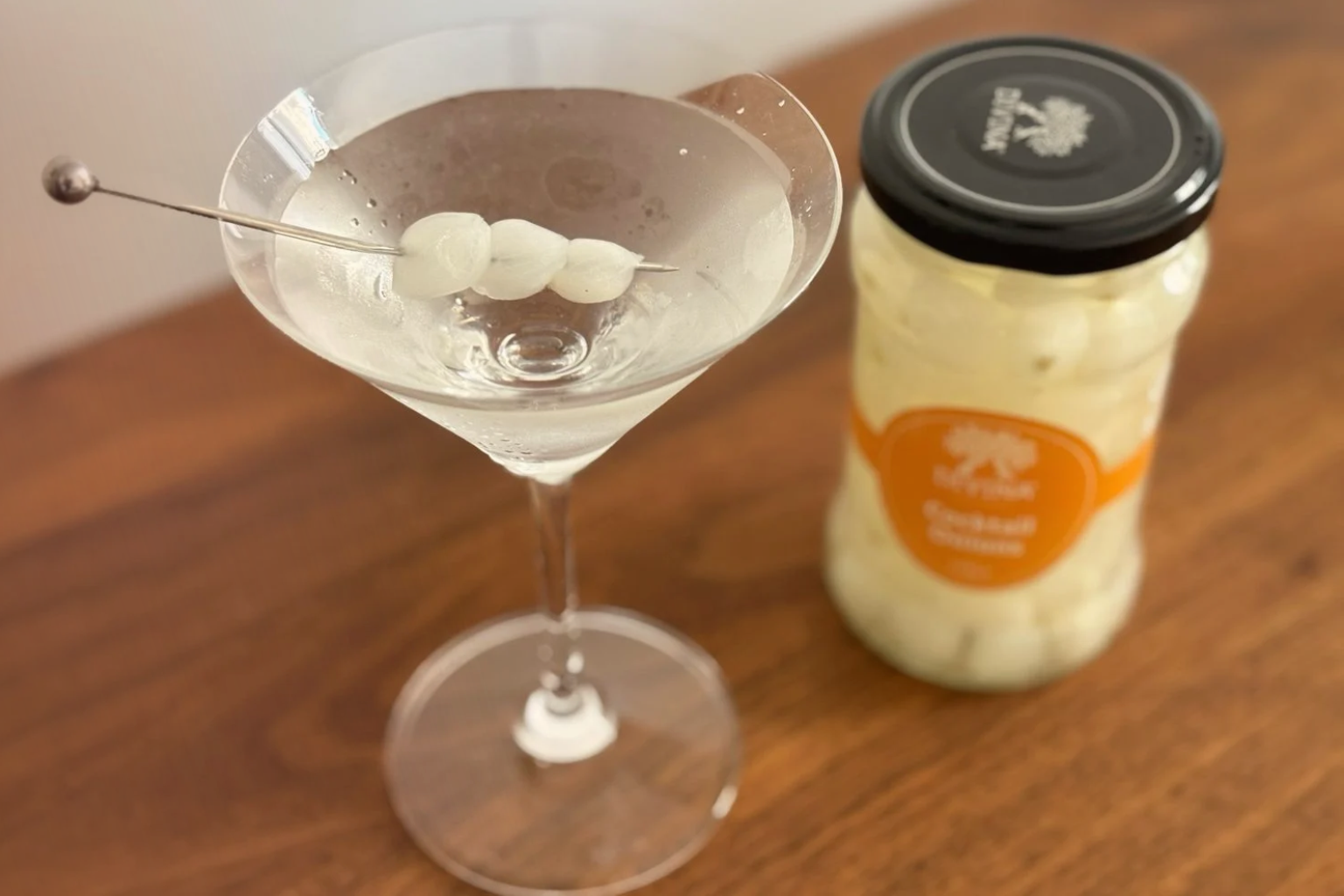
Classic cocktails demonstrate how small finishing elements can become part of a drink’s identity. The Dry Martini may be associated with either lemon or olive, each carrying a different aromatic and cultural signal. The Sazerac is strongly linked with lemon zest, which provides a bright counterpoint to the drink’s darker character. The Bloody Mary often carries a more visible garnish tradition, reflecting its savoury profile and its place between drink and culinary presentation.
These examples also show that garnish does not have one fixed role. In one drink it may be primarily aromatic; in another it may be symbolic or textural. Some garnishes are inseparable from the public image of a cocktail, while others vary from bar to bar. The important distinction is whether the finishing element supports the drink or competes with it.
Fresh herbs introduce another dimension because their aroma is immediate and fragile. Mint, basil and other leaves can make a drink feel vivid before it is tasted, but they also reveal neglect quickly. Their condition becomes part of the guest’s judgement of the bar, demonstrating how presentation and ingredient care remain closely connected.
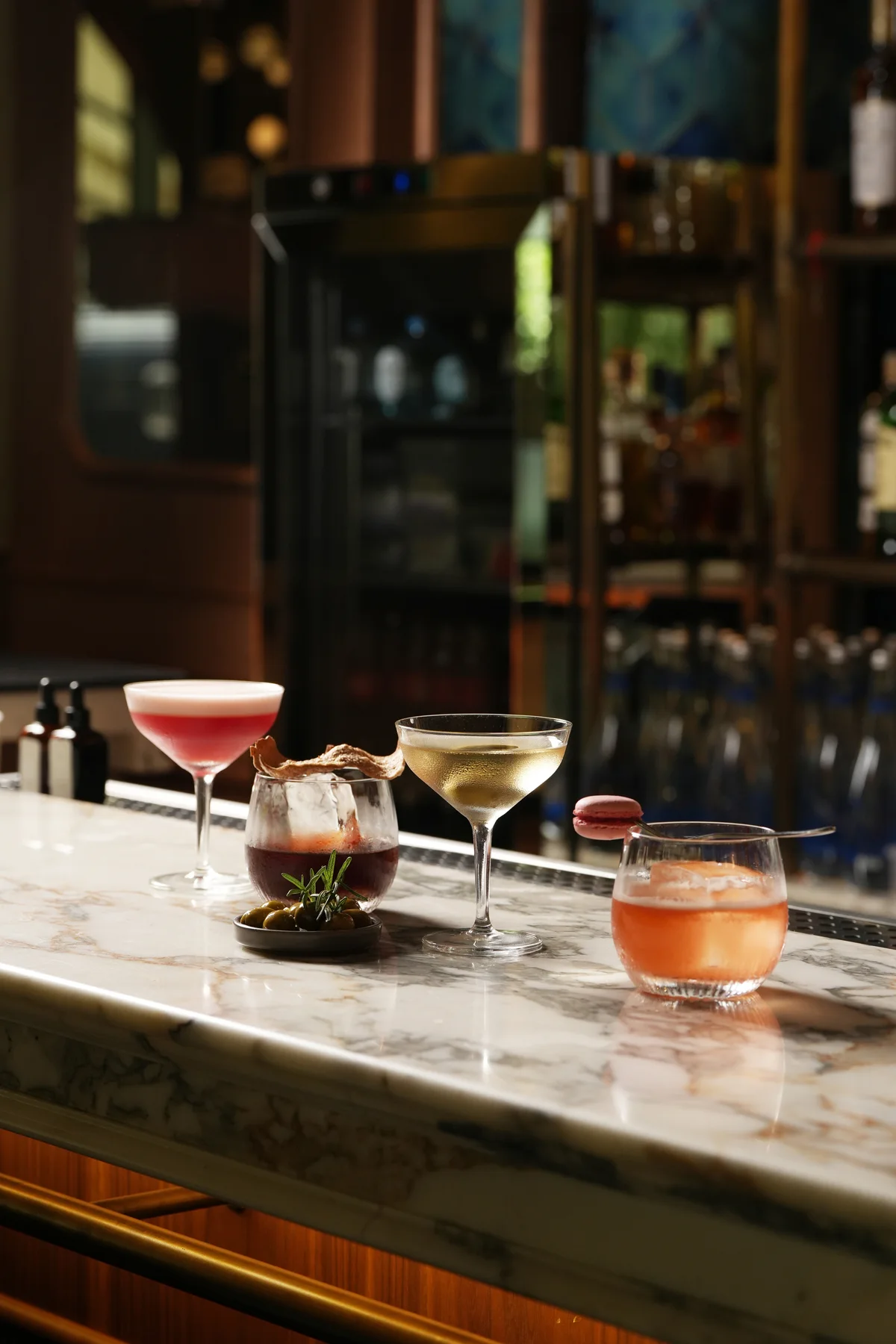
Visual proportion matters as well. A garnish can strengthen the composition of the glass or overwhelm it. The most successful examples appear integrated rather than attached, giving the drink a finished identity without turning the garnish into a separate performance.
Modern bars have also reconsidered garnish through the lens of waste. Elaborate fruit constructions, single-use accessories, and ingredients prepared only for appearance can create unnecessary cost and environmental burden. This has encouraged a broader return to purpose, where visual impact is weighed against usefulness, preparation and responsible use of ingredients.
Cultural context deserves the same care. A traditional garnish may carry regional, historical or ceremonial meaning that is easy to miss when copied without understanding. Contemporary reinterpretation can be entirely valid, but it gains strength when it knows which convention it is revising and why.
The final moments before service reveal the bartender’s attention to detail. A careless garnish can weaken an otherwise coherent drink, while a thoughtful one can focus aroma, expectation and presentation at once. Its value lies not in how much it adds, but in how precisely it completes what is already there.
Garnish is where the cocktail turns towards the guest. It carries recognition and visual intent across the small distance between bar and table. When it performs that role well, it does not ask to be admired separately. It makes the drink feel complete.
In mixology, a Garnish is far more than just a visual decoration; it is an essential component that directly affects the flavour profile, aroma, and overall perception of a spirit or cocktail.

Renowned international hospitality consultant, founder of Barpartners, and IBA Vice President of Classic Mixology, bringing over 25 years of luxury hotel bar operations.

In partnership with International Bartenders Association
The International Bartenders’ Association stands at the crossroads of exchange between new and established generations of professionals.
Cocktail
The Pink Lady is a cocktail that perfectly captures the elegance and charm of early twentieth-century drinking culture,…
Cocktail
The Cantarito is a vibrant and citrus-driven cocktail rooted in the traditions of Jalisco, Mexico, where tequila culture…
Cocktail
Citrus Coke is a refreshing and lively cocktail that elevates the classic cola experience by introducing bright, zesty…
Cocktail
Apple Cider Punch is a festive beverage that highlights the crisp and comforting flavors of apples, making it…
Cocktail
The Sazerac is one of the oldest and most storied cocktails in American history, a drink deeply tied…
Cocktail
The Bloody Mary is a classic cocktail celebrated for its bold, savory, and complex flavor profile. Traditionally made…
Cocktail
The Dry Martini is one of the most iconic and enduring cocktails in the history of mixology. Its…
Partnership
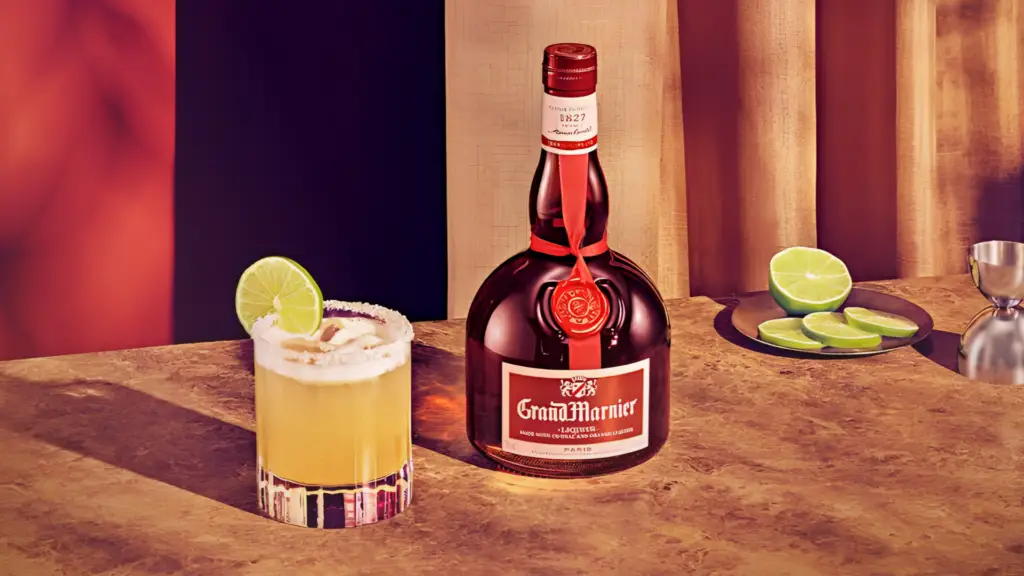
Grand Margarita: The Margarita Variation Defined by Liqueur Choice
The shift from a standard Margarita to a Grand Margarita happens in a single substitution, but the change is immediate in the glass. Where most builds rely on lighter orange liqueurs, this version is structured around Grand Marnier, introducing a deeper, more weighted profile that alters how the drink is perceived from the first sip. […]
September 10, 2026
Trending
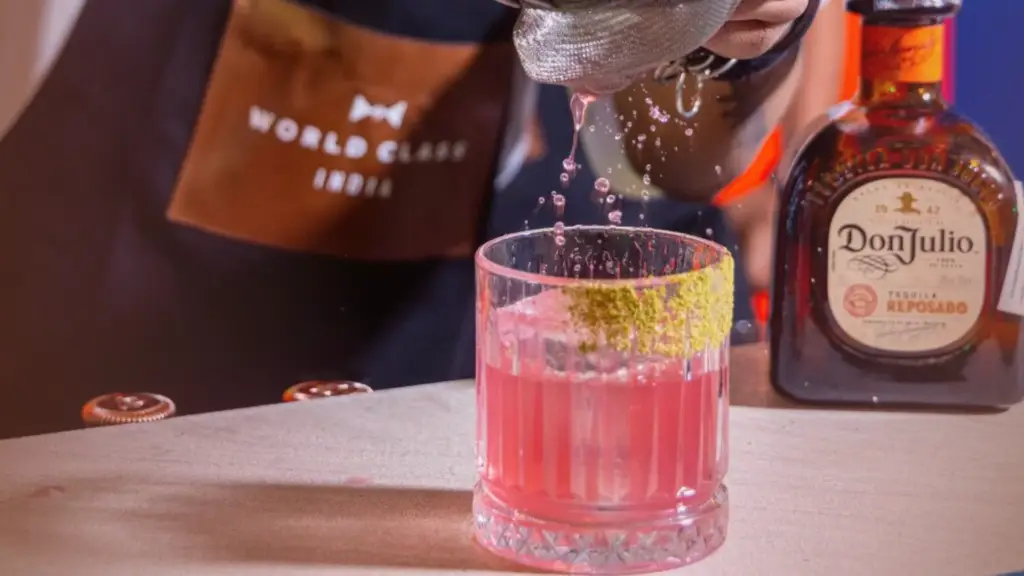
World Class 2026 and Dubai’s Rise as a Global Cocktail Culture Hub
From bartender competition to global industry platform The modern cocktail world has developed far beyond the traditional image of the bartender as a skilled server behind a bar. Over the past two decades, bartending has increasingly been recognised as a professional discipline built on technical knowledge, hospitality, creativity and a deeper understanding of spirits. Few […]
September 8, 2026
Partnership
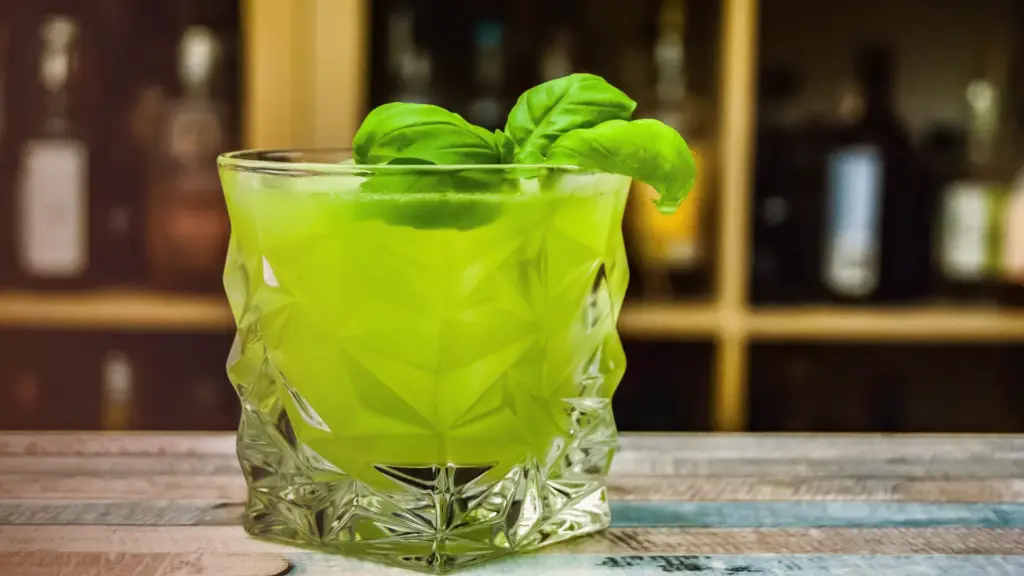
Gin Basil Smash: The Herbal Cocktail That Changed Modern Gin Drinking
When Jörg Meyer introduced the Gin Basil Smash at Le Lion in Hamburg in 2008, it wasn’t framed as a revival or a twist on a known template. It first appeared under the name “Gin Pesto,” before settling into the name by which it became internationally known. The idea was direct: make a drink where […]
September 3, 2026