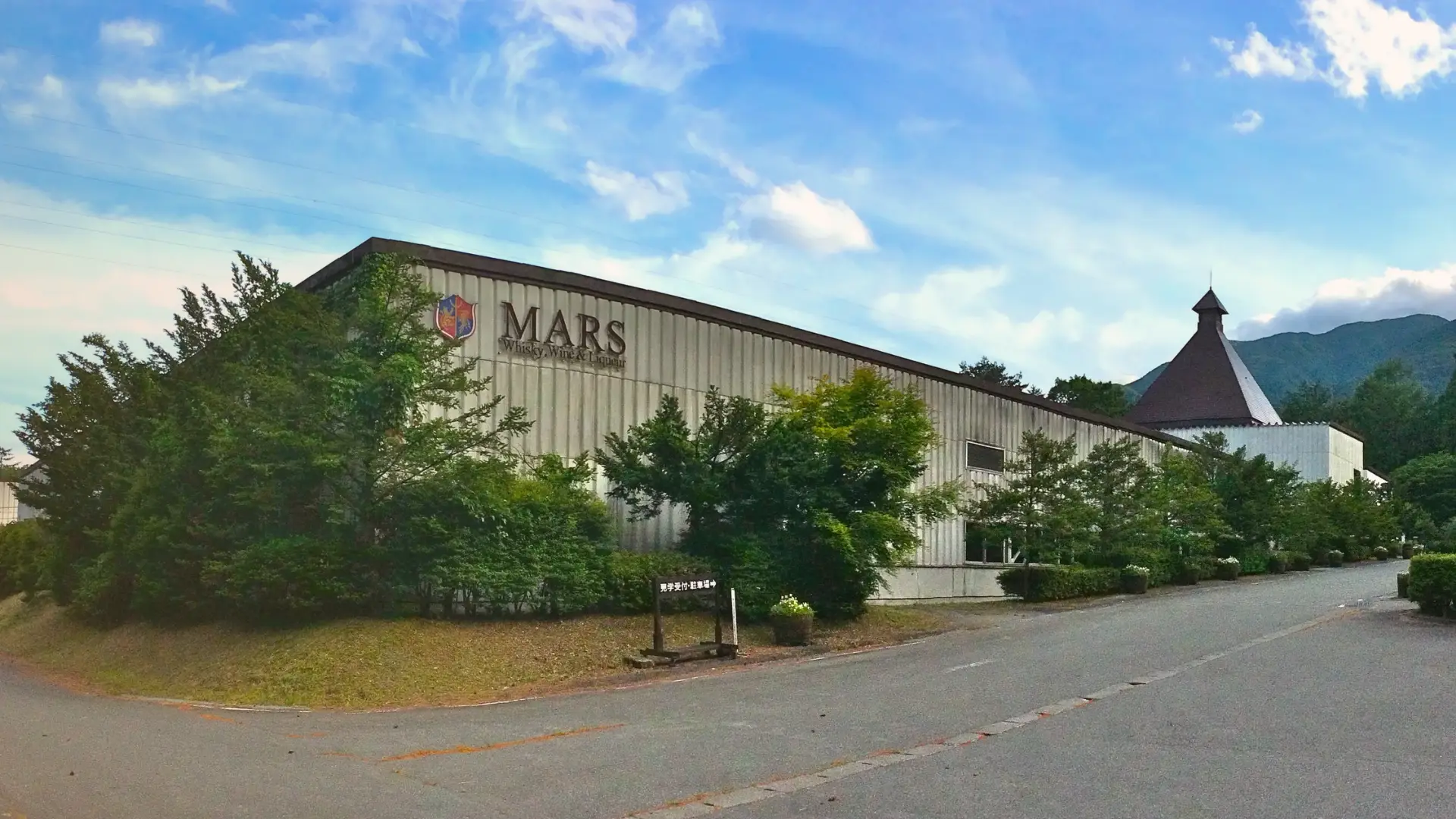
When the stills at Mars Shinshu Distillery began running again in 2011, they had been silent for 19 years.
The buildings had not disappeared, and Hombo Shuzo had not abandoned whisky entirely. Even so, a distillery at rest is not a sealed piece of history. Equipment ages, stocks diminish, employees move on, and the market that once justified production may no longer exist when the doors reopen.
That tension gives Mars Shinshu its importance. Its story is not simply about a mountain distillery returning after a long closure. It is about what survives when production stops, what must be rebuilt when it begins again, and how a company with roots in southern Japan created a new whisky identity in the high country of Nagano Prefecture.
The revival also arrived at a turning point. Japanese whisky was moving from a long period of weak domestic demand towards greater international recognition, but the scale of that future was not yet certain. Restarting in 2011 meant committing to a spirit that would require years of maturation before it could fully support the distillery’s renewed ambitions.
A Whisky History before Shinshu
Mars Shinshu Distillery was not Hombo Shuzo’s first encounter with distilled spirits.
The company was founded in Kagoshima Prefecture, where its history was rooted in the production of shochu and other alcoholic beverages. That background mattered because whisky did not appear inside an organisation unfamiliar with fermentation, distillation, storage, or regional production.
Hombo Shuzo entered the whisky business during the 1950s and later produced it in Yamanashi Prefecture. These earlier operations gave the company technical experience, although its whisky history was less continuous and less publicly visible than that of Japan’s largest producers.
The eventual move to Nagano should therefore be understood as another stage in a travelling production history. Mars whisky was not created by one uninterrupted distillery operating in the same place for generations. It developed across different sites, with changing equipment and commercial decisions made over several decades.
That unsettled history later became useful. When Shinshu fell silent, the company still possessed a broader distilling culture that extended beyond one building.
Building beneath the Central Alps
Mars Shinshu Distillery began production in 1985 in Miyada, a village in the Kamiina District of Nagano Prefecture.
The site stands at roughly 800 metres above sea level near the Central Alps, making it one of Japan’s highest whisky distilleries. The setting is visually dramatic, but its production significance should not be reduced to mountain scenery.
Altitude, seasonal temperature, water supply, and warehouse conditions can all affect how a distillery operates. They influence heating requirements, fermentation management, evaporation, and the pace at which casks respond to their surroundings.
None of those factors creates quality automatically. A mountain location does not guarantee distinctive whisky, just as an old building does not guarantee continuity. Place becomes meaningful only when the production system is designed and managed around it.
At Shinshu, the colder winters and marked seasonal changes offered a different environment from Hombo Shuzo’s southern base in Kagoshima. The site gave the company a second geographical identity, one tied to inland Japan rather than the warmer climate of Kyushu.
Why the Stills Fell Silent
The opening of Shinshu came at a difficult moment in the wider history of Japanese whisky.
Domestic whisky consumption had expanded during earlier decades, supported by corporate entertainment, bars, highballs, gifting, and the growing influence of Western drinks. By the late 1980s and early 1990s, however, the market had weakened. Consumer preferences changed, competition increased, and whisky lost part of its earlier commercial momentum. Producers across Japan faced declining demand and stocks that could not be moved as confidently as before.
In 1992, distillation at Mars Shinshu stopped.
The closure was not caused by a fire, natural disaster, or sudden mechanical failure. It was a commercial response to a market that no longer justified continued production at the same level. That makes the story more relevant, not less. Distilleries are often presented as permanent cultural institutions, but they remain industrial businesses dependent on demand, investment, and the ability to finance years of maturation.
When those conditions weaken, even a working distillery can become silent.
What Silence Preserves and What It Takes Away
A mothballed distillery can retain buildings, stills, warehouses, records, and mature stock. It cannot preserve time itself.
Production knowledge is partly written down, but much of it remains practical. Distillers learn how equipment responds, where inconsistencies appear, how fermentation changes through the seasons, and how the spirit behaves when the stills are run differently.
When production stops for nineteen years, that working rhythm disappears. Employees retire or move elsewhere, maintenance priorities change, and the relationship between people and machinery must later be rebuilt. Mature whisky can preserve evidence of earlier production, but it cannot teach a new team every decision that created it. Old stock becomes a record of the past rather than a complete manual for reproducing it.
This is why the phrase “distillery revival” can be misleading. Restarting does not restore a site to the exact condition in which it once operated. It creates a new working distillery inside the remains of an older one.
At Shinshu, the challenge was to recover continuity without pretending that nothing had changed.
The 2011 Restart
Whisky distillation resumed at Mars Shinshu in 2011.
By then, the conditions surrounding Japanese whisky were beginning to shift. International awards, specialist interest, renewed domestic attention, and the reputation of established Japanese producers had created a more favourable environment.
The restart still carried considerable risk. New make spirit could be produced immediately, but mature whisky could not. A revived distillery must fund raw materials, labour, energy, maintenance, casks, and warehouse space long before its new production reaches maturity.
Hombo Shuzo also had to decide what the revived distillery should become. It could not rely entirely on the character or reputation of whisky made before 1992, since the new spirit belonged to a different production period.
The first task was therefore not to recreate a lost bottle. It was to rebuild a dependable production identity.
That distinction shaped the years after reopening. Shinshu became less important as a curiosity from Japanese whisky’s past and more important as an active distillery capable of supporting the future of the Mars name.
Komagatake and the Creation of a Distillery Identity
The name Mars covers a wider whisky identity, while Komagatake became closely associated with single malt produced at Shinshu.
This separation matters. A company name, a brand name, and a distillery identity do not always describe the same thing. Mars can refer to a broader whisky portfolio, while Komagatake connects particular production more directly with the Shinshu site and its mountain setting.
The name draws attention to the landscape around the distillery, but the stronger editorial point lies in provenance. After decades in which Japanese whisky labelling could be difficult for consumers to interpret, clearer links between spirit and production site became increasingly important.
Shinshu’s revival allowed Hombo Shuzo to establish that link more firmly. The distillery could be presented not merely as one source within a blended system, but as a place with its own production history and maturing stock.
That change reflects a wider development in Japanese whisky. Distillery names, local conditions, production methods, and stock origins have become more visible as the category has expanded and consumers have demanded greater transparency.
For Mars Shinshu, the place became more than scenery. It became part of how the distillery explained itself.
From One Revived Distillery to Two
The reopening of Shinshu was followed by another important development.
In 2016, Hombo Shuzo began whisky production at Mars Tsunuki Distillery in Kagoshima Prefecture. Tsunuki brought whisky distillation back to the company’s southern homeland and created a production system spanning two very different parts of Japan.
Shinshu stands in a cool inland mountain environment, while Tsunuki operates much farther south. The contrast gives Hombo Shuzo the ability to produce and mature spirit under different conditions, although those differences should not be reduced to easy claims about flavour.
Climate does not act alone. Still, design, fermentation, cut points, casks, warehouse placement, and production schedules remain essential. Geography creates conditions, but distillers decide how those conditions are used.
The two distilleries also changed the meaning of Mars whisky. What had once been a company with a revived mountain plant became a multi-distillery Japanese producer capable of building stocks from more than one site.
Shinshu remained central because it had carried the company through the years of revival. Tsunuki did not replace it. The newer distillery expanded the production language that Shinshu had helped restore.
Revival without Recreating the Past
The appeal of a reopened distillery often depends on the idea of return. Old photographs, silent stills, rare stock, and lost labels create a powerful narrative. They suggest that history can be recovered if production begins again.
In practice, a revived distillery belongs to two periods at once. Its name, location, and records connect it with the past, while its equipment, workforce, regulations, market, and production decisions belong to the present.
Mars Shinshu cannot make 1980s whisky again simply by operating on the same site. Barley specifications change, cask supply evolves, equipment is repaired or replaced, and production knowledge develops in response to new goals.
That does not make the revived distillery less authentic. Authenticity does not require pretending that history stood still. The stronger claim is that Shinshu acknowledged its interruption and built from it. The nineteen silent years became part of the distillery’s identity rather than an inconvenience to be hidden.
A Different Kind of Japanese Whisky History
Japanese whisky history is often told through uninterrupted progress: early Scottish influence, the rise of major producers, international awards, and rapid global demand.
Mars Shinshu complicates that story. Its history includes relocation, weak demand, closure, old stock, revival, and the gradual construction of a clearer distillery identity. It shows that Japanese whisky did not move smoothly from obscurity to international success.
The industry contracted before it expanded. Distilleries stopped before new ones opened. Production knowledge had to be protected, recovered, or rebuilt. Shinshu’s return in 2011 placed it between two eras. It belonged to an older group of Japanese whisky operations, yet its revival anticipated the wave of distillery development that followed during the 2010s.
That position gives the site unusual historical value. It is neither simply an old distillery nor simply a new one. It is a working example of how both identities can exist in the same place. The most compelling part of Mars Shinshu’s history is not that the stills stopped. Many distilleries have closed, and some have remained silent permanently.
Its significance lies in what happened next.
When production returned in 2011, Hombo Shuzo could not recover the 19 lost years. It could only decide what knowledge, equipment, stock, and company memory were still useful, then build a new production future around them.
The result was not a perfect continuation of the distillery opened in 1985. It was a second life shaped by the first. Mars Shinshu reminds us that distillery heritage is not preserved by age alone. It survives through decisions, investment, people, and the willingness to accept that continuity sometimes includes interruption.
In Japan’s Central Alps, silence did not end the story. It became the chapter that made the revival worth understanding.

Distillery
Distillery
Kagoshima Distillery, operated by Hombo Shuzo Co., is a remarkable locale in the heart of Japan's innovative spirits…
Distillery
Mars Shinshu Distillery, located in the picturesque Nagano Prefecture of Japan, is renowned for its commitment to producing…
Distillery
Mars Tsunuki Distillery, established in 2016, is a vibrant addition to Japan's growing whisky scene, located in the…
Spirit
Mars Komagatake 8 YO 03 Tsuki-Otoshi Single Cask Japanese Whisky
Mars Komagatake 8 YO 03 Tsuki-Otoshi Single Cask Japanese Whisky is an exceptional offering from the renowned Mars…
Spirit
Mars Komagatake Limited Edition Single Malt Japanese Whisky
Mars Komagatake Limited Edition Single Malt Japanese Whisky is a distinguished expression of Japanese craftsmanship, showcasing the unique…
Spirit
Mars Komagatake Shinanotanpopo Single Malt Japanese Whisky
Mars Komagatake Shinanotanpopo is a remarkable representation of Japanese whisky craftsmanship, crafted with an elegant profile that appeals…
Spirit
Mars Komagatake Single Malt 2023 Japanese Whisky
Mars Komagatake Single Malt Japanese Whiskey is a hallmark of Japanese whisky craftsmanship, produced by the Mars Shinshu…
Partnership
Guadeloupe Rhum Agricole: Exploring the French Caribbean’s Diverse Cane Spirit Tradition
Guadeloupe Rhum Agricole follows a broader path than the agricole tradition of neighbouring Martinique. Both territories belong to the French Caribbean and share a long relationship with fresh sugarcane juice, yet Guadeloupe rhum agricole developed within an archipelago where more than one rum production tradition has endured. Across volcanic Basse-Terre, limestone Grande-Terre and the distinctive […]
September 4, 2026

Distilleries & Producers
Roseisle Distillery: The High-Tech Speyside Giant Behind a New Generation of Whisky
In Speyside, where whisky is often associated with generations of tradition, Roseisle Distillery represents something very different. Built by Diageo near Elgin and officially opened in 2010, Roseisle was designed as a modern, large-scale malt whisky distillery, combining traditional pot-still production with advanced engineering, energy recovery and unusual flexibility in how its spirit can be […]
September 2, 2026
Interviews & Insights
Elmer T. Lee: The Master Who Revived Bourbon’s Soul
In 1949, a young Elmer T. Lee walked into the George T. Stagg Distillery in Frankfort, Kentucky, looking for a job. He had recently returned from the Second World War, where he had served as a radar bombardier aboard a B-29, and had graduated with honours in electrical engineering from the University of Kentucky. The […]
August 5, 2026