A distillery at the edge of Islay’s map
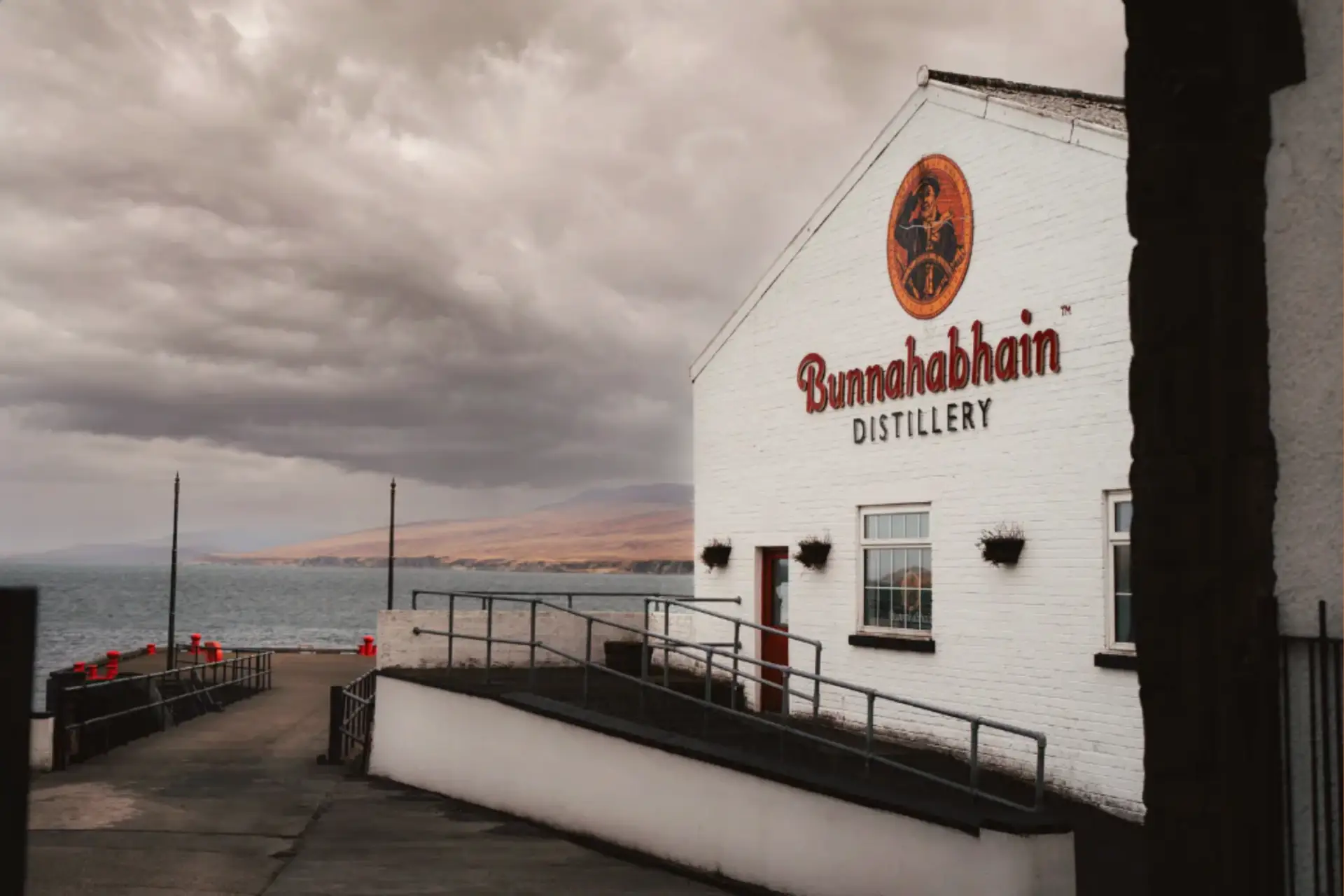
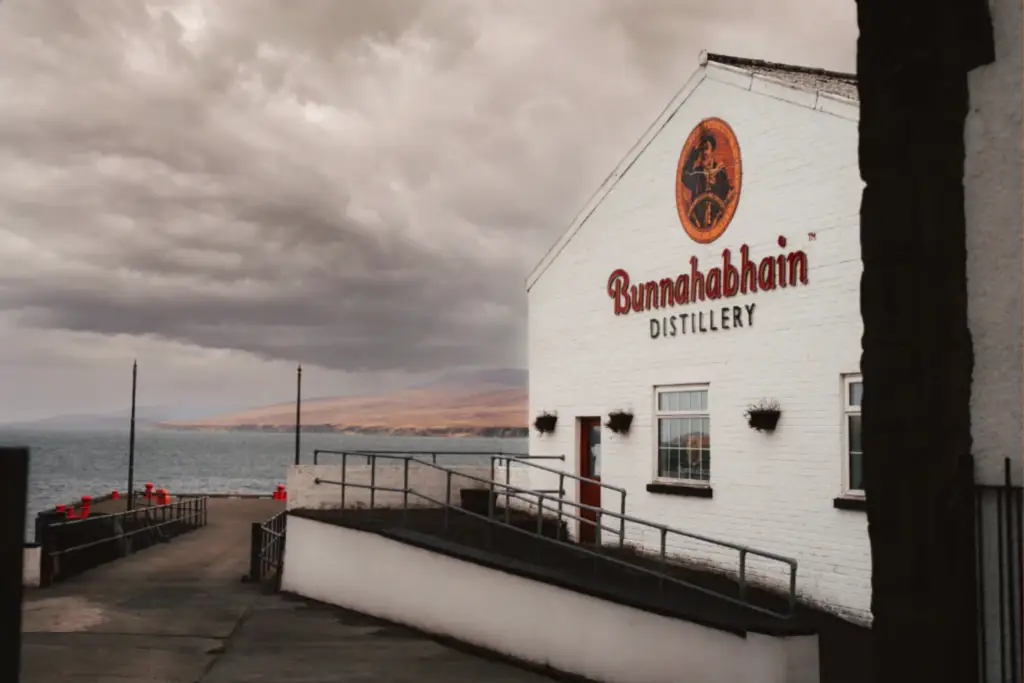
On the northeastern coast of Islay, facing the Sound of Islay toward the Isle of Jura, the landscape shifts. The Atlantic influence is still present, but it arrives differently. The coastline is less exposed than the southern shore where peat smoke dominates the identity of distilleries such as Lagavulin Distillery and Laphroaig Distillery.
It was here, in 1881, that Bunnahabhain Distillery was established by the Islay Distillery Company, led by William Robertson and the Greenlees Brothers. The distillery was constructed alongside a purpose-built village to support workers, reflecting the scale and ambition of the project.
Yet the defining decision was not architectural. It was stylistic. From the outset, the spirit produced here was designed without the heavy peat influence that would later come to define Islay globally.
Built for blending in the late 19th-century whisky economy
The timing of Bunnahabhain Distillery’s founding is critical. The late 19th century saw the rapid expansion of blended Scotch whisky, driven by advances such as the continuous still and the global reach of firms like Johnnie Walker.
Blenders required malt whisky that could provide body and structure without dominating the final composition. Heavily peated distillates from Ardbeg Distillery or Lagavulin Distillery offered intensity, but blending demanded contrast.
Bunnahabhain Distillery filled this role. Its spirit was distilled from largely unpeated malt, typically with phenol levels under 2 ppm, far below the levels found in southern Islay distilleries, which often exceed 30–50 ppm. This made it suitable for integration into blends without overwhelming them.
The absence of peat was not an omission. It was a requirement.
Water, terrain, and fermentation character
Water is drawn from the Margadale Spring, which runs through terrain less densely saturated with peat than other parts of Islay. This contributes to a cleaner base during mashing and fermentation.
Without phenolic compounds dominating the malt, fermentation produces a wash that emphasises cereal sweetness, light fruit esters, and subtle maritime notes. Yeast activity focuses on ester formation rather than interacting with smoke-derived compounds.
The resulting distillate carries a profile that aligns more closely with mainland styles such as The Glenlivet Distillery than with its island counterparts. This divergence begins before distillation.
Distillation weight and sherry cask structure
Bunnahabhain Distillery’s stills are configured to produce a relatively weighty spirit, despite the absence of peat. This weight provides the foundation for maturation, allowing the whisky to develop depth without relying on smoke.
Cask policy plays a defining role. A significant portion of production is matured in sherry-seasoned oak, often sourced from Spain. This introduces notes of dried fruit, nuts, spice, and subtle sweetness.
Expressions such as Bunnahabhain 12 Year Old and Bunnahabhain 18 Year Old demonstrate how this structure develops over time. The spirit gains complexity through cask interaction while maintaining its underlying softness.
In this system, wood replaces peat as the primary driver of character.
Controlled peat and modern variation
Although the core style remains unpeated, Bunnahabhain has introduced peated expressions in recent decades. Releases such as Toiteach A Dhà use peated malt to create a different profile, though still more restrained than traditional Islay standards. These expressions typically fall within a moderate phenol range, significantly below the intensity associated with Ardbeg Distillery or Laphroaig Distillery. The peat is integrated rather than dominant.
The distinction is deliberate. Peat is used selectively, not as the foundation of identity.
Coastal maturation and the influence of the Sound of Islay
Warehouses at Bunnahabhain Distillery sit close to the shoreline, exposed to the airflow from the Sound of Islay. While the direct impact of sea air on whisky remains debated, environmental conditions such as humidity and temperature stability are measurable. Casks mature under conditions that encourage gradual oxidation and steady interaction with oak. The resulting whisky often carries a subtle saline or briny note, reflecting its coastal environment without relying on peat smoke.
This maritime influence provides a connection to Islay that is environmental rather than compositional.
Ownership, revival, and repositioning
The distillery experienced periods of closure during the 20th century, including shutdowns in the 1930s and 1980s, reflecting broader challenges in the Scotch whisky industry.
A significant turning point came in 2003, when Burn Stewart Distillers, now part of the Distell Group, acquired Bunnahabhain Distillery. This transition marked a renewed focus on single malt releases and a clearer articulation of the distillery’s unpeated identity. Subsequent bottlings emphasised natural colour and non-chill filtration, aligning with evolving consumer expectations around authenticity and production transparency.
Expressions as a statement of style
The distillery’s range reflects its structural approach. Bunnahabhain 12 Year Old presents maritime salinity balanced with sherry-driven sweetness. Bunnahabhain 18 Year Old extends this profile, adding depth through prolonged cask interaction.
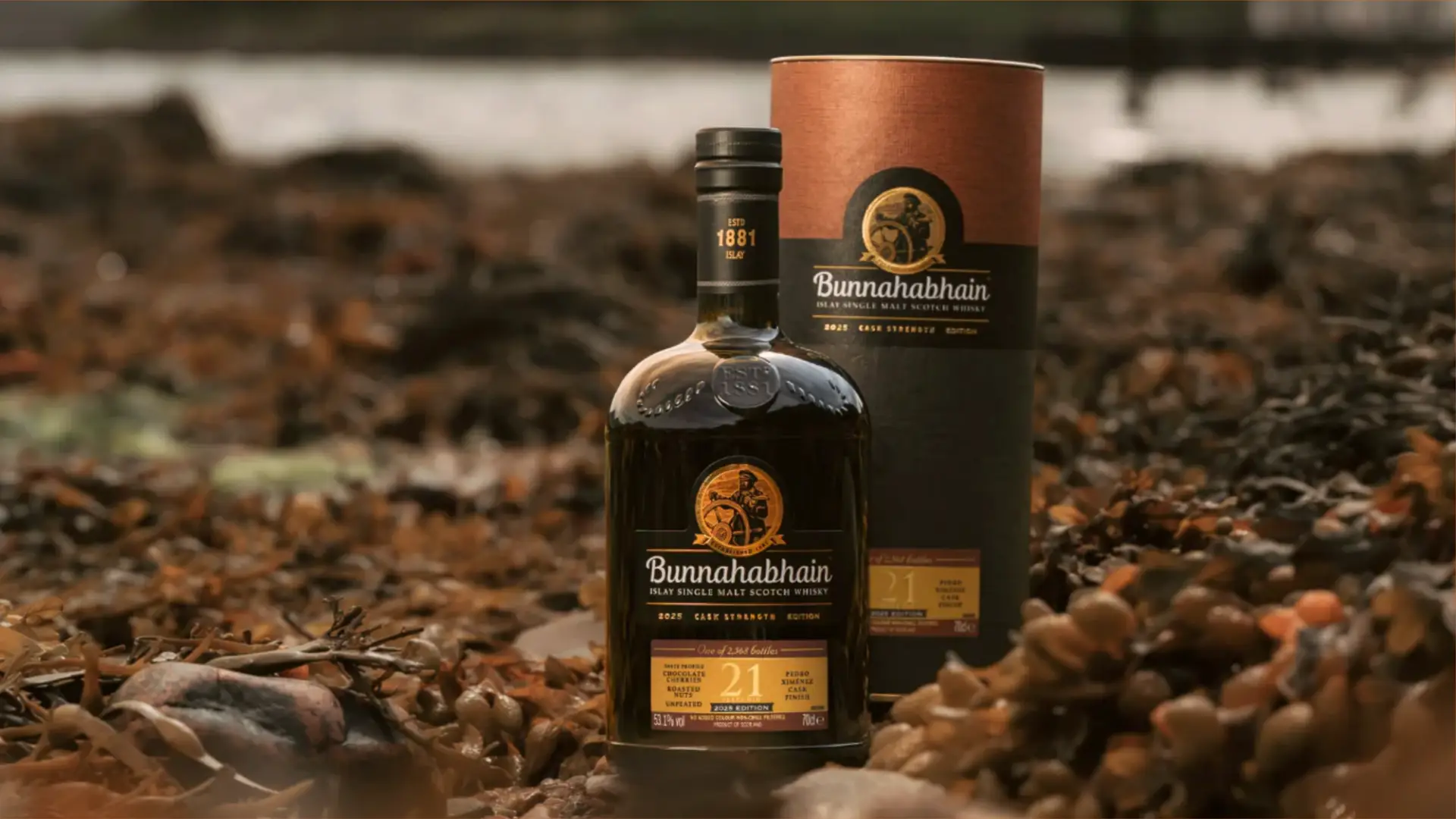
Limited releases, including older age statements and cask strength bottlings, further demonstrate how the spirit evolves without heavy peat influence. Even when smoke is introduced, as in Toiteach A Dhà, it remains controlled and secondary.
These expressions collectively define a style built on balance rather than intensity.
Redefining what Islay can represent
Global perception has long associated Islay with peat. Distilleries such as Ardbeg Distillery, Lagavulin Distillery, and Laphroaig Distillery have reinforced this identity through consistent production of heavily peated whisky. Bunnahabhain Distillery operates outside this framework. Its existence demonstrates that Islay encompasses a broader range of styles, shaped by geography, water, fermentation, and cask management as much as by peat.
This alternative model has gained recognition as the category has matured, allowing for a more nuanced understanding of the island.
Bunnahabhain Distillery was not designed to oppose Islay’s identity. It was built to serve a different purpose within the whisky system of its time. Over more than a century, that difference has become its defining characteristic. By minimising peat, the distillery reveals other aspects of production that are often overshadowed. Cask influence, fermentation character, and coastal maturation take precedence, shaping a whisky that reflects place without relying on smoke.
In doing so, Bunnahabhain Distillery expands the definition of Islay. It shows that identity within a category can be constructed through variation, not uniformity.


Distillery
Nestled on the southern coast of the Isle of Islay, Ardbeg Distillery is celebrated for its unique productions…
Distillery
The Glenlivet Distillery is an iconic Scottish whisky producer situated in the picturesque region of Speyside, near Ballindalloch…
Distillery
Burn Stewart Distillers Ltd is known for its ownership of three notable distilleries: Deanston in Perthshire, Bunnahabhain on…
Distillery
Bunnahabhain Distillery, located on the sweeping shores of the Sound of Islay, holds a significant place in the…
Distillery
Laphroaig Distillery, nestled on the rugged south coast of Islay, Scotland, is synonymous with rich and complex single…
Distillery
Lagavulin Distillery, nestled in the picturesque village of Lagavulin on the southern coast of Islay, Scotland, is renowned…
Spirit
Bunnahabhain 18 Year Old Single Malt Scotch Whisky
Bunnahabhain XVIII 18 Year Old Single Malt Whisky is an exquisite expression from the renowned Bunnahabhain distillery, located…
Spirit
Bunnahabhain Toiteach A Dhà Islay Single Malt Scotch Whisky
Bunnahabhain Toiteach A Dha is a uniquely crafted single malt Scotch whisky from the renowned Bunnahabhain distillery, situated…
Spirit
Bunnahabhain 12 YO Cask Strength Single Malt Scotch Whisky
Bunnahabhain 12 YO Cask Strength Single Malt Scotch Whisky is a refined expression from the Bunnahabhain distillery, situated…
Distillery
Nestled on the southern coast of the Isle of Islay, Ardbeg Distillery is celebrated for its unique productions…
Distillery
The Glenlivet Distillery is an iconic Scottish whisky producer situated in the picturesque region of Speyside, near Ballindalloch…
Distillery
Burn Stewart Distillers Ltd is known for its ownership of three notable distilleries: Deanston in Perthshire, Bunnahabhain on…
Distillery
Bunnahabhain Distillery, located on the sweeping shores of the Sound of Islay, holds a significant place in the…
Distillery
Laphroaig Distillery, nestled on the rugged south coast of Islay, Scotland, is synonymous with rich and complex single…
Distillery
Lagavulin Distillery, nestled in the picturesque village of Lagavulin on the southern coast of Islay, Scotland, is renowned…
Spirit
Bunnahabhain 18 Year Old Single Malt Scotch Whisky
Bunnahabhain XVIII 18 Year Old Single Malt Whisky is an exquisite expression from the renowned Bunnahabhain distillery, located…
Spirit
Bunnahabhain Toiteach A Dhà Islay Single Malt Scotch Whisky
Bunnahabhain Toiteach A Dha is a uniquely crafted single malt Scotch whisky from the renowned Bunnahabhain distillery, situated…
Spirit
Bunnahabhain 12 YO Cask Strength Single Malt Scotch Whisky
Bunnahabhain 12 YO Cask Strength Single Malt Scotch Whisky is a refined expression from the Bunnahabhain distillery, situated…
History
Lagavulin Distillery and the Discipline of Slow Distillation on Islay
On the southern coast of Islay, Lagavulin Distillery stands beside a sheltered bay between Laphroaig and Ardbeg. Its white buildings, dark kiln roofs, and long waterfront warehouses belong to one of Scotland’s most recognisable whisky landscapes. Still, the character associated with the distillery was not created by scenery alone. Peat is the most obvious part […]
June 28, 2026
Distilleries & Producers
The Last Days of Floor Maltings: When Scotch Distilleries Made Their Own Malt
Floor Maltings History: Where Whisky Began Before stainless steel vessels, automated temperature control, and industrial malt plants, a Scotch whisky distillery often began its work on a stone or concrete floor. Barley was steeped in water, spread in a shallow layer, and turned repeatedly by hand as it germinated. The process demanded time, judgement, space, […]
June 18, 2026
Distilleries
Laphroaig: The Islay Distillery That Turned Peat into a Global Identity
On the southern coast of Islay, the name Laphroaig stretches across a whitewashed warehouse facing a narrow bay. The lettering now belongs to one of the most recognisable names in Scotch whisky, yet the identity behind it was built from a tightly local set of materials: barley, peat, water, casks, coastal geography, and the decisions […]
June 15, 2026