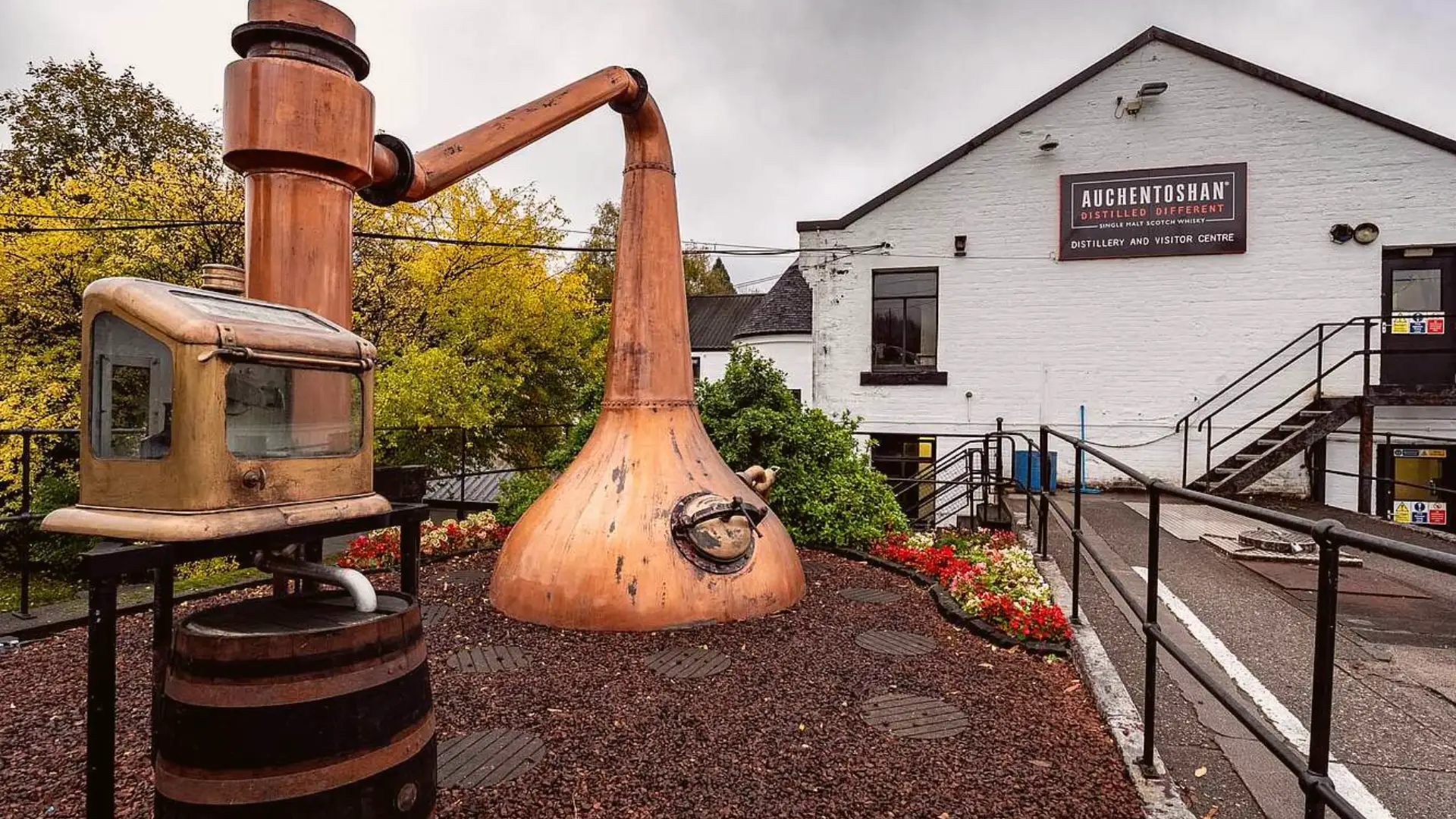
On the northwestern edge of Glasgow, close to the Kilpatrick Hills and the industrial history of the River Clyde, Auchentoshan Distillery has built its identity around a third passage through copper.
Most Scotch malt whisky is distilled twice. At Auchentoshan, every part of the spirit passes through a wash still, an intermediate still, and a spirit still before it enters the cask. The additional stage raises the final distillation strength to about 81 per cent alcohol by volume and gives the production team another opportunity to shape which compounds remain in the new make spirit.
That does not make triple distillation a guarantee of quality, nor does it explain the whisky on its own. Unpeated malted barley, clear wort, fermentation, still operation, spirit cuts, copper contact, and maturation all contribute to the final result.
What makes Auchentoshan distinctive is the consistency of its commitment. Triple distillation has remained central through financial difficulty, wartime destruction, rebuilding, repeated changes of ownership, and the wider transformation of the Lowland whisky industry.
From Duntocher to Auchentoshan
The official history begins in 1817, when John Bulloch acquired the estate and established Duntocher Distillery. The operation received its legal whisky licence in 1823, the date now generally used for the foundation of Auchentoshan Distillery.
Financial problems soon disrupted the business. In 1834, John Hart and Alexander Filshie acquired the distillery and renamed it Auchentoshan.
The site stood close enough to Glasgow to benefit from the city’s workers, merchants, engineering skills, and transport network, yet far enough from its centre to retain access to water and open land. Its position near the Clyde also connected it with the shipyards and trading economy that shaped western Scotland during the 1800s.
This was not the remote landscape often used to represent Scotch whisky. Auchentoshan belonged to an urban and industrial Lowland setting, and its history developed alongside the growth of Glasgow and Clydebank.
Triple Distillation in Lowland History
Triple distillation has a recognised place in Lowland whisky history, but it was never followed by every distillery in the region. Some Lowland producers used three stills, while others distilled twice or worked with different arrangements according to their equipment, ownership, and commercial requirements. The familiar idea that all Lowland whisky was triple distilled is therefore too simple.
At Auchentoshan, the method became something more specific than a regional habit. It became the organising principle of the still house and, eventually, the clearest part of the distillery’s public identity. That distinction is important. The distillery does not preserve triple distillation because every Lowland producer works in the same way. It preserves the method because its production system has been built around it.
The practice links Auchentoshan with an older Lowland tradition without pretending that the region was ever technically uniform.
Three Stills Working as One System
Production begins with completely unpeated malted barley. The grain is milled and mixed with water in the mash tun, where its starches are converted into fermentable sugars.
The distillery aims to produce a clear wort before fermentation. This matters because the composition of the wort influences the character of the fermented liquid and the compounds later available during distillation.
After fermentation, the liquid enters the wash still for the first distillation. The resulting low wines then pass through the intermediate still before selected portions move into the spirit still for the third and final run.
The complete sequence raises the spirit from a fermented strength of about 8 per cent alcohol by volume to approximately 81 per cent. A higher distillation strength does not mean that the whisky will necessarily be better. It means the spirit has undergone greater separation and further contact with copper before collection.
The production team must still decide how the stills are run and where the spirit cuts are made. The additional still creates another stage of control, but it also creates another stage at which judgement is required.
What the Third Distillation Changes
Distillation separates alcohol and volatile compounds from the fermented wash. Repeating that process changes the composition of what reaches the spirit receiver.
At Auchentoshan, the third distillation produces a more highly rectified new make spirit than would usually emerge from a conventional double distillation system. More compounds are separated during the three runs, while the extra contact with copper influences the spirit that remains.
This does not mean the third still simply removes everything heavy or complex. Distillation is more selective than that, and the character of the new make depends on still shape, heating, charge size, reflux, flow, and cut points. The third run gives the distillers another opportunity to refine the balance. It does not replace the knowledge required to operate the still house.
That is why Auchentoshan’s method should be described as a complete system rather than a numerical curiosity. The significance lies not merely in distilling three times, but in organising the entire production sequence around the character that the third distillation is intended to produce.
Wartime Damage beside the Clyde
The distillery’s proximity to the Clyde brought commercial advantages, but it also placed the site close to one of Britain’s most important industrial areas during the Second World War.
The shipyards and factories around Clydebank became targets during German air raids. In 1941, bombing severely damaged Auchentoshan, destroying a warehouse and interrupting production. The damage affected buildings and whisky stocks, while the industry more broadly faced restrictions on grain, labour, fuel, and ordinary commercial activity.
Production resumed in 1948. The restart was not simply a return to business after a temporary closure. It required the distillery to rebuild its working system after years of disruption. Triple distillation continued because the owners chose to restore it. The method survived through active investment and reconstruction rather than through an untouched line of production.
That distinction makes the continuity more meaningful. Auchentoshan’s identity endured despite physical interruption, not because the distillery escaped it.
Ownership and Rebuilding
Ownership changed repeatedly as the Scotch whisky industry consolidated. By 1878, the distillery had passed to C.H. Curtis and Co Ltd. In 1903, George Maclachlan and John Maclachlan acquired it, beginning a period of ownership that lasted for more than half a century.
J&R Tennent purchased the distillery in 1960. Eadie Cairns Ltd took control in 1969 and oversaw substantial rebuilding, giving the site much of its later production structure.
In 1984, Stanley P. Morrison acquired Auchentoshan. The business became part of Morrison Bowmore Distillers, before full ownership passed to Suntory in 1994. The distillery now sits within Suntory Global Spirits. Each owner brought different priorities, resources, and commercial relationships. Buildings changed, equipment was renewed, and distribution expanded. The three still method remained.
That continuity was not inevitable. Triple distillation requires more time, energy, and coordination than a two still system. Successive owners could have simplified production, but they continued to treat the method as central to the distillery’s identity.
Maturation after a High Strength Spirit
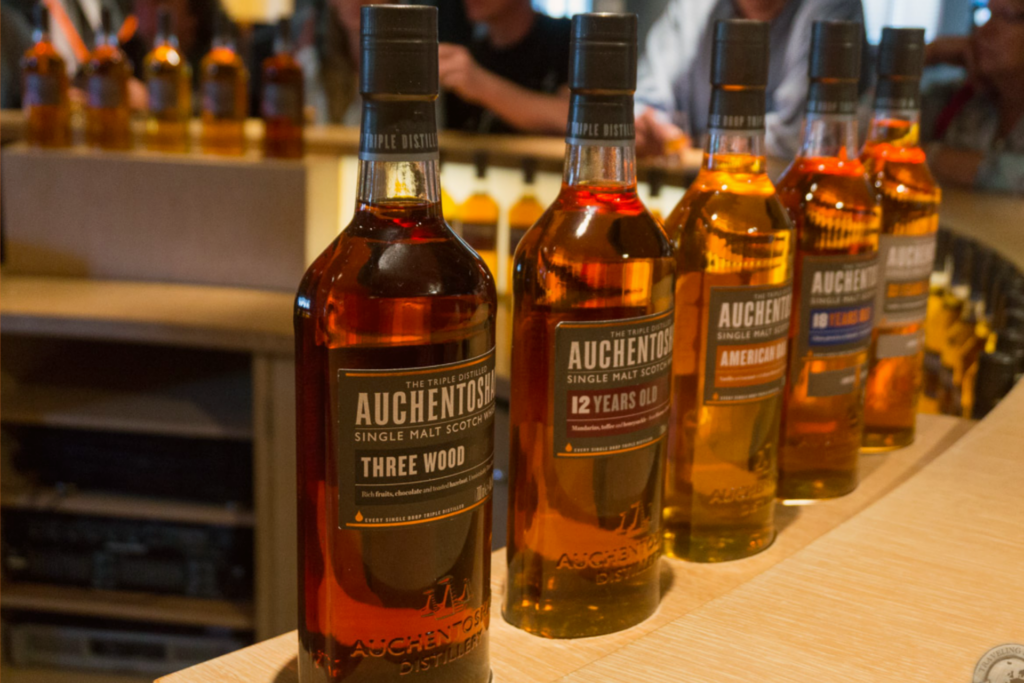
Triple distillation shapes the spirit entering the cask, but maturation determines how that spirit develops over the following years. Auchentoshan uses casks that previously held bourbon, sherry, or wine. Each type of oak and previous fill creates a different relationship with the highly rectified new make spirit.
The distillery’s lighter starting structure can make the influence of the cask especially visible, though the wood does not simply replace the distillery character. Spirit and oak develop together through extraction, oxidation, evaporation, and time.
Cask history, fill strength, warehouse conditions, and duration of maturation all affect the finished whisky. A third distillation does not reduce the importance of these decisions. In some respects, it makes them more exposed.
This is why broad descriptions such as “smooth” are not enough. They say little about the technical choices behind the whisky. The more useful point is that triple distillation creates a particular starting spirit, which must then be matched carefully with oak.
A Distillery Practice, Not a Regional Rule
The Lowland label can still encourage generalisations. Auchentoshan is sometimes presented as though its production system represents the whole region, but Lowland whisky has always contained different methods and styles.
The distillery’s importance is therefore specific. It did not invent triple distillation, and it is not the only Scottish malt distillery associated with the practice. What it has done is make the method inseparable from its own identity.
Every drop passes through the three still system. The process is not reserved for one release, one season, or one experimental production run. It defines the way the distillery works.
That consistency gives Auchentoshan a clearer technical identity than a regional description alone could provide. The word Lowland locates the distillery, but triple distillation explains how it has chosen to distinguish itself within that region.
Auchentoshan has survived because it changed when change became necessary. The distillery was renamed, sold, damaged during war, rebuilt, modernised, and incorporated into a global spirits company. What remained was the production decision at the centre of its still house.
Triple distillation did not survive as a decorative reference to Lowland history. It continued as a working method that shapes the strength and composition of every batch of new make spirit produced at the site. The third distillation does not guarantee superiority, and it cannot explain the whisky without reference to barley, wort, fermentation, copper, cuts, and casks. Its significance lies in the discipline of repetition.
For more than two centuries, changing owners have continued to organise Auchentoshan around the same demanding principle. That sustained choice, rather than any simplified idea of Lowland lightness, is what made triple distillation the distillery’s defining practice.

Distillery
Auchentoshan Distillery, nestled at the foot of the Kilpatrick Hills in Clydebank, Scotland, is renowned for its exquisite…
Distillery
Located in the heart of Islay, Bowmore Distillery is a hallmark of Scottish single malt whisky craftsmanship. Established…
Distillery
Auchindoun Distillery stands proudly in the heart of Moray, Scotland, near Dufftown, often regarded as the 'Malt Whisky…
Spirit
Auchentoshan 12 YO Bourbon and Sherry Cask Single Malt Scotch Whisky
Auchentoshan 12 Year Old is a remarkable expression of Lowland Scotch whisky, showcasing the distillery's commitment to craftsmanship…
Spirit
Auchentoshan 21 YO Singal Malt Scotch Whiskey
Auchentoshan 21 Year Old Single Malt Scotch Whisky is a refined and sophisticated expression from the Auchentoshan distillery,…
Spirit
Auchentoshan 2000 21 YO Cask Strength Collection Single Malt Scotch Whisky
Auchentoshan 2000 21 YO is a distinguished single malt whisky that represents the epitome of craftsmanship in Scotland's…
Spirit
Auchentoshan 12 YO Single Malt Scotch Whisky
Auchentoshan 12 Year Old Single Malt Scotch Whisky is renowned for its smooth and rich character, representing the…
Distilleries & Producers
The Last Days of Floor Maltings: When Scotch Distilleries Made Their Own Malt
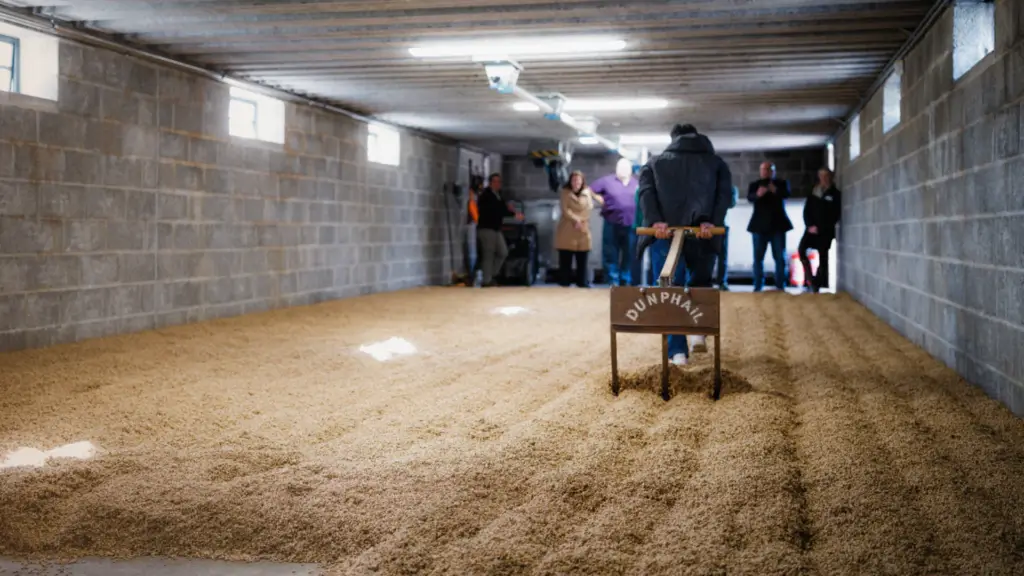
Floor Maltings History: Where Whisky Began Before stainless steel vessels, automated temperature control, and industrial malt plants, a Scotch whisky distillery often began its work on a stone or concrete floor. Barley was steeped in water, spread in a shallow layer, and turned repeatedly by hand as it germinated. The process demanded time, judgement, space, […]
June 18, 2026
Discovery and Education
Feis Ile: How a Small Islay Festival Became Whisky’s Global Pilgrimage
Islay is not a large island, but few places in the whisky world carry so much weight. Its coastline, peat bogs, warehouses, ferry routes, village halls, and distillery courtyards have shaped one of Scotland’s most recognisable spirit landscapes. Long before Fèis Ìle became a global whisky pilgrimage, it began as something more local and more […]
June 7, 2026
Features & Updates
Award Winners 2026 and What They Reveal About Spirits
Early 2026 did not produce one dominant style Award Winners 2026: Awards rarely define a category on their own, but they often reveal how it is being judged. In the first months of 2026, results across major competitions showed a consistent pattern. The leading distilleries and spirits were not unified by a single flavour profile […]
May 26, 2026