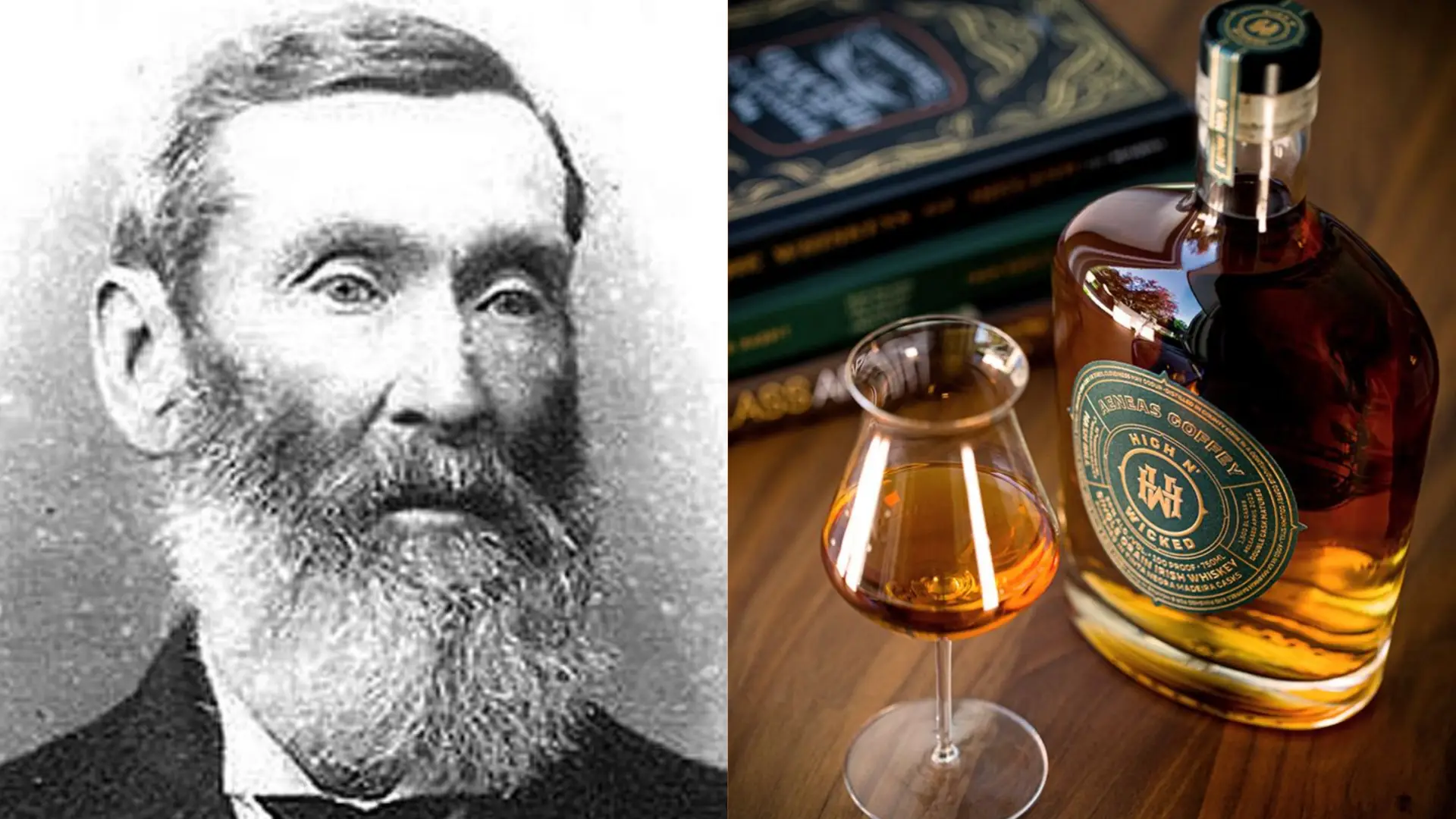
Modern spirits are often defined by brand, age, or origin, yet few drinkers consider the technology that made global spirits culture viable. The transition from small-scale pot still distillation to continuous production reshaped whisky, gin, vodka, and rum more profoundly than any single recipe or region. At the center of this shift stands Aeneas Coffey, whose work in the early nineteenth century transformed distillation from an artisanal craft into a scalable industry.
Coffey’s invention did not replace tradition. It created parallel paths. Pot stills remained central to identity-driven spirits, while continuous distillation enabled consistency, affordability, and global reach. Without Coffey’s contribution, modern spirits as an accessible cultural category would not exist.
Aeneas Coffey and His Background in Regulation
Aeneas Coffey was born in 1780 in County Wicklow, a region deeply connected to illicit distillation and excise enforcement. His career began not as a distiller, but as an excise officer. This role placed him at the intersection of regulation, inefficiency, and widespread tax evasion.
Through years of inspecting distilleries, Coffey observed the limitations of traditional pot stills. Batch distillation required repeated heating and cooling, consumed excessive fuel, and produced inconsistent spirit. Alcohol strength varied, impurities remained, and output was limited. These inefficiencies frustrated both producers and regulators.
Coffey’s understanding of distillation came from exposure rather than theory. His invention emerged from a desire to improve yield, control alcohol strength, and reduce waste. Regulation did not suppress innovation. It informed it.
The Coffey Still and Continuous Distillation
In 1830, Coffey patented what became known as the Coffey still, also referred to as the column still. Unlike pot stills, the Coffey still allowed continuous distillation. Wash entered one end, steam entered another, and alcohol was separated efficiently through a series of plates.
This method produced higher strength spirit with fewer impurities and far greater consistency. It required less fuel and less labor. Most importantly, it allowed distilleries to operate at scale without sacrificing control.
The Coffey still did not invent distillation. It optimized it. By solving industrial problems, Coffey opened the door to spirits that could be produced reliably, shipped globally, and priced accessibly.
Resistance and Adoption in Ireland and Scotland
Ironically, Coffey’s invention faced resistance in Ireland. Traditional pot still producers viewed continuous distillation as inferior and characterless. Irish whisky remained largely pot still based throughout the nineteenth century, emphasizing richness and weight over efficiency.
In Scotland, the response differed. Blenders quickly recognized the potential of a lighter, cleaner spirit produced by Coffey stills. Grain whisky, distilled using continuous methods, became the backbone of blended Scotch.
Distilleries such as Cameronbridge Distillery, founded in 1824, adopted Coffey-style distillation early. The resulting grain whisky allowed blenders to balance cost, consistency, and flavor, accelerating the global spread of Scotch whisky.
The Rise of Blended Whisky and Global Expansion
The true impact of Coffey’s invention became visible through blending. Single malt whisky remained expressive but expensive. Grain whisky offered neutrality and scalability. Together, they formed blends that appealed to broader audiences.
Brands such as Johnnie Walker and Chivas Regal built global reputations on this balance. Without continuous distillation, blending at this scale would have been impossible.
Blended whisky dominated international markets throughout the late nineteenth and early twentieth centuries. Coffey’s invention made whisky not just a regional product, but a global one.
Influence Beyond Whisky
The Coffey still reshaped spirits beyond whisky. Neutral spirits essential to gin and vodka production rely almost entirely on continuous distillation. The clean alcohol base produced by column stills allows botanicals, filtration, and water quality to define character.
Rum production also adopted continuous methods, particularly in former British colonies. Lighter column-distilled rums complemented heavier pot-still styles, expanding the category’s versatility.
Modern spirits categories depend on Coffey’s principles even when they celebrate tradition. Continuous distillation underpins consistency, safety, and accessibility across the industry.
Craft Revival and the Return of Choice
The late twentieth and early twenty-first centuries witnessed a craft revival that reembraced pot still distillation. This movement did not reject Coffey’s invention. It reintroduced choice. Distillers could now select methods based on intent rather than limitation.
Craft distilleries across Scotland, Ireland, and the United States intentionally select pot stills for their texture and character, while relying on Coffey-style distillation for efficiency when necessary. The modern spirits landscape is plural, not binary.
Coffey did not erase tradition. He expanded the toolkit.
Structural Legacy and Cultural Meaning
Aeneas Coffey is not defined by replacing tradition, but by enabling possibility. By tracing how his invention reshaped efficiency, blending, and global access, this history reveals how modern spirits became scalable without losing identity. It reminds drinkers that progress in spirits often comes from understanding structure as deeply as flavor.
On Barlist, spirits are explored through production logic, historical systems, and cultural continuity. By mapping distillation technology alongside distilleries and modern expressions, Barlist connects drinkers to the unseen foundations of what they enjoy. In that sense, Coffey’s legacy mirrors Barlist’s mission: clarity, structure, and respect for the systems that make spirits culture endure.


Distillery
Cameronbridge Distillery, located in Windygates, Fife, Scotland, is renowned for being the oldest grain whisky distillery in the…

Spirit
That Boutique Cameronbridge 39 YO Single Grain Scotch Whisky
Cameronbridge Whiskey is a remarkable expression that showcases the art and science of grain whisky production. This esteemed…

Spirit
Ed Gwenn Whisky is a unique expression from the Distillerie des Menhirs located in Brittany, France. This whisky…

History
The Gin Act of 1736 and the Law That Backfired on London
In early 18th century London, gin was no longer an occasional indulgence. It had become an everyday presence, poured in kitchens, alleys, and unlicensed dram shops across the city. The spirit most commonly consumed was not a refined product, but a rough style later known as Old Tom Gin, such as Hayman’s Old Tom, sweetened […]
February 12, 2026

History
Oktoberfest: Where Beer, History, and Bavarian Tradition Meet
Every autumn, the city of Munich undergoes a remarkable transformation. The streets become filled with traditional music, the aroma of Bavarian cuisine spreads through the city, and millions of visitors gather at Theresienwiese for a celebration unlike any other. Known around the world as Oktoberfest, this festival represents much more than beer. It is a […]
September 25, 2026
History
Royal Salute 21-Year-Old: A Celebration Born from Royal Tradition
Some whiskies acquire ceremony around them after decades of reputation. Royal Salute 21-Year-Old began with ceremony already embedded in its identity. The blended Scotch was launched in 1953 in connection with the Coronation of Queen Elizabeth II, held at Westminster Abbey on 2 June that year. The occasion reached an audience unprecedented for a British […]
September 11, 2026