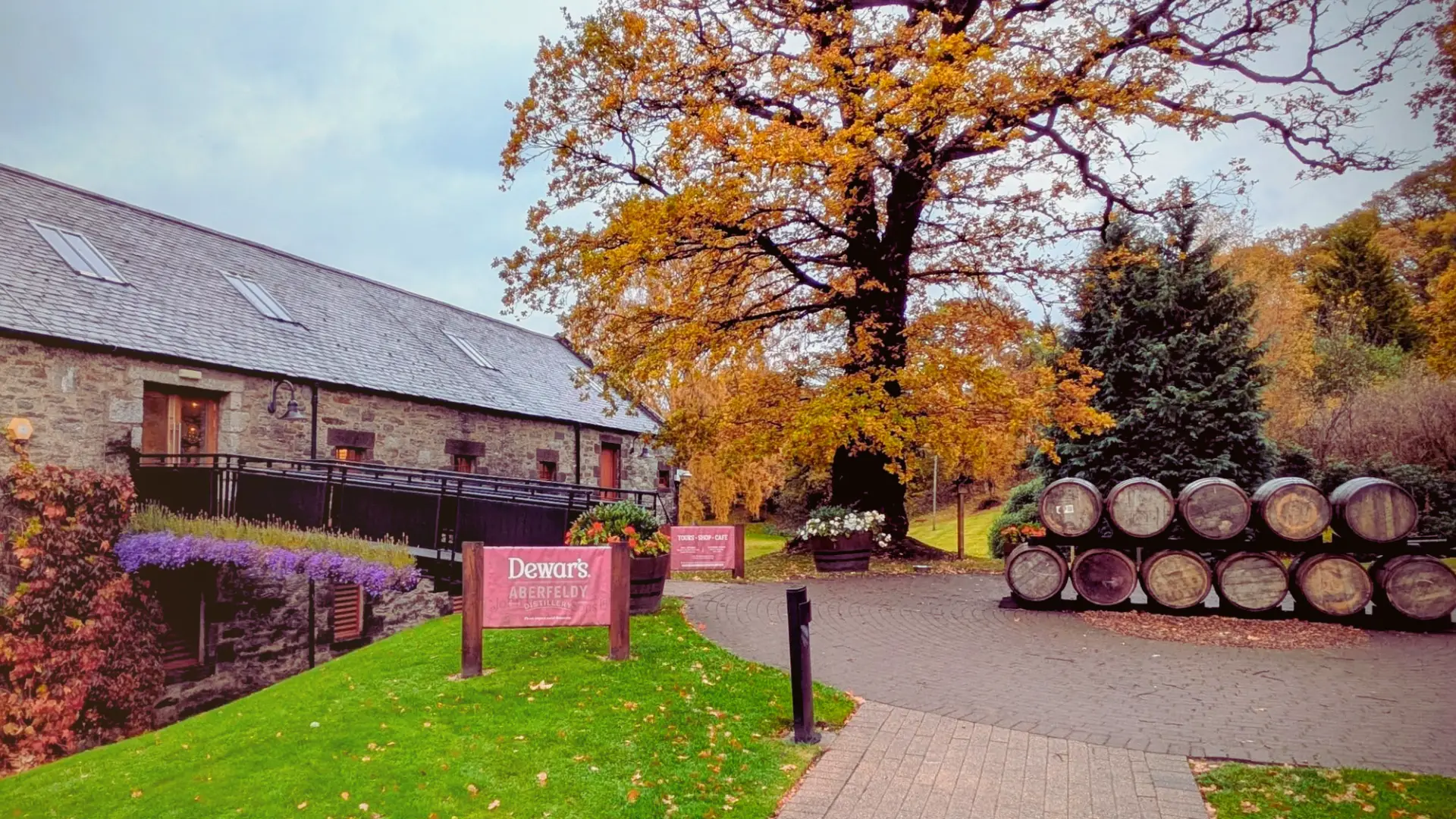
The history of Aberfeldy Distillery begins with a problem that every successful blender eventually faces: how to protect character when demand outgrows supply.
By the late 1800s, Dewar’s had moved far beyond the ambitions of a local Perth wine and spirits merchant. The family business had become one of the rising names in blended Scotch, selling into a widening market where consistency mattered as much as reputation. Blending required more than commercial flair. It needed dependable malt whisky, available in sufficient quantity, with a character stable enough to support a house style over time.
The answer was not to buy more anonymously from the market. John Alexander Dewar and Thomas Dewar built their own distillery near the place where their father’s story had begun.
That decision gives Aberfeldy its real historical importance. It was not founded as a romantic Highland outpost for single malt admirers, though it later became visible under its own name. It was built as a strategic production centre, designed to give Dewar’s greater control over the malt whisky at the heart of its blends.
Journey of Aberfeldy Distillery: From Perth Merchant to Blending House
John Dewar was born in 1805 in the village of Dull, close to Aberfeldy in Perthshire. His early life belonged to rural Scotland, but his career developed in the commercial world of Perth, where wine, spirits, groceries, and merchant networks connected local trade with a much larger market.
In 1846, he opened his own wine and spirits shop in Perth. The business was not unusual in its basic form, but Dewar understood the value of reliability and name recognition at a time when many spirits were still sold with limited brand identity.
His sons expanded that foundation more aggressively. John Alexander Dewar brought business discipline and political influence, while Thomas Dewar, often called Tommy Dewar, became one of Scotch whisky’s most visible travelling salesmen and brand builders.
Together, they turned John Dewar & Sons into a blending house with international reach. The family’s success depended on a simple but difficult promise: a bottle carrying the Dewar’s name should remain recognisable from one market to the next.
That promise required control. A blender could build a style through skill, but without secure access to malt whisky, consistency became vulnerable to competition, changing supply, and the bargaining power of other distilleries.
Why Aberfeldy Was Built
The decision to build Aberfeldy Distillery was both sentimental and practical.
The chosen site lay close to the birthplace of John Dewar, giving the distillery a family connection that could later be folded into the company’s story. Yet the site also made production sense. It stood in Highland Perthshire, near railway connections, water, barley supply routes, and the commercial centre from which the Dewar family had built its business.
Construction began in the late 1890s, and production started in 1898. The distillery was designed by Charles Doig, one of the most recognisable distillery architects of the period and the man associated with the pagoda roof form that became a visual shorthand for Scotch whisky production.
The timing was revealing. Blended Scotch had become a powerful commercial force, and companies with serious ambitions needed dependable stocks. Owning a distillery allowed Dewar’s to secure malt whisky for blending rather than relying entirely on outside supply.
The official Aberfeldy history describes the distillery as providing the heart malt content for Dewar’s blends. That phrase is useful because it explains the site’s purpose without reducing it to anonymity. Aberfeldy was not hidden because it lacked importance. It was hidden because its importance lay inside the blend.
The Pitilie Burn and the Making of Place
Every distillery needs a language of place, but that language must be handled carefully.
At Aberfeldy Distillery, the central natural reference is the Pitilie Burn, the water source that runs through the surrounding landscape. The burn is closely tied to the distillery’s identity and to the local story of alluvial gold found in the area.
The gold story has become part of the brand’s visual and verbal identity, but the more serious point is continuity. The water source links the distillery to a particular landscape in Highland Perthshire, even though its commercial role long depended on blending rather than single malt visibility.
Place does not create whisky on its own. Water must pass through mashing, fermentation, distillation, maturation, and blending before it becomes part of a finished spirit. Still, design, yeast activity, fermentation length, cask policy, and human judgement all matter.
Even so, the Pitilie Burn gave Aberfeldy a fixed anchor. The distillery may have served a global blend, but its production began in a specific valley, beside a specific stream, under conditions that could not be moved easily to another site.
That tension between local production and international brand identity is one of the reasons Aberfeldy deserves attention.
Malt for a Blend, Not a Supporting Actor
For much of the twentieth century, many Scotch malt distilleries were known more to blenders than to ordinary consumers.
Their spirit was not insignificant. It was essential. But it disappeared into blends whose public identity belonged to the merchant, blender, or brand owner rather than the individual distillery. Aberfeldy belonged firmly to that world. Its role inside Dewar’s meant that the distillery helped provide structure, continuity, and house character to a blended Scotch brand sold far beyond Perthshire.
This challenges a common modern assumption that single malt is always the most important expression of a distillery. In historical terms, many malt distilleries achieved their greatest commercial significance through blending.
A blender does not need every malt to shout. Some malts provide weight, others lift, grain, fruit, texture, or continuity across batches. A distillery such as Aberfeldy mattered because it gave Dewar’s a recurring centre of gravity.
That role required consistency rather than celebrity. In many ways, it was the quieter form of influence.
War, Consolidation, and Industrial Change
The twentieth century tested Scotch whisky repeatedly.
The First World War placed pressure on barley, shipping, labour, and production. Like many distilleries, Aberfeldy Distillery faced interruption during wartime conditions, when food supply and national priorities outweighed normal distilling schedules.
In 1925, John Dewar & Sons became part of a larger corporate structure through its association with The Distillers Company Limited, often known as DCL. This move reflected a wider pattern in Scotch whisky, as blending houses, distilleries, grain plants, and stock ownership became increasingly concentrated.
For Aberfeldy, consolidation did not remove its blending function. It placed the distillery within a broader industrial network where malt whisky production, warehousing, distribution, and brand ownership could be managed at scale. The distillery underwent a major expansion in 1972, doubling its capacity to its present form. That investment shows that Aberfeldy remained commercially important even when its own name was not yet widely recognised as a single malt brand.
Expansion is sometimes treated as the opposite of heritage. At Aberfeldy, it was part of the heritage because the site’s historical purpose had always been tied to a reliable supply for a larger Scotch whisky system.
The Architecture of Usefulness
The appearance of Aberfeldy Distillery carries the familiar visual language of Scotch whisky: stone buildings, a pagoda roof, and a sense of Victorian industrial order softened by the Highland setting.
It is tempting to read that architecture romantically, but its original purpose was practical. Distilleries were designed to move grain, water, heat, vapour, liquid, casks, and people efficiently through a demanding production sequence.
Charles Doig’s pagoda was not merely decorative. The pagoda form developed from the needs of malt kilning and ventilation, although at many distilleries it later became more important as a symbol than as a working necessity. At Aberfeldy, the architecture tells two stories at once. It reflects the technical confidence of late 19th-century Scotch whisky production, and it also reveals how quickly functional distillery features became part of the public image of Scotch.
The buildings mattered because they produced. They later mattered because they helped explain. That shift from industrial site to heritage space became especially important after 2000, when the old maltings buildings were converted into Dewar’s World of Whisky.
The Single Malt Emerges from the Blend
The modern visibility of Aberfeldy as a single malt is relatively recent when compared with the age of the distillery.
For most of its history, Aberfeldy’s public significance was tied to Dewar’s rather than to bottles carrying the distillery name. That changed around the turn of the 2000s, when the company began presenting Aberfeldy more clearly as a single malt in its own right.
This did not mean the distillery suddenly became important. It meant that one part of its importance became easier for consumers to see. The change reflected a wider transformation in Scotch whisky culture. Single malts gained prestige during the late twentieth century, and distilleries that had long served blends began to receive more direct attention.
For Aberfeldy, the move created a second identity. The distillery remained central to Dewar’s, but it could also be discussed as a Highland single malt with its own production choices, water source, fermentation approach, still house, and maturation policy.
That dual identity is not a contradiction. It is the history of Scotch whisky in miniature.
Bacardi and the Dewar’s Estate
Ownership changed again in 1998, when Bacardi Martini acquired the Dewar’s estate.
The transfer placed Aberfeldy within a family-owned international spirits company rather than the corporate system that had emerged through DCL, Guinness, Grand Metropolitan, and Diageo. The change mattered because it grouped Aberfeldy with other John Dewar & Sons malt distilleries under a distinct portfolio identity.
Today, the wider Dewar’s malt estate includes names such as Aultmore, Craigellachie, Macduff, and Royal Brackla. Each has its own production identity, but all belong to a broader blending and single malt strategy. For Aberfeldy, Bacardi ownership reinforced the connection between heritage and brand education. The opening of Dewar’s World of Whisky in 2000 made the distillery a place where the history of blending, family business, and malt production could be presented together.
That development is worth reading carefully. A visitor centre is not the same thing as production heritage, but it can change how production heritage is understood. The public story of Aberfeldy Distillery became less hidden than it had been during the years when its main role was to serve the blend.
Production Identity without Myth
The official production language around Aberfeldy emphasises Scottish malted barley, longer fermentation, copper pot stills, and maturation in oak casks, including bourbon barrels, hogsheads, butts, and sherry casks.
Those details matter, but they should not be exaggerated into simple cause and effect. Longer fermentation can encourage the development of flavour-bearing compounds, but the final character depends on the whole process. Copper contact, distillation regime, cask type, filling strength, warehouse management, and blending decisions all affect the spirit’s development.
The distillery’s house identity is often described through a honeyed register. That language belongs partly to brand communication, but it also reflects how the company wants Aberfeldy Distillery to function inside both single malt presentation and Dewar’s blending architecture.
A more useful way to understand the distillery is through balance. Aberfeldy had to produce malt whisky with enough character to matter, but enough adaptability to serve a blend reliably. That is a demanding role. A malt built for blending cannot be too fragile, too erratic, or too dependent on one narrow expression of character.
Its strength lies in carrying identity without overwhelming the system around it.
Why Aberfeldy Matters
Aberfeldy Distillery matters because it corrects a distorted way of thinking about Scotch whisky history.
Modern drinkers often encounter distilleries through single malt labels, but the Scotch industry was not built only by famous single malts. It was built by blending houses, merchants, grain distilleries, warehouses, transport networks, export markets, and malt distilleries whose names remained in the background for generations.
Aberfeldy Distillery sits exactly at that intersection. It was founded by a blended family, built in a meaningful Highland location, designed for reliable production, expanded to meet demand, and later brought forward as a named single malt.
Its story shows how a distillery can be both local and global. The spirit begins beside the Pitilie Burn, but its original commercial purpose was tied to a Scotch brand that travelled far beyond Perthshire. The distillery also reminds us that visibility is not the same as significance. For decades, Aberfeldy mattered most where consumers could not see it: inside the architecture of Dewar’s blended Scotch.
That hidden role is precisely what makes it valuable as history.
The story of Aberfeldy Distillery is not a simple tale of a Highland malt waiting to be discovered. It is the story of a distillery built to solve a business problem, shaped by family ambition, and designed to give a growing blended Scotch brand greater control over its own identity.
The distillery’s later life as a single malt did not erase that original purpose. It revealed another layer of it. Aberfeldy can now be understood both as an individual Highland distillery and as one of the production foundations behind Dewar’s global presence.
That dual role is important because Scotch whisky heritage is often told through the language of individual distilleries. Blending, by contrast, is sometimes treated as less romantic or less authentic. Aberfeldy Distillery challenges that division. Its heritage belongs to both worlds: the place where malt spirit is made and the wider system where malt, grain, cask, and the blender’s judgement become a recognisable Scotch identity.
The distillery’s quiet power lies there. It did not need to stand apart from blending to matter. It mattered because blending needed it.

Distillery
Dewar's Aberfeldy Distillery is a prominent single malt Scotch whisky distillery located on the outskirts of Aberfeldy, in…
Distillery
Dewar's, officially known as John Dewar's & Sons, is a distinguished Scottish whisky producer renowned for its exceptional…
Spirit
Aberfeldy 12 YO Highland Single Malt Scotch Whisky
Aberfeldy 12 YO Highland Single Malt Scotch Whisky is a fine representation of the craftsmanship found in the…
Spirit
Aberfeldy 10 YO Equinox & Solstice Whisky
Aberfeldy 10 Year Old Equinox & Solstice Whisky is a single malt Scotch that represents the craftsmanship and…
Spirit
Dewar's 'Double Double' 27 YO Whisky
Dewar's 'Double Double' 27 Year Old Whisky exemplifies the art of whisky craftsmanship, combining age-old traditions with innovative…
Spirit
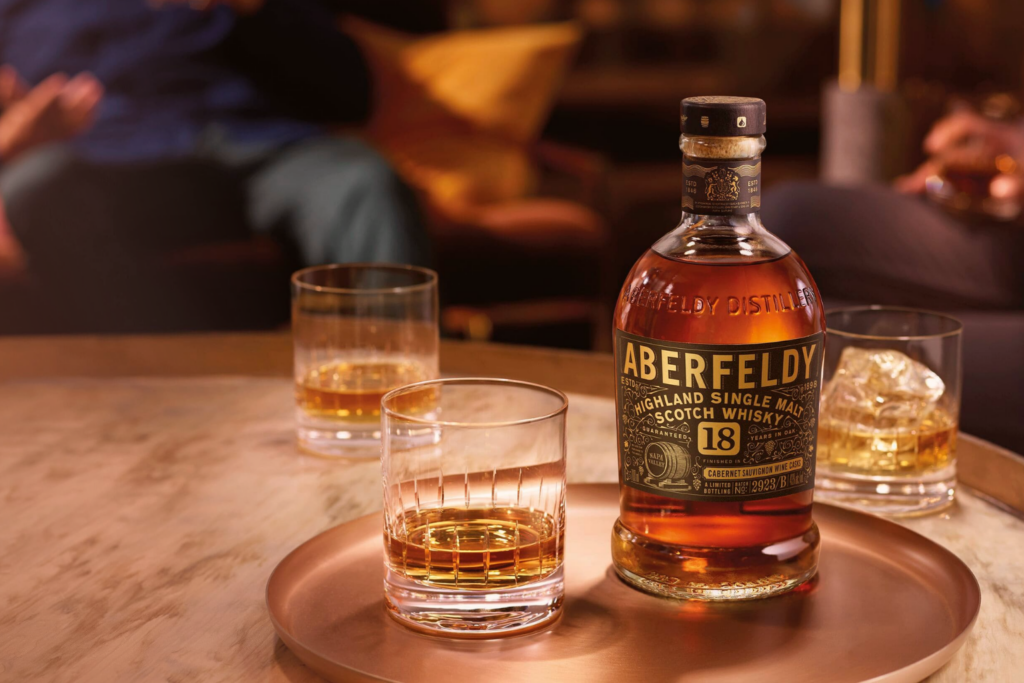
Aberfeldy 18 YO Single Malt Scotch Whisky
Aberfeldy 18 Year Old Single Malt Scotch Whisky is a distinguished expression from the heart of the Scottish…
Spirit
Aberfeldy 15 YO Highland Single Malt Scotch Whisky
Aberfeldy 15 Year Old Highland Single Malt Scotch Whisky represents a masterful balance between traditional Scottish distilling techniques…
Partnership
Guadeloupe Rhum Agricole: Exploring the French Caribbean’s Diverse Cane Spirit Tradition
Guadeloupe Rhum Agricole follows a broader path than the agricole tradition of neighbouring Martinique. Both territories belong to the French Caribbean and share a long relationship with fresh sugarcane juice, yet Guadeloupe rhum agricole developed within an archipelago where more than one rum production tradition has endured. Across volcanic Basse-Terre, limestone Grande-Terre and the distinctive […]
September 4, 2026

Distilleries & Producers
Roseisle Distillery: The High-Tech Speyside Giant Behind a New Generation of Whisky
In Speyside, where whisky is often associated with generations of tradition, Roseisle Distillery represents something very different. Built by Diageo near Elgin and officially opened in 2010, Roseisle was designed as a modern, large-scale malt whisky distillery, combining traditional pot-still production with advanced engineering, energy recovery and unusual flexibility in how its spirit can be […]
September 2, 2026
Interviews & Insights
Elmer T. Lee: The Master Who Revived Bourbon’s Soul
In 1949, a young Elmer T. Lee walked into the George T. Stagg Distillery in Frankfort, Kentucky, looking for a job. He had recently returned from the Second World War, where he had served as a radar bombardier aboard a B-29, and had graduated with honours in electrical engineering from the University of Kentucky. The […]
August 5, 2026