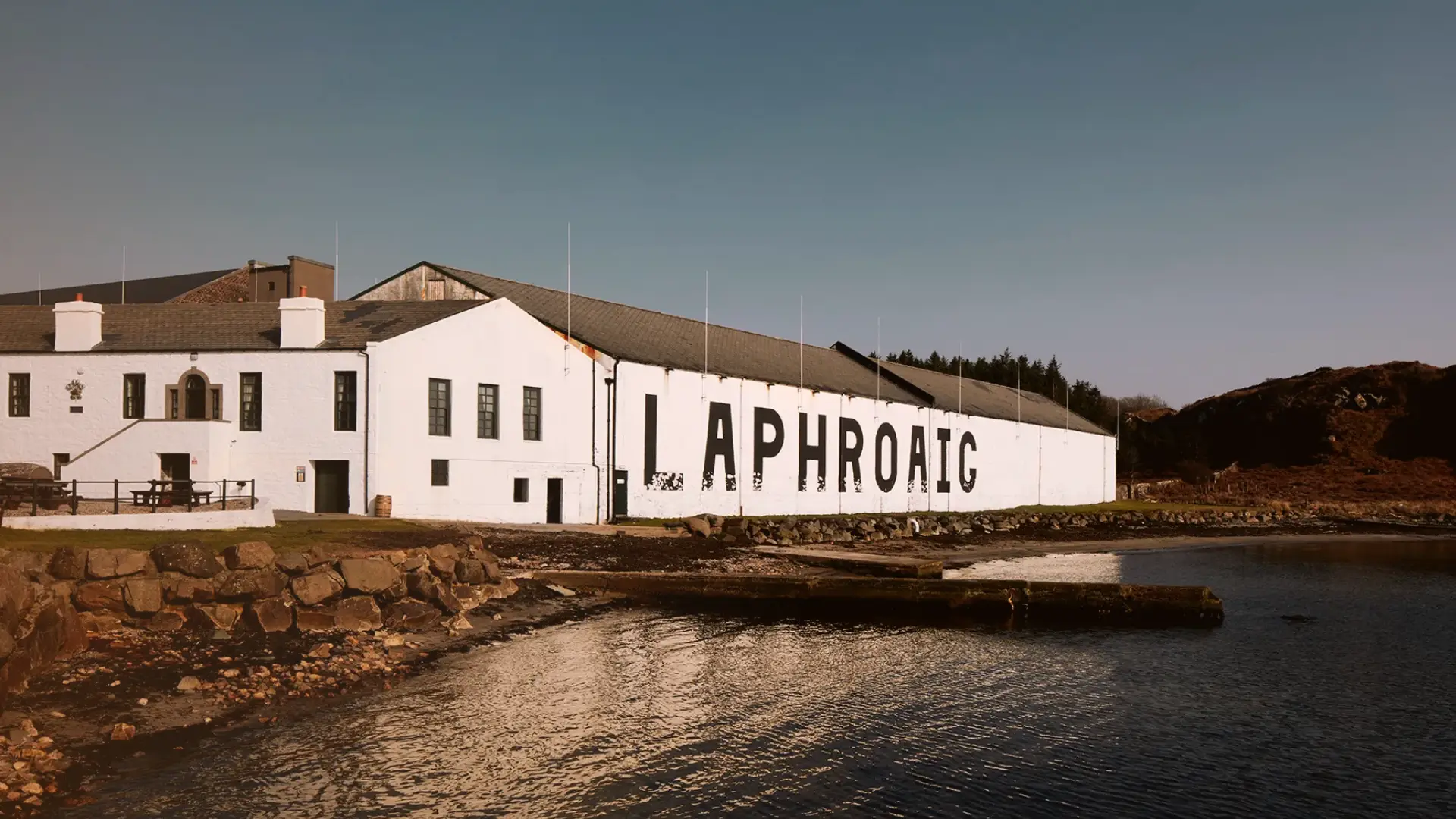
On the southern coast of Islay, the name Laphroaig stretches across a whitewashed warehouse facing a narrow bay. The lettering now belongs to one of the most recognisable names in Scotch whisky, yet the identity behind it was built from a tightly local set of materials: barley, peat, water, casks, coastal geography, and the decisions of people who understood that difference could be commercially valuable.
Peat alone did not create Laphroaig. Many distilleries used it, and several on Islay still do. What distinguished Laphroaig was the way the distillery combined peat smoke with its own malting traditions, water supply, still configuration, spirit cuts, maturation choices, and a willingness to present an uncompromising style without softening its origins.
That character might once have confined the whisky to blending warehouses and specialist buyers. Instead, it became the basis of a global identity. The path from farm distillery to international brand was neither smooth nor inevitable, and it depended on family ownership, legal disputes, technical continuity, and two figures who reshaped the business during the 1900s: Ian Hunter and Bessie Williamson.
A Distillery beside the Bay
Laphroaig Distillery was established in 1815 by the brothers Donald Johnston and Alexander Johnston. They had leased land on Islay’s southern coast for farming, but distilling soon became more commercially important than raising cattle.
The location gave the new business access to water from the Kilbride Stream, peat from nearby bogs, and a shoreline from which supplies and whisky could be moved by boat. At a time when island roads were limited, coastal transport was not simply convenient. It shaped whether a distillery could reach merchants and blending houses beyond Islay.
In 1836, Donald Johnston bought his brother’s share of the business, leaving him in sole control. After he died in 1847, responsibility passed through the family and a succession of trustees, managers, and relatives who kept the distillery working through a period when Islay malt whisky was becoming increasingly important to the blending trade.
The name Laphroaig became associated with a spirit that blenders valued for its strength of character. That demand supported the distillery, but it also created a difficult question. A whisky useful inside a blend could remain largely invisible to the wider public unless its owners found another route to market.
Peat as Production, Not Decoration
Peat is often treated as shorthand for Islay whisky, but its role at Laphroaig begins with a practical production decision. Smoke from burning peat is used during the drying of malted barley, allowing aromatic compounds from the smoke to attach to the damp grain before it is fully dried.
Laphroaig retains working floor maltings for part of its barley requirement. The grain is steeped, spread across the malting floor, and turned as germination develops, after which it moves to the peat kilns overlooking the bay. The distillery also uses malt prepared by external suppliers, so the process should not be described as completely self contained.
The surviving kilns date from 1840 and remain part of current production rather than functioning as historical scenery. Peat is burned at a relatively low temperature, and the damp malt is exposed to smoke before the drying process is completed.
The resulting spirit is not shaped by peat alone. Fermentation, the arrangement of three wash stills and four spirit stills, the height of the lyne arms, the rate of distillation, and the timing of the spirit cut all influence what leaves the still house. Maturation then adds another layer, with former American bourbon casks becoming especially important to the distillery’s house style during the 1900s.
Laphroaig’s identity emerged from the whole sequence. Peat became its most visible symbol because it was easy to recognise, but the production system gave that smoke its particular form.
A Difficult Relationship with Lagavulin
During the late 1800s, much of Laphroaig’s output went to Mackie & Co, the company associated with neighbouring Lagavulin Distillery and the White Horse blend. Laphroaig’s spirit was valuable within that commercial system, but the relationship became increasingly strained as the distillery sought greater control over its own sales.
The disagreement grew beyond an ordinary dispute between supplier and merchant. Access to water from the Kilbride supply became a legal issue, and in 1907, Peter Mackie attempted to interfere with the flow reaching Laphroaig. The courts required the obstruction to be removed.
The following year, Mackie recruited a brewer from Laphroaig and established Malt Mill Distillery within the Lagavulin complex. The project is commonly understood as an attempt to produce a spirit capable of replacing the whisky that Mackie could no longer secure on his preferred terms.
It did not create another Laphroaig. Water, peat, equipment, fermentation, distillation, and the working habits of a production team could not be duplicated simply by copying part of the process.
The episode strengthened the idea that Laphroaig’s identity belonged to its site rather than to one recipe. It also pushed the distillery towards greater commercial independence at a time when most malt whisky still reached consumers through blends.
Ian Hunter and the Move beyond Islay
Ian Hunter, the final member of the founding family to own Laphroaig, took control during the early 1900s. He inherited a distillery with a strong reputation among blenders but a fragile position as an independent business.
Hunter expanded and reorganised parts of the production site, increasing capacity while trying to preserve the features he considered important to the spirit. He also placed greater emphasis on markets beyond Scotland and sought to establish Laphroaig as a whisky recognised under its own name.
This was not a small change. Single malt Scotch whisky had not yet developed the international market it would acquire much later in the century, and most distilleries depended heavily on blending companies for sales.
Hunter understood that Laphroaig’s pronounced identity could become an advantage if buyers were encouraged to recognise the distillery rather than only the blend containing its whisky. Scandinavia, continental Europe, Canada, Latin America, and the United States became increasingly important to the business.
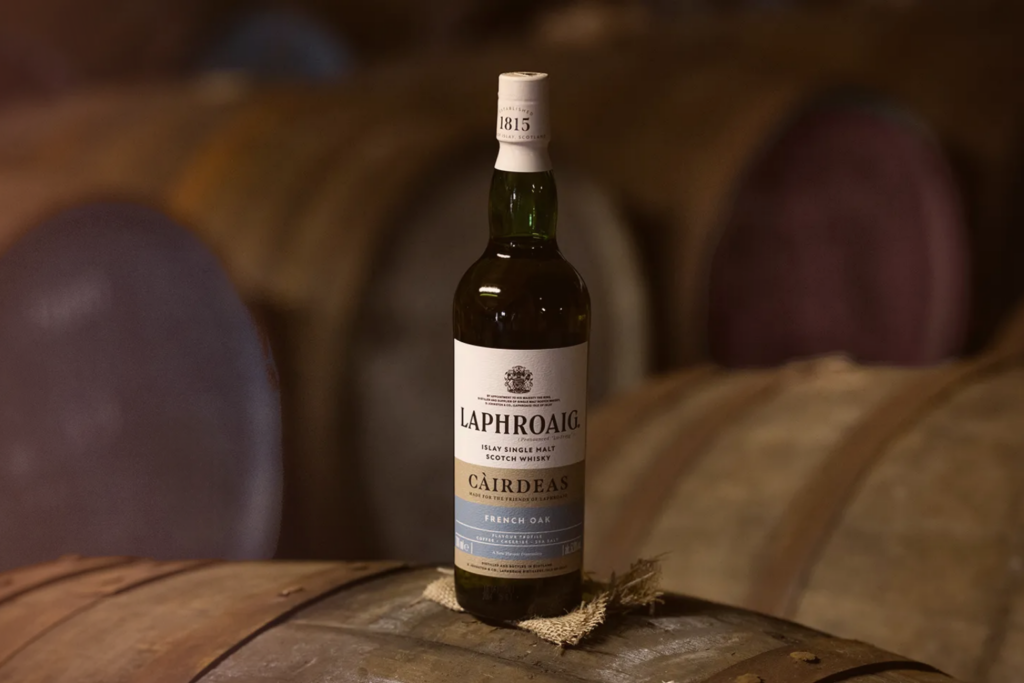
He also helped establish the use of former American bourbon barrels at the distillery. These casks became central to Laphroaig’s maturation system and connected the whisky to the expanding movement of used American oak into Scotch production after the end of Prohibition.
Hunter did not make Laphroaig global by himself, but he gave the distillery a more outward looking commercial direction. He treated its distinctiveness as an asset to be explained rather than a difficulty to be concealed.
Bessie Williamson Takes Control
Bessie Williamson arrived on Islay in 1934 for what was meant to be a temporary office position. She remained at the distillery, became closely involved in its administration, and took on increasing responsibility as Hunter’s health declined.
Her role expanded during a difficult period. Production was interrupted by the Second World War, and the distillery had to protect its buildings, equipment, and stocks while industrial priorities shifted towards the war effort.
When Ian Hunter died in 1954, Williamson inherited a controlling interest in Laphroaig. She became one of the most significant women in the history of Scotch whisky and one of the few to own and direct a distillery during the 1900s.
Williamson continued the movement towards direct recognition of Laphroaig as a single malt. She travelled to the United States, represented Islay whisky to distributors and buyers, and helped position the distillery for a market that was beginning to look beyond blended Scotch.
Her approach combined continuity with realism. Laphroaig needed investment and distribution strength if it was to expand internationally, so she gradually sold interests in the company to Seager Evans & Co during the 1960s. The acquisition was completed in 1967, although Williamson remained involved in management until her retirement in 1972.
The transfer ended the period of individual ownership that had begun with the Johnston family. It also gave the brand access to the commercial structure required for wider growth.
Keeping a Distinctive Production Identity
Corporate ownership changed several times after the 1960s, but the distillery continued to present its production identity through place and process. The floor maltings, peat kilns, Kilbride water supply, still house, and coastal warehouses remained central to how Laphroaig understood itself.
That continuity should not be confused with complete resistance to change. Capacity increased, equipment evolved, external malt became necessary, ownership moved through larger companies, and distribution became international.
The important point is that modernisation did not require the distillery to remove the features that made its spirit recognisable. Instead, those features became the basis of the brand’s public explanation.
This was a notable shift in Scotch whisky. During earlier decades, distillery character was often discussed mainly by blenders and production teams. By the late 1900s, consumers were being invited to think about peat source, water, maltings, still shape, casks, and place.
Laphroaig was well suited to that change because its identity had never been neutral. It inspired strong reactions, and the company increasingly treated that division as proof of recognisability rather than a problem requiring correction.
From Local Distillery to Global Community
In 1994, distillery manager Iain Henderson established Friends of Laphroaig. The programme offered members a symbolic lease on a square foot of land on Islay, turning the distillery’s geography into a direct relationship with people far beyond Scotland.
The same year, the distillery received a Royal Warrant from Charles, Prince of Wales, following his visit to the site. The warrant added another layer of public recognition at a time when Laphroaig was becoming increasingly visible in international single malt markets.
Friends of Laphroaig was more than a conventional customer scheme. It connected the whisky’s global audience with the land, water, peat, and buildings used to explain its identity.
That idea was commercially effective because it did not separate the brand from Islay. Growth was presented through deeper attachment to the original place rather than through the suggestion that the whisky had outgrown it.
By the early 2000s, Laphroaig had become an international single malt name, yet its most recognisable images still came from the same small bay, the white warehouse walls, the peat kilns, and the malting floor.
The Limits of the Peat Story
The success of Laphroaig has encouraged a simplified version of its history in which Islay peat alone created a global whisky. That account is memorable, but it leaves out most of the work.
Peat supplied a visible point of difference. The Johnston family established the site, the dispute with Mackie forced greater independence, Ian Hunter developed overseas markets and maturation practices, and Bessie Williamson carried the distillery into a new commercial era.
Later owners supplied capital and distribution, while production teams preserved the working knowledge required to keep the spirit recognisable through changes in scale and equipment.
Global identity came from the alignment of those elements. The whisky needed to remain connected with Islay, but it also needed people capable of translating that connection into a form understood by buyers, distributors, and drinkers abroad.
The strongest brands in spirits history are rarely created by one ingredient. They emerge when production, place, ownership, and storytelling support the same idea over a long period.
Laphroaig did not become internationally important by making peat fashionable. It became important by turning a local production reality into a consistent identity that survived family succession, commercial conflict, war, corporate ownership, and changes in the Scotch whisky market.
The distillery’s peat smoke remains central, but it has never stood alone. Water from the Kilbride supply, working floor maltings, the arrangement of the stills, decisions in the spirit safe, former bourbon casks, and generations of production knowledge all contributed to the whisky attached to the name.
What changed during the 1900s was not simply the liquid. Laphroaig learned how to explain itself beyond Islay without making its identity more generic.
That is the larger achievement. A small coastal distillery turned peat into a global symbol because it understood that place could travel, provided the production behind it remained convincing.

Distillery
Laphroaig Distillery, nestled on the rugged south coast of Islay, Scotland, is synonymous with rich and complex single…
Spirit
Laphroaig 10 YO Cask Strength Islay Single Malt Scotch Whisky
Laphroaig 10-YO Cask Strength is a distinguished expression of Islay single malt Scotch whisky, renowned for its unfiltered…
Spirit
Laphroaig 10 YO Single Malt Scotch Whisky
Laphroaig 10 Year Old Single Malt Scotch Whisky is renowned as one of the most iconic expressions of…
Spirit
Laphroaig 10 YO Cask Strength Batch 015 Islay Single Malt Scotch Whisky
Laphroaig 10 Year Old Cask Strength is a quintessential expression of Islay whisky, known for its robust character…
Spirit
Laphroaig 10 YO Sherry Oak Finish Islay Single Malt Scotch Whisky
Laphroaig 10 YO Sherry Oak Finish Islay Single Malt Scotch Whisky is a remarkable expression that showcases the…
History
Lagavulin Distillery and the Discipline of Slow Distillation on Islay
On the southern coast of Islay, Lagavulin Distillery stands beside a sheltered bay between Laphroaig and Ardbeg. Its white buildings, dark kiln roofs, and long waterfront warehouses belong to one of Scotland’s most recognisable whisky landscapes. Still, the character associated with the distillery was not created by scenery alone. Peat is the most obvious part […]
June 28, 2026
Distilleries & Producers
The Last Days of Floor Maltings: When Scotch Distilleries Made Their Own Malt
Floor Maltings History: Where Whisky Began Before stainless steel vessels, automated temperature control, and industrial malt plants, a Scotch whisky distillery often began its work on a stone or concrete floor. Barley was steeped in water, spread in a shallow layer, and turned repeatedly by hand as it germinated. The process demanded time, judgement, space, […]
June 18, 2026
Discovery and Education
Feis Ile: How a Small Islay Festival Became Whisky’s Global Pilgrimage
Islay is not a large island, but few places in the whisky world carry so much weight. Its coastline, peat bogs, warehouses, ferry routes, village halls, and distillery courtyards have shaped one of Scotland’s most recognisable spirit landscapes. Long before Fèis Ìle became a global whisky pilgrimage, it began as something more local and more […]
June 7, 2026