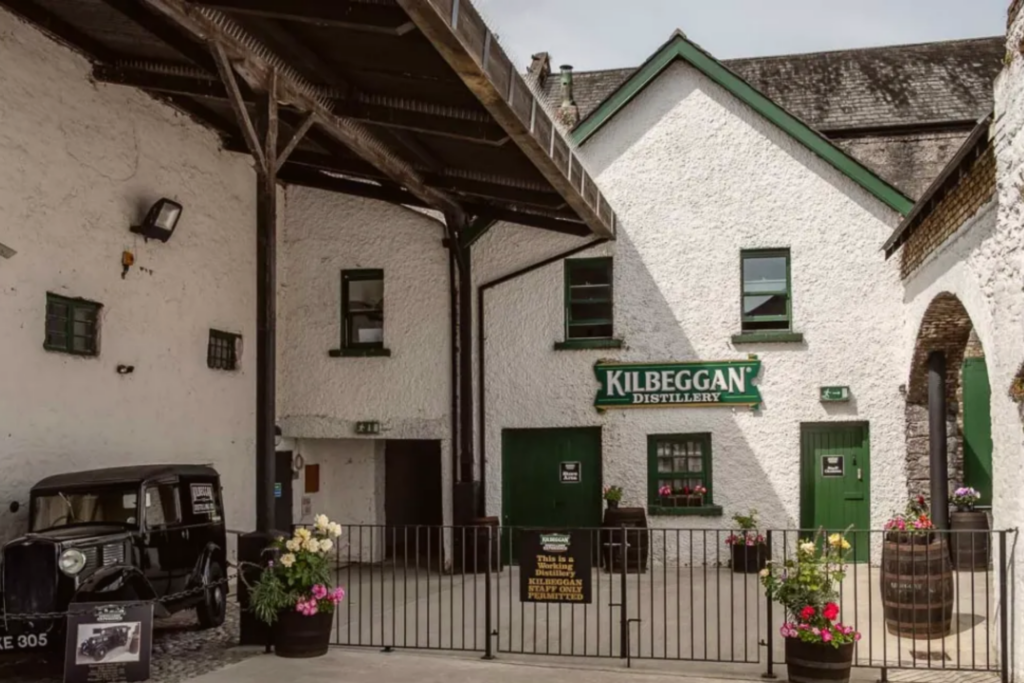
Along the River Brosna in County Westmeath, the buildings of Kilbeggan Distillery remained intact long after distillation had ceased. Water continued to move through the wheel, timber structures held their form, and the layout of what had once been known as Locke’s Distillery did not disappear with production.
Founded in 1757, the site operated through Ireland’s shifting whiskey economy before entering a period of decline in the mid-20th century. By 1953, production had effectively stopped, and by 1957, the distillery was fully closed. In most cases, closure marked the end. At Kilbeggan Distillery, it marked a transition.
The collapse of Irish whiskey and the risk of erasure
The closure occurred during one of the most difficult periods in Irish whiskey history. By the mid-20th century, global demand had shifted toward Scotch blends, while trade barriers and economic conditions reduced Irish exports.
Distilleries across the country were dismantled. Equipment was sold for scrap, buildings were repurposed, and entire production systems disappeared. Even long-established sites could not survive without scale, as seen in the consolidation around operations such as Old Bushmills Distillery.
Kilbeggan Distillery faced the same trajectory. Its machinery, including an early 19th-century pot still, could easily have been removed and sold. The distillery’s waterwheel, already more than a century old, might have followed the same path.
What prevented this outcome was not industrial investment. It was a local intervention.
1982 and the decision to preserve rather than dismantle
In 1982, residents formed the Kilbeggan Preservation and Development Association. Their objective was not to restart production immediately. It was to prevent the site from disappearing.
This intervention altered the distillery’s trajectory. Rather than allowing machinery to be dismantled, the group preserved the physical infrastructure, including the waterwheel, still house, and supporting equipment. The site’s original distillery license was also maintained, an administrative detail that would later become critical. This phase introduced a different model of survival. Production was absent, but continuity was preserved.
The museum years and the protection of the infrastructure
By May 1987, the site reopened as a museum, presenting visitors with a working representation of a historic Irish distillery. The waterwheel, powered by the River Brosna, continued to operate. Mash tuns, fermentation vessels, and distillation equipment were retained in situ.
Tourism became a supporting mechanism. Revenue generated from visitors allowed the site to be maintained without requiring immediate commercial production. At a time when Irish whiskey infrastructure was being lost elsewhere, Kilbeggan Distillery remained structurally intact.
In 1988, the site was acquired by Cooley Distillery, under the leadership of John Teeling. The museum continued to operate, while warehouses and maturing stocks were maintained. The distillery was no longer producing, but it had not been erased.
Preservation as a condition for revival
The importance of this period becomes clearer when viewed against the broader industry. Most Irish distilleries that closed in the mid-20th century lost their physical identity. Even where brands survived, the original sites did not.
Kilbeggan Distillery followed a different path. Because its machinery, layout, and licensing were preserved, the possibility of restarting production remained viable. The retention of the original license, in particular, ensured that distillation could legally resume without reconstructing the framework from scratch. This continuity is rare. It positioned Kilbeggan Distillery not as a recreated distillery, but as one that had endured.
2007 and the return of distillation
In 2007, exactly 250 years after its founding, distillation resumed at Kilbeggan Distillery. The restart was not built on a modern replacement facility, but on a restored historical site. The 19th-century pot still was brought back into operation, and the waterwheel remained integrated into the system. Unlike new distilleries designed for efficiency, Kilbeggan Distillery’s production reflected its preserved structure.
By 2010, additional equipment, including mash tuns and fermentation vessels, had been installed to support full operational capacity. The site functioned simultaneously as a working distillery and a historical environment. Production had returned, but it had not replaced what came before.
Integration into modern Irish whiskey
The acquisition of Cooley Distillery by Beam Suntory in 2012 placed Kilbeggan Distillery within a larger international framework. Despite this integration, the distillery retained its dual identity.
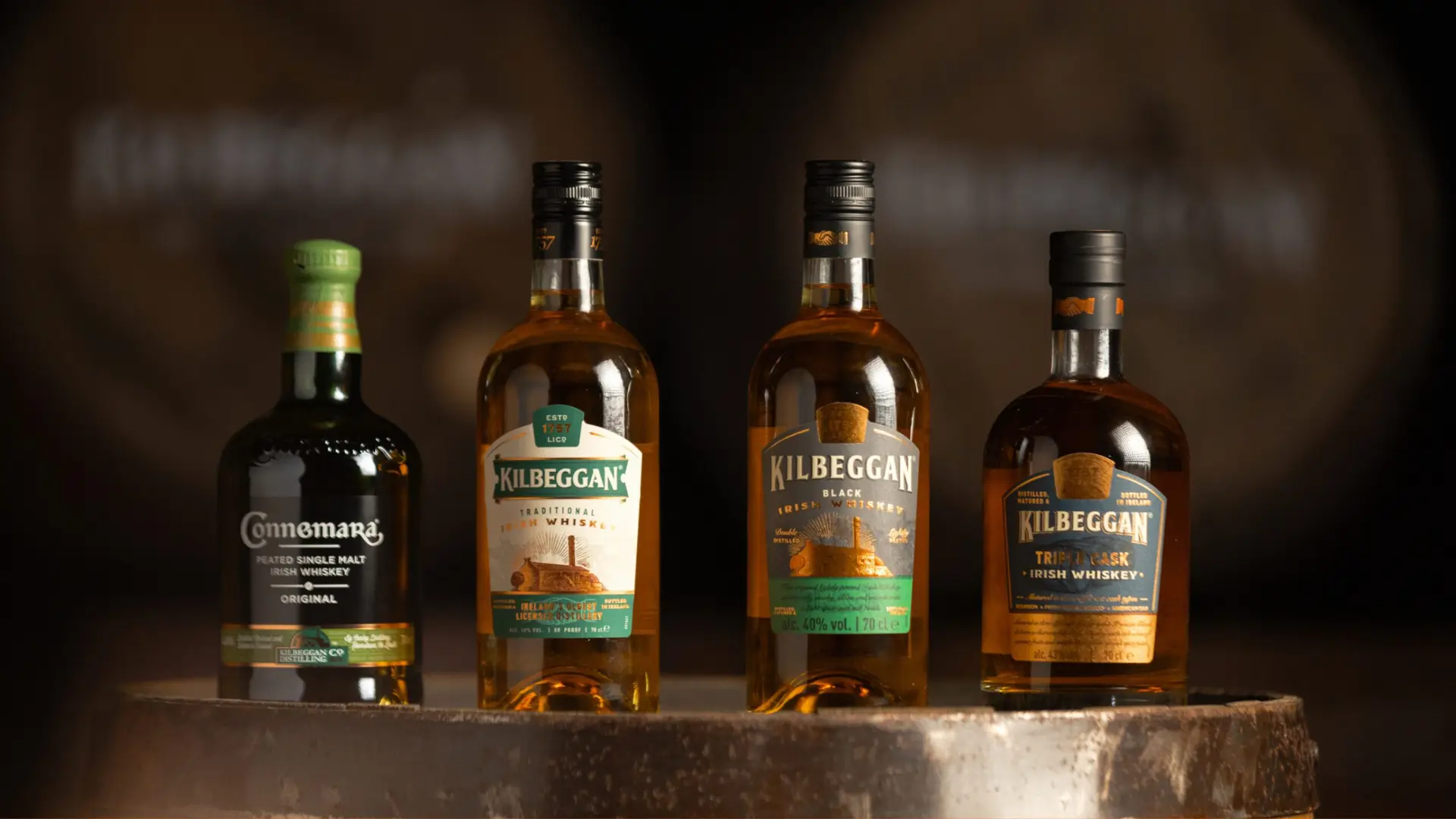
It operates both as a production site and as a museum, allowing visitors to experience the continuity between past and present. Whiskeys such as Kilbeggan Traditional Irish Whiskey and Kilbeggan Single Grain draw from this system, combining current production with stocks matured within the broader Cooley Distillery network.
Its role is not defined by scale. It is defined by continuity.
A distillery that survived by not producing
The survival of Kilbeggan challenges the assumption that continuous production is necessary for continuity. For decades, no whiskey was made on site. Yet those decades ensured that the distillery itself remained intact.
The preservation of machinery prevented the loss of physical heritage. The maintenance of licensing preserved legal continuity. The museum sustained itself through public engagement. When production resumed, it did so within an existing structure rather than a reconstructed one.
Kilbeggan Distillery demonstrates that heritage can function as infrastructure rather than narrative. Its museum years were not an interruption, but a form of protection that allowed production to return without reinvention.
The distillery did not survive because it continued to produce. It survived because it was preserved when production was no longer possible. In an industry where closure often leads to disappearance, Kilbeggan represents a different outcome. It shows that continuity can exist without output and that preservation can become the foundation for revival.

Distillery
Beam Suntory, now rebranded as Suntory Global Spirits, embodies a rich heritage and a commitment to craftsmanship in…
Distillery
The Old Bushmills Distillery, nestled in the picturesque village of Bushmills, County Antrim, Northern Ireland, holds the revered…

Distillery
Kilbeggan Co. Distillery, established in 1757, proudly holds the title of the oldest licensed distillery in Ireland, nestled…
Distillery
Cooley Distillery, located on the picturesque Cooley Peninsula in County Louth, Ireland, is renowned for its artisan approach…
Spirit
Kilbeggan Traditional Irish Whiskey
Kilbeggan Traditional Irish Whiskey is a premium Irish whiskey that embraces the quintessential craftsmanship and methodology associated with…
Spirit
Kilbeggan Single Pot Still Irish Whiskey
Kilbeggan Single Grain Irish Whiskey represents an innovative spirit from the Kilbeggan Distilling Co., renowned as the oldest…
Partnership
Guadeloupe Rhum Agricole: Exploring the French Caribbean’s Diverse Cane Spirit Tradition
Guadeloupe Rhum Agricole follows a broader path than the agricole tradition of neighbouring Martinique. Both territories belong to the French Caribbean and share a long relationship with fresh sugarcane juice, yet Guadeloupe rhum agricole developed within an archipelago where more than one rum production tradition has endured. Across volcanic Basse-Terre, limestone Grande-Terre and the distinctive […]
September 4, 2026
Distilleries & Producers
Roseisle Distillery: The High-Tech Speyside Giant Behind a New Generation of Whisky
In Speyside, where whisky is often associated with generations of tradition, Roseisle Distillery represents something very different. Built by Diageo near Elgin and officially opened in 2010, Roseisle was designed as a modern, large-scale malt whisky distillery, combining traditional pot-still production with advanced engineering, energy recovery and unusual flexibility in how its spirit can be […]
September 2, 2026
Interviews & Insights
Elmer T. Lee: The Master Who Revived Bourbon’s Soul
In 1949, a young Elmer T. Lee walked into the George T. Stagg Distillery in Frankfort, Kentucky, looking for a job. He had recently returned from the Second World War, where he had served as a radar bombardier aboard a B-29, and had graduated with honours in electrical engineering from the University of Kentucky. The […]
August 5, 2026