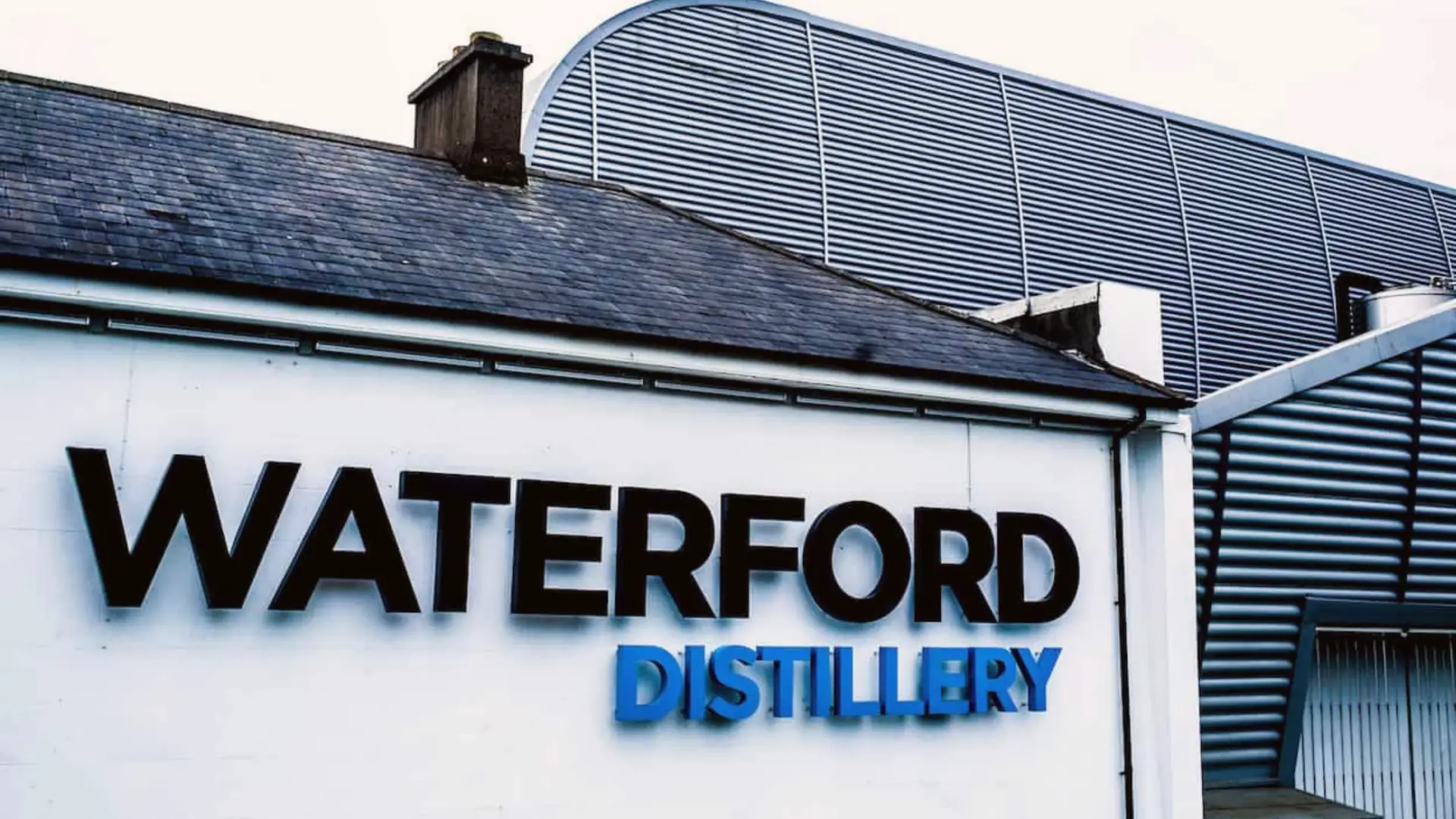
Whiskey has always been a balance between tradition and innovation. Rarely has this balance been tested as rigorously as at Waterford Distillery. Founded in 2015 by Mark Reynier, former director of Bruichladdich, Waterford sought to redefine Irish whiskey by making terroir, barley provenance, and farm-level traceability central to production. Every batch of whiskey was designed to showcase the unique character of the farm where the barley was grown, offering a level of agricultural transparency unprecedented in the industry.
Despite early acclaim, the distillery faced immense challenges. By late 2024, financial pressures and market realities forced Waterford into receivership under Interpath Advisory, placing thousands of casks and proprietary techniques in a state of uncertainty. The story of Waterford is not just about business failure but also about the technical ambition of a distillery that sought to make whiskey both a scientific and sensory exploration.
A Radical Vision: Terroir in Irish Whiskey
Waterford Distillery entered the Irish whiskey scene with a radical philosophy. Unlike traditional Irish producers who prioritize blending for consistency, Waterford aimed to preserve and highlight the individuality of barley from each farm. This approach was inspired by wine production, where the soil, microclimate, and farming techniques define flavor, structure, and aroma.
The distillery’s concept involved partnering with over one hundred farms across Ireland. Barley from each farm was tracked, malted, fermented, and distilled separately, creating a system in which every batch could be traced back to its origin. This extreme focus on provenance required meticulous logistics, advanced record-keeping, and bespoke infrastructure.
Waterford’s Single Farm Origins series, including notable releases like Ballykilcavan 1.1 and Bannow Island 1.1, exemplified the philosophy. Heritage barley strains, such as Goldthorpe, were resurrected specifically for these releases, adding historical and agronomic significance. Casks were carefully chosen, ranging from American oak to French oak and Vin Doux Naturel barrels, each selected to complement the raw barley profile rather than mask it.
Production Philosophy and Technical Innovation
At Waterford, the technical approach to whiskey was as innovative as the agricultural ambition. Small batch distillation preserved the unique characteristics of each farm’s barley. Fermentation was closely monitored to reduce variability, and distillation employed traditional copper pot stills and stainless steel column stills, depending on batch requirements.
The distillery also pioneered data-driven methods rarely seen in whiskey production. Each bottle included detailed information on the farm, soil composition, barley variety, and even harvest conditions. QR codes linked consumers to these datasets, creating an unprecedented level of transparency. The goal was not only to produce whiskey but to educate the market on the agricultural and chemical variables that define flavor.
Early Acclaim and Market Reception
Waterford’s approach drew critical attention. Reviewers praised the Single Farm Origins for their clarity, structure, and expression of terroir. Whiskey connoisseurs appreciated the revival of heritage barley strains and the focus on raw material transparency.
However, the market presented challenges. Irish whiskey has seen rapid growth over the last decade, but Waterford’s meticulous approach resulted in limited production capacity. High operational costs, niche appeal, and the difficulty of distributing small-batch, farm-specific expressions constrained revenue.
Financial Pressures and Receivership
By 2022, despite early acclaim, Waterford faced mounting financial pressure. Sales were reported at approximately €3 million, but accumulated losses exceeded €7 million. Costs included farm sourcing, malt separation, specialized malting, detailed record-keeping, and small-batch distillation.
Late 2024 marked a turning point. Interpath Advisory was appointed as receiver, taking control of nearly 50,000 casks of whiskey. Discussions over the casks, intellectual property, and production methods are ongoing, with industry observers monitoring whether Waterford’s systems will be acquired intact or absorbed into other distilleries.
Distilleries and Production Legacy
Waterford’s innovations were not just conceptual but grounded in production reality. The distillery operated from a site in Waterford city, previously a Guinness brewery, equipped to manage multiple independent fermentations and distillations.
The Single Farm Origins series demonstrated how barley source could dramatically influence flavor. A distillate from Ballykilcavan might exhibit a distinct grassy and mineral profile, while Bannow Island could display floral and cereal-driven notes. This attention to micro-variation was a technical milestone for Irish whiskey, demonstrating that provenance can be both measurable and sensory.
Barley as a Technical Ingredient
Waterford’s work highlighted the scientific complexity of barley in whiskey production. Factors such as soil composition, barley variety, microclimate, and cultivation method affect starch content, enzymatic activity, and fermentable sugar yield. The distillery’s systematic tracking allowed experiments that were replicable and measurable, providing insights into agricultural impact rarely documented in whiskey production.
Heritage strains like Goldthorpe required special care in germination, mashing, and fermentation. Waterford’s approach blurred the line between agronomy and distillation, showing that whiskey flavor is as much about farm practice as it is about cask choice or distillation method.
The Cultural and Industry Impact
While financially unsuccessful, Waterford Distillery reshaped thinking about Irish whiskey. Its attempt to integrate agricultural transparency, data-driven production, and heritage barley revival created a new category of terroir-focused whiskey. Small batch and single farm expressions are now considered technically viable, inspiring other distillers to experiment with provenance without relying solely on blending for consistency.
The story also emphasizes the tension between innovation and market realities. Waterford’s products appealed to connoisseurs but challenged traditional scaling models and distribution channels. Its receivership serves as a cautionary tale for distilleries balancing technical ambition with commercial sustainability.


Distillery
Bruichladdich Distillery Company
Bruichladdich Distillery Company, nestled on the idyllic Isle of Islay in Scotland, is renowned for its dedication to…
Distillery
Waterford Distillery is a pioneering micro distillery located in Waterford, Ireland. Established in 2015, it was created by…

Spirit
Waterford Single Farm Origin Irish Single Malt Whisky
Waterford Single Farm Origin Ballyroe 1.1 Whisky is a pioneering expression in the realm of Irish whiskey, distinguished…
Spirit
Waterford Single Farm Origin Hook Head 1.1 Single Malt Irish Whisky
Waterford Single Farm Origin Hook Head 1.1 is a remarkable expression of Irish single malt whisky, characterized by…
Spirit
Waterford Single Farm Origin Sheestown Edition 1.2 Irish Single Malt Whisky
Waterford Single Farm Origin Sheestown Edition 1.2 is a remarkably crafted Irish Single Malt Whisky, showcasing a dedication…
Spirit
Waterford Heritage Hunter Irish Single Malt Whisky
Waterford Heritage Hunter Irish Single Malt Whisky is a testament to the art of distillation, showcasing a unique…
Trends and Innovations
Luxury Packaging in Spirits: Perception Versus Liquid Quality
Weight arrives before aroma. A heavy glass bottle, a magnetized closure, an embossed crest, and a velvet-lined box signal prestige before the cork is drawn. In the global spirits market, presentation often precedes palate. Luxury Packaging in Spirits operates at the intersection of psychology, design, and economics, shaping perception long before liquid quality can be […]
April 1, 2026

Community and Lifestyle
The Best Irish Whiskey to Drink on St Patrick’s Day 2026
Not every whiskey belongs on March 17. Some are made for quiet evenings. Others are built for reflection. St Patrick’s Day asks for something different. It asks for a whiskey that can move between conversation, celebration, and continuity without losing its character. The question is not simply what is best. It is what fits the […]
March 17, 2026
Spirits
Best 7 Gins in 2026 and the Distilleries Behind Their Reputation
Gin in 2026 no longer revolves around surprise botanicals or short-lived fashion. The category has settled into a more mature phase, one where credibility is earned through repetition, clarity of method, and a distillery’s ability to articulate intent over time. The gins that now command attention are not the loudest or most experimental, but those […]
February 14, 2026