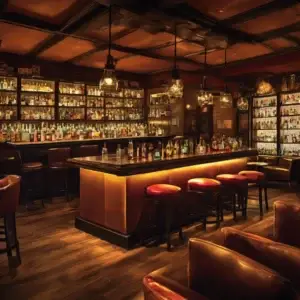
A ringing telephone inside a New York hot dog shop opens a concealed door. A narrow staircase in Shoreditch descends into candlelit jazz. An unmarked façade in Singapore reveals one of Asia’s most awarded cocktail programs. These are not acts of evasion but of design. The rise of Speakeasy 2.0 marks a shift from prohibition secrecy to experiential intention, where hidden entrances serve as psychological thresholds into disciplined craft. What began as a survival tactic between 1920 and 1933 has reemerged as a curated ritual, redefining how modern drinkers engage with cocktail culture.
From Prohibition to Precision
The original American speakeasies operated under the constraints of the Volstead Act, relying on coded language and concealed rooms to avoid federal enforcement. Their legacy was improvisational rather than refined. Yet the mythology endured long after repeal in 1933. When Sasha Petraske opened Milk and Honey in London in 2002, he did not revive secrecy for necessity but for atmosphere. Access was controlled. Reservations were mandatory. Bartenders measured with restraint and avoided theatrical excess.
Milk and Honey became foundational to the rise of Speakeasy 2.0 because it reframed hidden space as a marker of seriousness. Petraske’s rules, including no loud music and no flashy shaking, emphasized technical precision and hospitality discipline. The concealed format became a filter for guests seeking craft over spectacle.
New York and the Theatrical Threshold
The movement gained global visibility in 2007 when Jim Meehan opened PDT, short for Please Don’t Tell, inside Crif Dogs in Manhattan’s East Village. Entry through a vintage phone booth fused nostalgia with architectural play. Yet behind the door stood rigorous execution. Recipes balanced heritage spirits such as Beefeater, founded in 1863 and Campari, established in 1860, with modern infusions and clarified components.
Employees Only, founded in 2004 in New York’s West Village, also adopted discreet signage and dim lighting while preserving high-volume professionalism. Here, The Rise of Speakeasy 2.0 demonstrated that hidden access could coexist with consistency and scale. Concealment heightened anticipation. Craft sustained reputation.
London’s Subterranean Narrative
Across the Atlantic, London embraced immersive storytelling. Nightjar opened in 2010 beneath Old Street, combining live jazz with historically inspired cocktails. Its menu referenced pre-Prohibition and mid century recipes, aligning ambiance with archival research. Oriole, launched in 2015, extended the concept through globally inspired ingredients and exploration-themed design.
Although not concealed in the same manner, the Connaught Bar under Agostino Perrone reinforced the movement’s ethos through ritual. The Martini trolley service elevated measurement and personalization to performance. The lesson embedded in the rise of Speakeasy 2.0 was unmistakable. Craft thrives when context amplifies focus.
Asia and the Global Benchmark
Singapore’s 28 HongKong Street opened in 2011 behind an unmarked façade, catalyzing the city’s rise within global cocktail rankings. The bar combined an understated entrance with structured menu development and staff training programs. Atlas, opened in 2017, introduced Art Deco grandeur while maintaining disciplined gin service, exceeding one thousand labels.
In Tokyo, Bar High Five, founded in 2008 by Hidetsugu Ueno, reinforced Japanese bartending minimalism. Ice carving, glassware selection, and dilution control became central acts of craftsmanship. Within these spaces, The Rise of Speakeasy 2.0 transcended aesthetics. It became an international hospitality model grounded in precision, restraint, and narrative architecture.
Spirits, Technique, and the Laboratory Influence
Modern hidden bars often function as controlled laboratories. Clarified juices, house bitters, and barrel-aged blends reflect production literacy. Plantation Rum, founded in 1999, Hennessy Cognac, established in 1765, and Tanqueray from 1830 appear on menus that emphasize provenance and balance.
Unlike Prohibition era predecessors, Speakeasy 2.0 venues rely on transparency in sourcing, even if entrances remain concealed. Guests expect origin stories, distillation details, and thoughtful technique. Concealment reframes the experience without obscuring integrity.
Beyond Nostalgia Toward Sustainability
The sustainability conversation has also entered hidden bars. Controlled entry reduces overcrowding. Batch preparation limits waste. Clarification techniques extend shelf life and ensure consistency. As climate awareness influences hospitality, the rise of Speakeasy 2.0 adapts, proving that concept and conscience can coexist.
Critics sometimes dismiss the format as aesthetic repetition. Yet its endurance suggests deeper resonance. In an era of algorithm-driven visibility, hidden spaces offer tactile discovery. They create a pause before consumption. That pause reframes value.
Modern hidden bars transformed nostalgia into disciplined execution. From Milk and Honey in 2002 to PDT in 2007 and 28 HongKong Street in 2011, The Rise of Speakeasy 2.0 illustrates how architecture can elevate craft without diminishing authenticity. Concealment became not a disguise but a threshold.
Barlist documents these intersections of venue, producer, and technique. By tracing the evolution of Speakeasy 2.0 across London, New York, Singapore, and Tokyo, the platform highlights how the environment shapes perception and how ritual reinforces quality. Behind each unmarked door stands intention. Within that intention, contemporary mixology discovered renewed clarity.