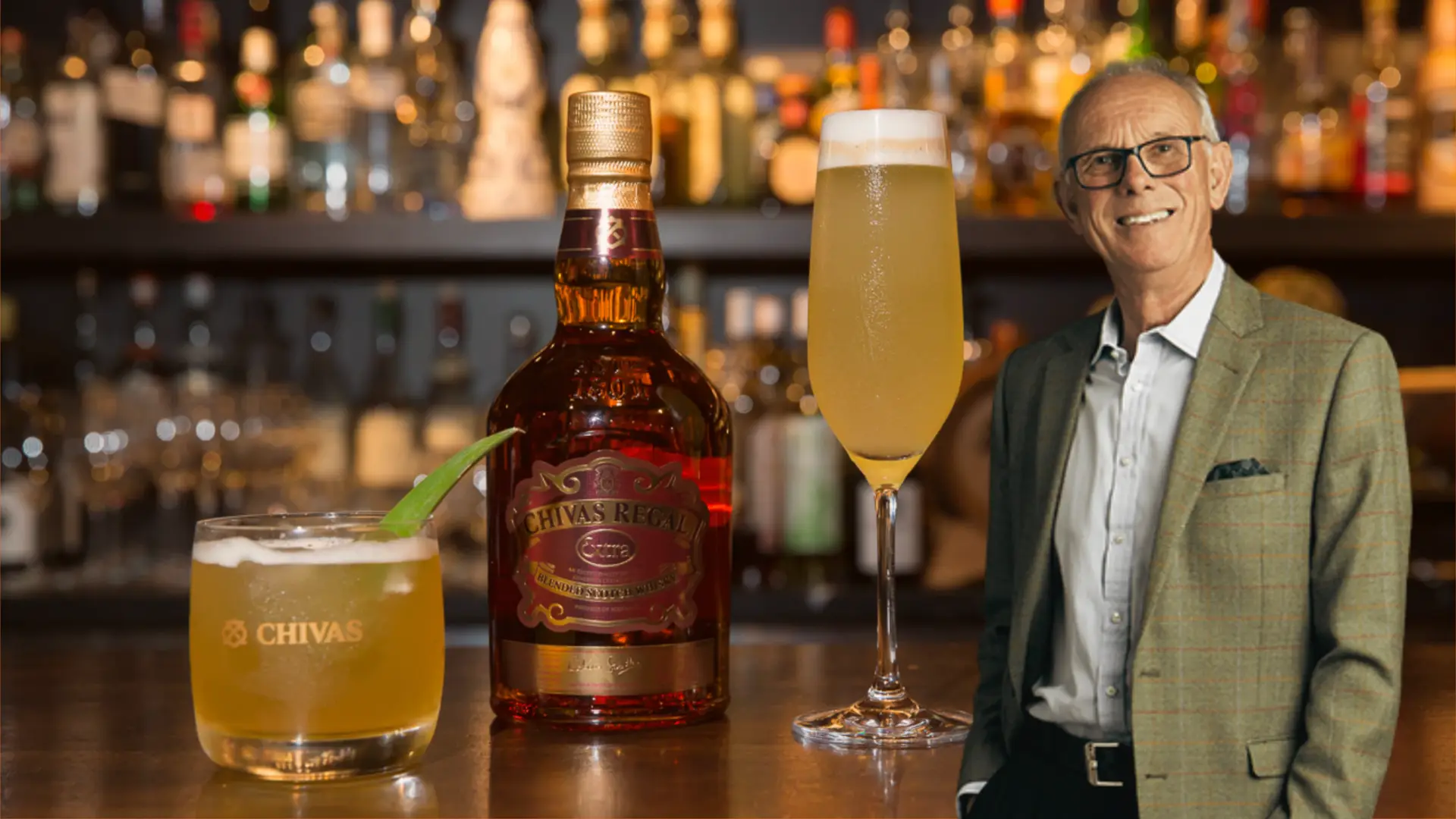
Blending rarely announces itself. It does not produce singular moments that can be isolated and attributed. Its influence accumulates quietly, across batches, across years, across shifts in production and demand. In Scotch whisky, few careers reflect that sustained discipline more clearly than that of Colin Scott.
When Scott joined Chivas Brothers in 1973, he entered a system already built on consistency. Over the next 47 years, he would help maintain that system at scale, eventually becoming Custodian Master Blender for Chivas Regal. His role was not to redefine the whisky, but to ensure that it remained recognisable across generations of drinkers.
By the time he stepped down in July 2020, the work had become inseparable from the brand itself.
Learning a system rather than creating one
Scott’s early years were shaped within a framework where progression depended on repetition and calibration. Training involved extended exposure to distillation, maturation, and most critically, sensory evaluation.
At Strathisla Distillery, the heart of Chivas Regal, he worked with a spirit that defines the blend’s structure. Orchard fruit, honeyed sweetness, and a balanced oak profile form the base from which the blend is built.
Development as a blender meant understanding how this core interacted with grain whisky from sites such as Strathclyde Distillery and with additional malt components sourced across Speyside. The process was not about invention. It was about alignment.
Sensory memory and the discipline of repetition
The phrase often attached to Scott is “the nose,” but the role extends beyond sensory ability. It depends on maintaining a stable reference point over time. Each batch of Chivas Regal 12 Year Old, Chivas Regal 18 Year Old, and later Chivas Regal 25 Year Old must reflect the same underlying profile, regardless of variation in cask conditions or ageing environments. This requires a combination of memory and system.
Cask records, maturation tracking, and blending protocols support decisions, but the final calibration remains sensory. The blender adjusts components until the whisky aligns with an established standard. Over the decades, this process becomes cumulative. The reference point is not static. It is maintained.
Scaling consistency across global demand
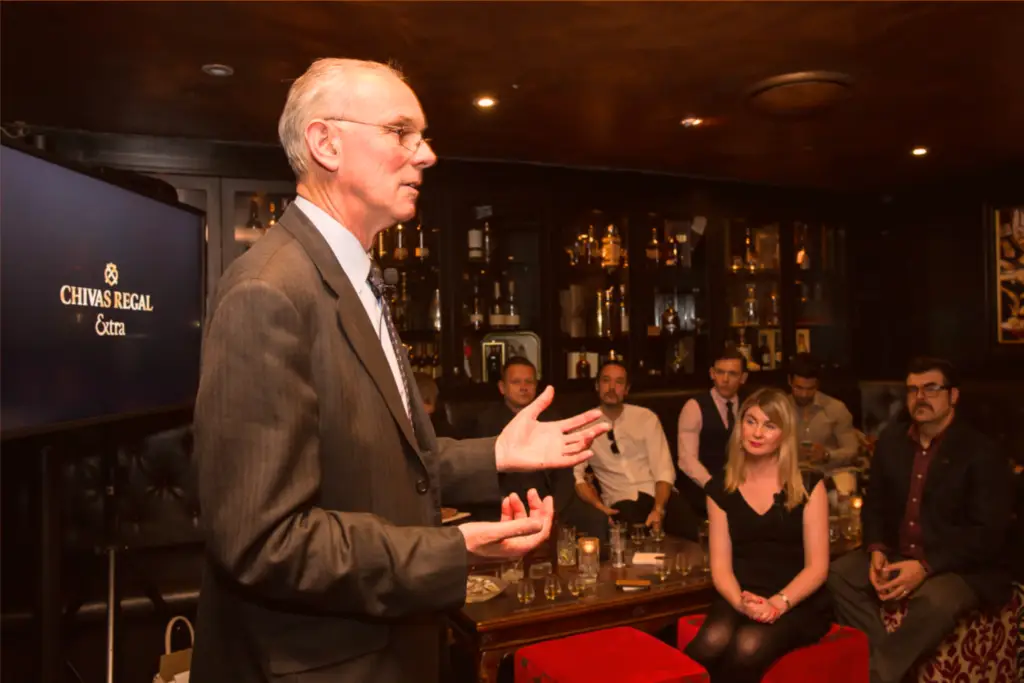
During Scott’s tenure, Chivas Regal expanded into a global brand. Increased demand required larger volumes of whisky, more extensive cask inventories, and tighter control over production variables. Scaling does not simplify blending. It introduces additional complexity. More casks must be assessed, more variations must be balanced, and the margin for deviation becomes narrower.
The challenge lies in ensuring that growth does not alter identity. Scott’s work ensured that expansion remained aligned with the original profile, even as production increased significantly.
2020 and the shift from volume to rarity
Scott’s retirement from Chivas Brothers in July 2020 marked the end of a career defined by scale and consistency. What followed was not a complete departure from blending, but a shift in context.
In September 2020, he joined The Last Drop Distillers as Master Blender. The environment here differs fundamentally from his previous role. Instead of managing large-scale production, the focus is on ultra-rare, limited releases, often built from long-aged or previously overlooked casks.
One example of this approach is his 50-Year-Old Signature Blend, a whisky constructed from mature stocks where availability is defined by rarity rather than demand. The work changes accordingly. Decisions are no longer driven by consistency across millions of bottles, but by the singular character of individual casks.
The Assembly and cross-category knowledge
Alongside his role at The Last Drop Distillers, Scott became a founding member of The Assembly, an independent group of specialists brought together to share expertise across categories including whisky, Cognac, and rum.
This shift expands the scope of blending beyond Scotch whisky alone. It introduces comparative evaluation, where techniques and perspectives from different spirit traditions inform decision-making. The structure reflects a different stage of a career. Less focused on maintaining a single house style, more oriented toward interpreting rare and diverse material.
From system to selection
The contrast between Scott’s two phases of work is structural. At Chivas Regal, blending operates within a fixed system designed for continuity. At The Last Drop Distillers, blending begins with what exists, often in limited quantity, and builds outward. In one, the objective is replication. In the other, it is an interpretation.
Both require the same foundation: sensory discipline, understanding of maturation, and the ability to balance components. The difference lies in scale and constraint.
Colin Scott’s career illustrates two distinct models of blending. The first, defined by consistency across decades, demonstrates how identity is maintained within a global system. The second, focused on rare and aged spirits, shows how that same expertise can be applied under entirely different conditions.
What connects both is not the scale of production, but the discipline behind it. Blending, whether for millions of bottles or a single release, depends on the ability to align variables into a coherent result. In this sense, the work does not change. Only the context does.

Distillery
Chivas Brothers - Kilmalid Distillery
Chivas Brothers - Kilmalid Distillery is a significant player in the realm of Scotch whisky, renowned for its…
Distillery
The Last Drop Distillers, founded in 2008, has carved a niche in the world of luxury spirits, focusing…
Distillery
Strathisla Distillery & Home of Chivas
Strathisla Distillery, nestled in the iconic Speyside region of Scotland, stands as a pillar of tradition and craftsmanship…
Spirit
Chivas Regal 18 YO Blended Scotch Whisky
Chivas Regal 18 Year Old is a blended Scotch whisky that showcases the perfection of craft and the…
Spirit
Chivas Regal 12 YO Blended Scotch Whisky
Chivas 12 Year Old Blended Scotch Whisky represents a fusion of tradition and craftsmanship, harmonizing a blend of…
Spirit
Chivas Regal 25 YO Blended Scotch whisky
Chivas Regal 25 Year Old is a prestigious blended Scotch whisky that stands as a symbol of luxury…
Partnership
Guadeloupe Rhum Agricole: Exploring the French Caribbean’s Diverse Cane Spirit Tradition
Guadeloupe Rhum Agricole follows a broader path than the agricole tradition of neighbouring Martinique. Both territories belong to the French Caribbean and share a long relationship with fresh sugarcane juice, yet Guadeloupe rhum agricole developed within an archipelago where more than one rum production tradition has endured. Across volcanic Basse-Terre, limestone Grande-Terre and the distinctive […]
September 4, 2026

Distilleries & Producers
Roseisle Distillery: The High-Tech Speyside Giant Behind a New Generation of Whisky
In Speyside, where whisky is often associated with generations of tradition, Roseisle Distillery represents something very different. Built by Diageo near Elgin and officially opened in 2010, Roseisle was designed as a modern, large-scale malt whisky distillery, combining traditional pot-still production with advanced engineering, energy recovery and unusual flexibility in how its spirit can be […]
September 2, 2026
Interviews & Insights
Elmer T. Lee: The Master Who Revived Bourbon’s Soul
In 1949, a young Elmer T. Lee walked into the George T. Stagg Distillery in Frankfort, Kentucky, looking for a job. He had recently returned from the Second World War, where he had served as a radar bombardier aboard a B-29, and had graduated with honours in electrical engineering from the University of Kentucky. The […]
August 5, 2026