
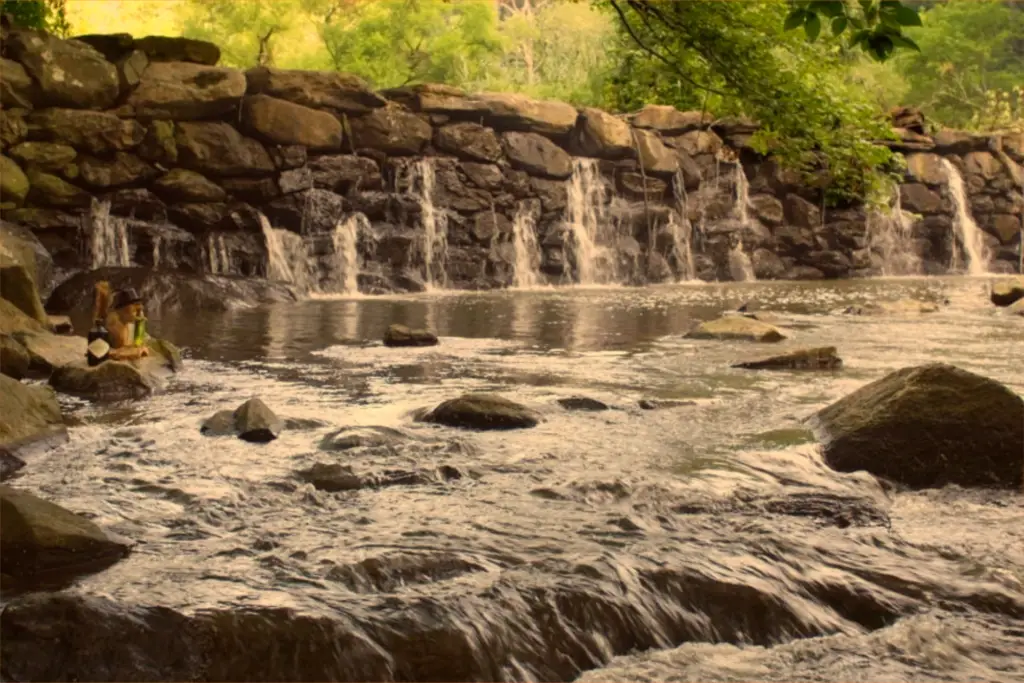
Long before a spirit carries a name, an age statement, or a cask history, it exists as water moving through rock. In the Livet Valley in Speyside, that movement defines the beginning of one of Scotch whisky’s most consistent production systems.
The Glenlivet distillery primarily uses water from Josie’s Well for its whisky production. While Speyside Glenlivet was once a known brand of bottled mineral water sourced from the same estate, its bottling operations ceased around 2020. For the best tasting experience, The Glenlivet recommends adding a few drops of room-temperature, low-mineral water to your whisky to open up its aromas.
When George Smith licensed The Glenlivet in 1824, the decision secured legal status, but it also fixed the distillery to a specific water source. Springs rising through sandstone and granite in the surrounding hills delivered water that was naturally filtered, low in iron, and stable across seasons. In a period when fermentation was conducted in wooden vessels and yeast control was limited, this stability was not incidental. It was operational.
What followed, over nearly two centuries, was a production system in which water became a constant against which all other variables were measured.
Mineral Balance and the Predictability of Fermentation
Fermentation is often described as biological, but in distillation, it is equally chemical. The mineral composition of water influences enzyme activity during mashing and yeast metabolism during fermentation.
The Glenlivet’s spring water contains moderate levels of calcium and magnesium, both of which support the enzymatic breakdown of starch into fermentable sugars. Calcium stabilizes mash pH and enhances enzyme efficiency, while magnesium contributes to yeast health in controlled amounts. Critically, the water is low in iron, a mineral that can inhibit yeast activity and introduce metallic off-notes if present in excess.
In practical terms, this creates a predictable fermentation environment. Wash produced from the same water source behaves consistently across batches, allowing distillers to maintain control over alcohol yield and the formation of secondary compounds.
This consistency underpins the style found in expressions such as The Glenlivet 12 Year Old, where the resulting spirit presents a clean structure with restrained fruit and balanced sweetness. The clarity of that profile begins not in the cask, but in fermentation stability.
Mash Conversion and Extraction Control
Before yeast is introduced, water interacts with milled barley during mashing. The objective is precise. Extract fermentable sugars without over-extracting tannins from the husk.
Water with balanced mineral content supports this process. At The Glenlivet, the spring water allows efficient starch conversion while maintaining a controlled extraction rate. In 19th -century practice, this was not measured analytically, but observed through yield and repeatability. Distillers learned that certain water sources produced consistent wort, while others introduced variation.
This early empirical understanding continues to shape modern production. Even with laboratory analysis, distilleries rarely change water sources once a system is established. The risk of altering fermentation behavior is too great.
Wooden Washbacks and Microbial Equilibrium
Fermentation at The Glenlivet historically took place in wooden washbacks, a practice that continues alongside modern materials. These vessels introduce a secondary layer of complexity, as they host residual microbial populations in addition to cultivated yeast.
Water quality plays a stabilizing role within this environment. Clean, low-contaminant water reduces the risk of unwanted bacterial activity, allowing fermentation to proceed over controlled durations, typically between 48 and 72 hours.
This balance contributes to the formation of esters and light fruit compounds that define the distillery’s character. In expressions such as The Glenlivet 15 Year Old French Oak Reserve, these early fermentation-derived compounds evolve through maturation into subtle orchard fruit and spice notes. The connection is indirect but continuous. Fermentation stability influences maturation potential.
Comparison Within Speyside Systems
Across Speyside, distilleries operate under similar climatic conditions but with distinct water sources. At The Macallan, water drawn from local springs supports a production system focused on richness and structure, later amplified through sherry cask maturation. At Glenfiddich, the Robbie Dhu springs provide consistent water input that supports a lighter, fruit-forward spirit style.
These differences are not directly perceptible in water itself. They emerge through fermentation behavior and subsequent distillation. Water does not define flavor in isolation, but it defines the conditions under which flavor is created.
The Glenlivet’s profile, evident in expressions such as The Glenlivet 18 Year Old, reflects this system. A balance of citrus, honey, and soft oak that begins with controlled fermentation rather than expressive raw material.
Continuity as a Production Decision
Modern distilleries possess the technical ability to adjust water composition through filtration or mineral correction. Yet many, including The Glenlivet, maintain sources. The reason lies in continuity.
Changing water alters fermentation dynamics. It introduces a new variable into a system built on long-term consistency. For distilleries producing spirit intended to mature for decades, even small changes at the start of production can have amplified effects over time. Water, once established, becomes part of the distillery’s identity.
Spring water at The Glenlivet is not presented as heritage. It functions as a structure. Its mineral composition supports enzymatic conversion, stabilizes yeast activity, and maintains predictable fermentation across production cycles.
In a category where maturation often dominates discussion, the role of water remains less visible. Yet without controlled fermentation, consistency in the final whisky would not be possible. Every expression, from The Glenlivet 12 Year Old to older releases, carries this foundation, not as a flavor, but as a system that allows flavor to develop without disruption. Whisky begins with grain and yeast, but it stabilizes with water.


Distillery
The Glenlivet Distillery is an iconic Scottish whisky producer situated in the picturesque region of Speyside, near Ballindalloch…

Spirit
The Glenlivet 18 YO Single Malt Scotch Whisky
The Glenlivet 18 Year Old Single Malt Scotch Whisky is a distinguished expression from the iconic Glenlivet distillery,…

Spirit
The Glenlivet 12 YO Single Malt Scotch Whisky
The Glenlivet 12 Year Old Single Malt Scotch Whisky stands as a beacon of the craftsmanship and elegance…
Spirit
The Glenlivet 12 YO Excellence Single Malt Scotch Whisky
The Glenlivet 12 YO Excellence is a distinguished single malt Scotch whisky that embodies the essence of traditional…
Spirit
The Glenlivet 15 YO French Oak Reserve Single Malt Scotch Whisky
Glenlivet 15 Year Old French Oak Reserve is a distinguished single malt Scotch whisky celebrated for its craftsmanship…
Partnership
Guadeloupe Rhum Agricole: Exploring the French Caribbean’s Diverse Cane Spirit Tradition
Guadeloupe Rhum Agricole follows a broader path than the agricole tradition of neighbouring Martinique. Both territories belong to the French Caribbean and share a long relationship with fresh sugarcane juice, yet Guadeloupe rhum agricole developed within an archipelago where more than one rum production tradition has endured. Across volcanic Basse-Terre, limestone Grande-Terre and the distinctive […]
September 4, 2026

Distilleries & Producers
Roseisle Distillery: The High-Tech Speyside Giant Behind a New Generation of Whisky
In Speyside, where whisky is often associated with generations of tradition, Roseisle Distillery represents something very different. Built by Diageo near Elgin and officially opened in 2010, Roseisle was designed as a modern, large-scale malt whisky distillery, combining traditional pot-still production with advanced engineering, energy recovery and unusual flexibility in how its spirit can be […]
September 2, 2026
Interviews & Insights
Elmer T. Lee: The Master Who Revived Bourbon’s Soul
In 1949, a young Elmer T. Lee walked into the George T. Stagg Distillery in Frankfort, Kentucky, looking for a job. He had recently returned from the Second World War, where he had served as a radar bombardier aboard a B-29, and had graduated with honours in electrical engineering from the University of Kentucky. The […]
August 5, 2026