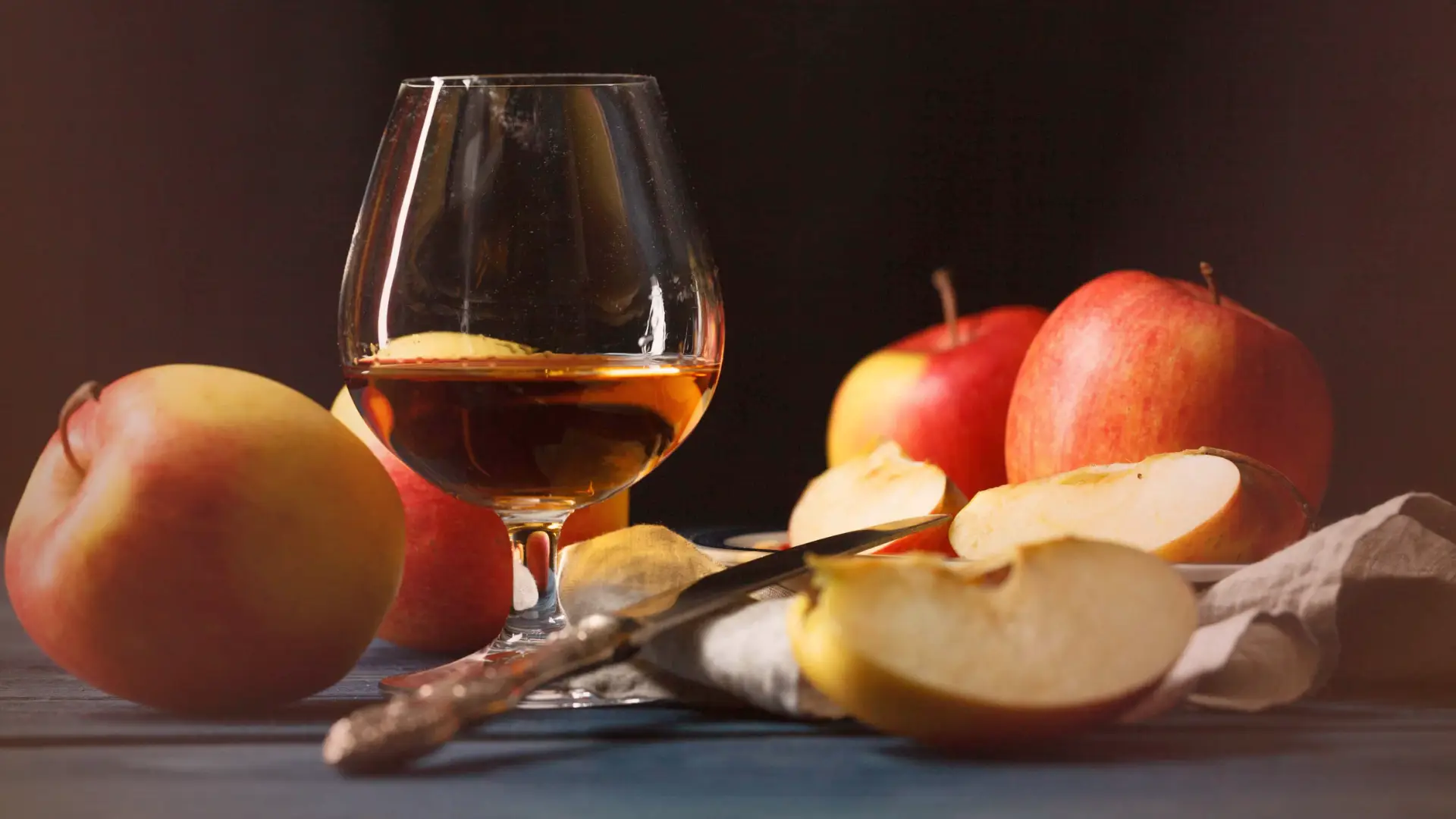
Normandy’s orchards gave Calvados its meaning before law gave it protection. In this part of northern France, apples and pears were not minor crops. They shaped farm landscapes, hedgerows, local drinks, rural economies, and the way agricultural value moved from fruit to cider, then from cider to spirit.
Calvados belongs to that orchard world. Its identity is not built around a single distillery or one famous village. It comes from cider apples, perry pears, Norman climate, fermentation, distillation, oak ageing, and a legal framework that keeps the name attached to a defined production system.
Today, Calvados is protected as an Appellation d’Origine Contrôlée. The general AOC sits alongside Pays d’Auge and Calvados Domfrontais, which have their own specific rules and will be treated separately. The general appellation remains the broad foundation of the category, linking much of Normandy’s orchard heritage to a controlled fruit spirit.
From Cider Country to Protected Name
The modern legal system came much later. Calvados Pays d’Auge received AOC recognition in 1942, while the broader Calvados AOC was established in 1984. Calvados Domfrontais was recognised as a separate AOC in 1997. Together, these three appellations form the protected Calvados family.
The general Calvados AOC is important because it covers the widest part of the system. It protects the name Calvados for eaux de vie made from cider, perry, or cider and perry, produced under defined rules and aged in oak.
This legal protection matters because Calvados is not simply any apple brandy. A fruit spirit made elsewhere from apples may share a broad raw material idea, but it cannot use the protected name unless it follows the appellation requirements.
The AOC turns a regional agricultural practice into a controlled origin system. It defines where the fruit must come from, where the cider or perry must be made, where distillation must occur, and where the spirit must age.
A Large Norman Territory With Orchard Logic
The Calvados AOC extends across a large part of Lower Normandy and includes bordering areas where orchard culture has historical and agricultural continuity. The production area includes the department of Calvados and significant areas of Manche and Orne, with defined communes in neighbouring departments.
This wide geography reflects the reality of Norman fruit production. It is not the spirit of one valley only. It is tied to a broader orchard zone shaped by oceanic climate, steady rainfall, moderate temperature variation, bocage landscapes, and soils suited to cider apples and perry pears.
The AOC specification connects the appellation to areas where orchard systems remained historically important. This is why the geography must be understood through agriculture rather than administrative convenience. The legal map follows the persistence of fruit growing, cider making, and distillation culture.
Fruit Chosen for Fermentation
Calvados begins with fruit, but not ordinary dessert fruit. The apples and pears used for cider and perry are selected for fermentation. They include bitter, bittersweet, sweet, sharp, and bitter-sharp profiles that contribute tannin, acidity, sugar, and aromatic balance.
The general AOC allows the use of cider apples and perry pears from recognised varieties. The specification also protects the role of traditional orchards. A minimum share of the fruit used must come from high-stem orchards, and the orchards must include a strong proportion of phenolic apple varieties.
This orchard requirement is essential. It keeps Calvados connected to a particular agricultural landscape, not only to industrial fruit supply. High stem orchards are part of Normandy’s visual and ecological identity. They also reflect older forms of fruit growing where trees, pasture, and mixed farming coexisted.
The fruit therefore does more than provide sugar. It connects the spirit to rural land use, biodiversity, and inherited agricultural practice.
Cider and Perry as the Base of the Spirit
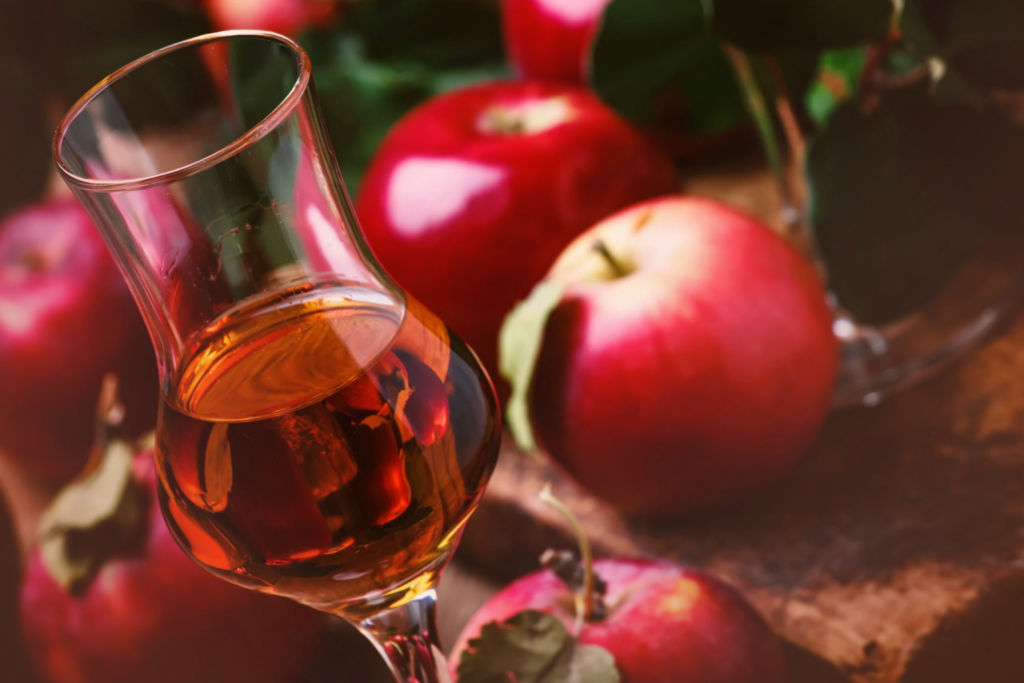
Calvados is made from cider, perry, or a combination of cider and perry. The fruit must first become a fermented drink before it can become eau de vie. This places Calvados inside a cider culture as much as a distilling culture.
The fermentation stage is important because the character of the future spirit depends on the fruit, the balance of varieties, the maturity of the harvest, and the quality of the cider or perry. Calvados is not distilled from neutral sugar wash. It is distilled from fermented fruit material carrying the aromatic identity of Normandy’s orchards.
The legal system protects this link by requiring fruit production and harvest, cider and perry elaboration, distillation, and ageing to occur within the defined area. The chain of production is therefore local from orchard to cask.
Copper, Distillation, and Fruit Character
The Calvados AOC requires distillation using copper apparatus. The spirit must be distilled at a strength no higher than 72 per cent ABV. This limit helps preserve volatile compounds and fruit character rather than pushing the distillate toward neutrality.
Unlike Calvados Pays d’Auge, where pot still double distillation is mandatory, the general Calvados AOC does not impose one single distillation method. It is commonly associated with continuous column distillation, although other permitted copper distillation systems may also be used when they comply with the specification.
The technical point is clear. Calvados must remain a fruit eau de vie with recognisable orchard origin. Its distillation rules protect aromatic character rather than permitting a neutral spirit identity.
Oak and the Minimum Age of Calvados
Calvados intended for direct consumption must be aged in oak for at least 2 years. This is one of the key figures Alexandre asked to include, and it belongs clearly in the article.
Ageing changes the spirit without erasing its fruit base. In oak, the eau de vie gains colour, texture, spice, and depth while retaining the memory of apple and pear. The Norman cellar environment, with humidity and a moderate climate, contributes to this evolution.
The AOC specification sets the minimum legal ageing period, but many producers age it for longer. The protected system does not require every bottle to taste the same. It requires that the spirit pass through a controlled relationship between fruit, distillation, oak, and time.
Calvados must also be bottled at a minimum strength of 40 per cent ABV. This gives the final product a clear legal floor for market presentation.
Age Language and Label Meaning
Calvados age indications are regulated. VS, three stars, or three apples refer to eaux de vie aged for at least 2 years. Vieux or Réserve indicates at least 3 years. VO, Vieille Réserve, or VSOP indicates at least 4 years. XO, Hors d’Age, Très Vieux, Extra, Très Vieille Réserve, or Napoléon indicates at least 6 years.
These terms help protect the language of maturity. They do not describe every difference between producers, orchards, or cask histories, but they prevent vague ageing claims from replacing legal meaning.
The rule also reinforces one of the central ideas of Calvados. The appellation does not protect only the origin of fruit. It protects the transformation of that fruit into a spirit whose maturity can be verified.
Three AOCs, One Orchard Family
The general Calvados AOC should be understood within a larger family of three protected appellations. Calvados Pays d’Auge and Calvados Domfrontais are not casual subregions. They are separate AOCs with additional requirements.
Pays d’Auge is closely associated with clay-limestone slopes, a stronger requirement for high-stem orchard fruit, and mandatory pot still distillation. Domfrontais is marked by a major role for perry pears and a longer minimum ageing period of 3 years.
These systems deserve their own articles because their rules and landscapes are distinct. In this general article, their importance is to show that Calvados is not a single flat category. It is a family of protected orchard spirits, organised through French appellation law.
INAO, IDAC, and Appellation Control
The Calvados AOC is governed through the French origin and quality system overseen by the Institut National de l’Origine et de la Qualité. The Interprofession des Appellations Cidricoles represents and supports the cider-based controlled appellations sector, including Calvados, Pommeau, ciders, and perries.
This institutional structure matters because the name Calvados has economic and cultural value. Legal control prevents the name from becoming detached from Normandy’s fruit, cider, distillation, and ageing systems.
The appellation defines the production area, fruit requirements, cider and perry preparation, distillation rules, ageing conditions, labelling terms, and minimum strength. It turns orchard heritage into an accountable legal system.
A Protected Spirit Written by Orchards
Calvados is one of the clearest examples of a spirit whose identity begins in fruit trees rather than grain, cane, or grapes. Its appellation protects a Norman system where apples and pears move from orchard to cider or perry, from fermentation to distillation, and from oak ageing to a legally recognised spirit.
The category matters because it shows how rural orchard culture can become a protected production system. The law does not invent Calvados. It gives legal form to a landscape that had already learned how to turn fruit into value, memory, and regional identity.
It remains meaningful because the name still points back to Normandy’s orchards, and to the controlled chain of production that allows those orchards to become spirit.

Renowned freelance spirits consultant, award-winning author, and international spirits judge, recognized globally as a leading authority on spirits selection, historical distillates, and market innovation.

Spirit
Eau de vie de Poires Michel Gillet Redu
Eau de Vie de Poires Michel Gillet is an exquisite representation of artisanal pear brandy, crafted in the…

Spirit
Le Calvados AOC Busnel 32 ans est un excellent exemple du savoir-faire exceptionnel de la Distillerie Busnel, qui…
Spirit
Calvados AOC Rare 20 ans BUSNEL - Carafe
Calvados AOC Rare 20 ans BUSNEL is a distinguished apple brandy that embodies the rich heritage of the…
Spirit
Calvados 1963 Domfrontais 63 YO Asta Maurice
Calvados 1963 Domfrontais 63 YO Asta Maurice is a remarkable expression of the age, terroir, and traditional craftsmanship…
Spirit
Calvados Ambre 14 YO Rhum Agricole
Ambre 14 ans Rhum Agricole is a remarkable representation of artisanal rhum crafted from sugarcane juice. Its unique…
Spirit
Lecompte Calvados Pays d'Auge 5 YO French Apple brandy
LeCompte 5 YO Calvados is a premier spirit originating from the Pays d'Auge region of Normandy, France, renowned…
Partnership
Armagnac: The Oldest French Brandy Defined by Region and Continuous Distillation
In Gascony, wine and distillation developed together long before Armagnac became a protected name. The region was rural, mixed, and agricultural, shaped by vines, forests, cereals, livestock, local markets, and routes that connected inland producers with wider trade. Distilling wine gave this landscape a durable product that could travel, age, and carry value beyond the […]
August 9, 2026
Partnership

Pisco: A Spirit Claimed by Two Nations
Pisco is one of the few spirits whose identity is divided by national borders rather than defined by them. Both Peru and Chile claim pisco as a national spirit, each supported by legal frameworks, historical narratives, and active production. This dual claim is not a modern branding dispute. It is the outcome of colonial administration, […]
October 7, 2026
Partnership
Singani: Bolivia’s High-Altitude Spirit and a Forgotten Andean Heritage
Singani is one of the least understood legally protected spirits in the world. Despite centuries of continuous production in Bolivia, it remains largely absent from global spirits discourse. This absence is not due to ambiguity or lack of definition. Singani is one of the most tightly structured grape distillates in existence, defined by altitude, grape […]
September 30, 2026