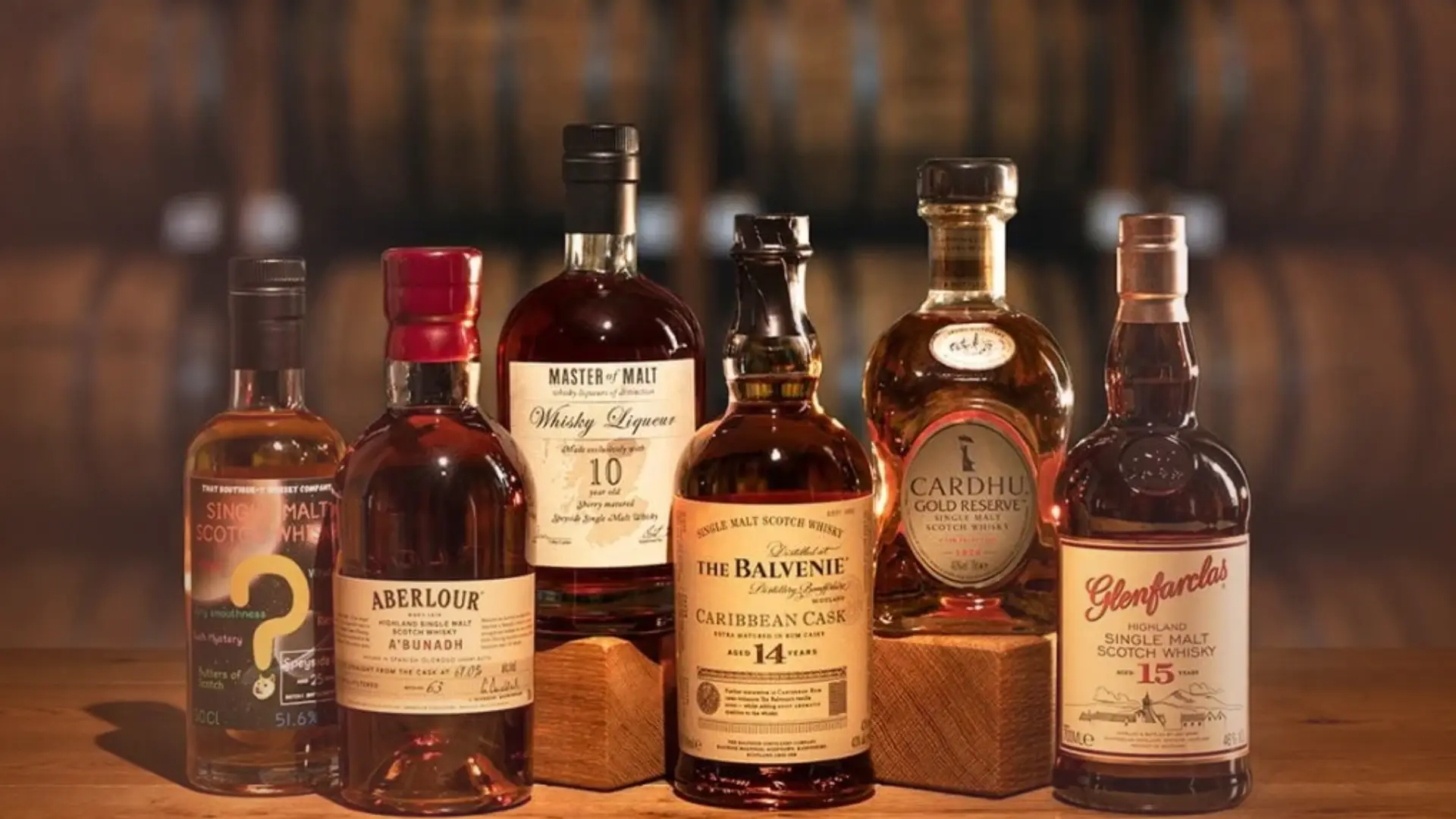
Scotch whiskies collection is no longer simply about finding the oldest bottle or the most expensive name. A serious collection should tell a story about the spirit itself: where it comes from, how it is made, how oak changes it, how peat shapes it and why particular distilleries have earned lasting reputations.
That makes choosing ten bottles surprisingly difficult. Scotland has more than 150 Scotch whisky distilleries, and single malt alone encompasses an extraordinary range of production methods, regional characters and house styles. Under the legal definition, Scotch must be distilled and matured in Scotland for at least three years, while single malt must be produced at one distillery from malted barley and distilled in copper pot stills.
The following ten expressions are therefore not presented as a definitive ranking of Scotland’s finest whiskies. They are a collector’s working library: bottles that represent important styles, distilleries and ideas, while remaining relevant to the way enthusiasts understand Scotch in 2026.
The Bottles That Define the Modern Collector’s Shelf
1. The Macallan Sherry Oak 18 Years Old
Few names demonstrate the relationship between Scotch whisky, oak and luxury quite as clearly as The Macallan. Its Sherry Oak 18 Years Old remains one of the most recognisable mature single malts in the category, and the 2026 release continues the distillery’s annual series.
The whisky is matured for a minimum of 18 years in predominantly sherry-seasoned European oak casks sourced from Jerez, giving it the dried-fruit, ginger, dark-chocolate and oak-spice character associated with the Sherry Oak style. The Macallan also places considerable emphasis on the provenance of its wood, its Speyside estate and the distinctive shape of its small stills.
For a collector, its importance extends beyond flavour. The Macallan has become one of the clearest examples of how provenance, presentation, cask management and scarcity can influence the cultural and commercial status of Scotch.
A bottle of The Macallan Sherry Oak 18 Years Old therefore represents more than an aged single malt. It represents one of the defining models of modern Scotch luxury.
Why It Belongs in a Collection
The Macallan 18 is particularly useful for understanding sherry-seasoned oak and the role of mature European oak in Scotch whisky. Its annual releases also create a natural collecting trail, allowing enthusiasts to compare different vintages and release years rather than treating the expression as a single static product.
2. Springbank 15 Years Old
If The Macallan demonstrates the power of global luxury branding, Springbank represents almost the opposite philosophy. The Campbeltown distillery remains one of Scotland’s most closely watched independent whisky producers, with a production model built around unusually high levels of on-site control.
Springbank states that it is the only distillery in Scotland to carry out 100 per cent of its production process on one site. The distillery has been making Springbank since 1828, and its distinctive production includes lightly peated barley and a unique two-and-a-half-times distillation process.
The result is a style that sits comfortably outside simple regional stereotypes. Springbank can show maritime, mineral, fruity, oily and lightly smoky characteristics without becoming defined by one flavour alone. For collectors, that combination of heritage, independence, limited availability and distinctive production philosophy makes Springbank particularly significant.
Why It Belongs in a Collection
Springbank demonstrates why the production method matters. It also gives a collection a bottle from Campbeltown, a historic whisky region whose modern identity is closely tied to a small number of surviving distilleries.
3. Lagavulin 16 Years Old
A serious Scotch collection needs to explain peat, and Lagavulin 16 Years Old remains one of the clearest benchmarks.
Produced on Islay, Lagavulin 16 combines intense peat smoke with seaweed, salt, oak and underlying sweetness. The official profile describes it as a benchmark Islay dram, matured in oak for at least 16 years. It has also continued to receive recognition in major spirits competitions, including Gold medals at the San Francisco World Spirits Competition and New York International Spirits Competition in 2025.
Its importance is partly historical. Lagavulin traces its origins to the eighteenth century, while the distillery’s modern reputation was strongly shaped by Peter Mackie from the late nineteenth century onwards. The whisky demonstrates how peat can be powerful without becoming one-dimensional. Smoke is only one part of the structure. The interaction between peat, coastal character, oak and sweetness is what gives Lagavulin its enduring identity.
Why It Belongs in a Collection
Lagavulin 16 is one of the best reference points for understanding mature, heavily peated Islay single malt. It also provides a useful benchmark against which other smoky whiskies can be tasted.
4. Ardbeg Uigeadail
Where Lagavulin demonstrates the classic mature Islay style, Ardbeg Uigeadail shows how peat can be combined with cask influence and high strength to produce something more intense and concentrated.
Named after Loch Uigeadail, the water source associated with the distillery, the whisky combines spirit matured in ex-bourbon and ex-Oloroso sherry casks. It is bottled at 54.2% ABV and is non-chill-filtered. Ardbeg describes the expression as a combination of deep smoke, sweetness, spice and rich dried-fruit character.
That makes Uigeadail particularly interesting for collectors because it demonstrates the importance of cask composition alongside peat intensity. The whisky is not simply a stronger version of a conventional smoky malt.
It is a study in contrast. Smoke and sweetness are deliberately placed alongside one another, with sherry-seasoned casks adding another layer to the heavily peated spirit.
Why It Belongs in a Collection
Ardbeg Uigeadail is a useful benchmark for high-strength Islay whisky and for understanding how peat, cask type and maturation can interact. It also shows why non-chill filtration and higher bottling strength can matter to enthusiasts interested in texture and intensity.
5. Laphroaig 10 Years Old
No serious discussion of Scotch collecting can ignore Laphroaig. Its 10 Year Old is one of the most distinctive expressions in the category, particularly because of its combination of peat smoke, medicinal character, maritime influence and sweetness.
The whisky is made from malted barley cold-smoked over peat fires and matured for ten years in ex-bourbon casks. Laphroaig describes the resulting spirit through notes of peat smoke, seaweed, vanilla, oak spice and sweetness.
Its importance lies in how clearly it expresses the personality of its home on Islay. Laphroaig does not attempt to make peat anonymous. The smoke, coastal character and distinctive medicinal notes are central to the identity. For a collector, that makes it an essential reference bottle rather than merely another smoky whisky.
Why It Belongs in a Collection
Laphroaig 10 gives enthusiasts a clear example of a strongly peated Islay style. Tasting it beside Lagavulin 16 and Ardbeg Uigeadail can reveal how three distilleries on the same island can produce remarkably different interpretations of peat.
6. Talisker 18 Years Old
Talisker 18 Years Old brings another dimension to a Scotch collection: maritime whisky from the Isle of Skye.
Talisker has been made by the sea since 1830, and the distillery’s official profile emphasises the connection between the whisky and its rugged coastal setting. The 18 Year Old combines rich fruit, sweetness and smoke, with notes including plum, orange peel, toffee and a restrained thread of smoke.
It occupies an interesting position between the richer fruit-driven character of some Highland and Speyside malts and the more aggressively peated styles associated with Islay.
That makes it especially valuable in a collection built around comparison. Talisker demonstrates that maritime character does not have to mean overwhelming peat. Smoke can be integrated into a whisky whose structure remains fruity, warming and comparatively elegant.
Why It Belongs in a Collection
Talisker 18 represents Skye and provides a useful bridge between heavily peated island whiskies and richer, more fruit-driven mature single malts.
7. Highland Park 18 Years Old
From Orkney comes Highland Park 18 Years Old, a whisky whose identity combines island character, peat and mature fruit.
The current 18 Year Old is bottled at 43% ABV and is described by Highland Park through flavours including baked cherries, dark chocolate, salted honeycomb, orange zest and heathered peat smoke. The distillery also highlights its natural colour and layered character.
Highland Park is particularly useful for collectors because it demonstrates how peat does not necessarily need to dominate a whisky. Orkney’s character is expressed through a more integrated relationship between smoke, fruit, sweetness and oak.
The result is a whisky that sits comfortably between styles. It is smoky enough to belong in a collection exploring peat, yet sufficiently fruit-driven and rounded to show how island whisky can differ from the more intense expressions of Islay.
Why It Belongs in a Collection
Highland Park 18 adds Orkney to the geographical story of a Scotch collection while providing another interpretation of lightly integrated island peat.
8. The Balvenie PortWood 21 Years Old
The story of modern Scotch maturation cannot be told without discussing cask finishing, and The Balvenie PortWood 21 Years Old is one of the most important examples.
The whisky is first matured in traditional oak before being transferred to port casks for a second period of ageing. The Balvenie credits former Malt Master David C. Stewart MBE with pioneering the cask-finishing technique used for PortWood, which was first released in 1996.
The result combines fruit, honey and spice with the additional influence of port casks. It demonstrates how a second maturation stage can alter a mature spirit without completely obscuring its original character.
For collectors, this is historically significant because cask finishing has become one of the defining areas of experimentation in modern Scotch.
Why It Belongs in a Collection
The Balvenie PortWood 21 offers an excellent way to understand the development of secondary maturation and the influence of fortified-wine casks on single malt.
9. Glenmorangie Signet
Glenmorangie Signet occupies a different place on the collector’s shelf because its importance comes from experimentation rather than simply age.
The expression was developed by Dr Bill Lumsden, Glenmorangie’s Director of Whisky Creation, after the idea was inspired by the flavours of Jamaican Blue Mountain coffee. Signet uses a chocolate malt spirit produced only once a year, alongside whisky matured in bourbon, sherry and virgin charred oak casks and older stocks from the distillery. It is bottled at 46% ABV.
The resulting profile moves towards espresso, mocha, dark chocolate, spice and butterscotch rather than relying on the traditional fruit-and-vanilla vocabulary associated with many Highland single malts.
For collectors, Signet demonstrates that innovation in Scotch does not always require extreme age or rare casks. A producer can create a distinctive expression by changing the relationship between malt, distillation, cask selection and flavour design.
Why It Belongs in a Collection
Glenmorangie Signet represents the experimental side of modern Scotch and provides a useful contrast with traditional sherry-led and peat-led expressions.
10. The Macallan Sherry Oak 25 Years Old
If the Macallan 18 demonstrates mature sherry-seasoned oak within the modern collector’s market, the Macallan Sherry Oak 25 Years Old shows how the same philosophy develops over a longer maturation period.
The current Sherry Oak Collection includes 25 Years Old alongside the 12, 18 and 30 Year Old expressions. The collection is built around predominantly sherry-seasoned European oak casks from Jerez, with the distillery emphasising the way those casks shape the rich, dried-fruit and spice-led character of the whisky.
The 25 Year Old also illustrates why age alone should not be treated as a simple measure of quality. Longer maturation can deepen the relationship between spirit and oak, but the result depends on cask quality, warehouse conditions, the character of the new make and the balance achieved over time.
For a collector, the bottle is therefore useful not merely because it is older than the 18 Year Old, but because it allows the progression of a single maturation philosophy to be studied at a different point in time.
Why It Belongs in a Collection
The Macallan Sherry Oak 25 allows collectors to explore how extended maturation changes a sherry-led Speyside single malt while also illustrating the importance of cask provenance in premium Scotch.
Ten Bottles, Ten Different Lessons
A collection built from these ten whiskies would reveal much more than a list of prestigious labels.
The Macallan explains the influence of sherry-seasoned European oak and the modern luxury position of single malt. Springbank demonstrates independent production and unusually high levels of on-site control. Lagavulin, Ardbeg and Laphroaig reveal three different approaches to heavily peated Islay whisky, while Talisker and Highland Park show how island character can develop outside the classic Islay framework.
The Balvenie PortWood introduces the history and technique of secondary maturation. Glenmorangie Signet demonstrates how modern whisky makers can use unusual malt and cask combinations to create new flavour profiles. Returning to The Macallan with its 25 Year Old extends the examination of sherry-seasoned oak into longer maturation.
The value of the collection therefore lies in contrast. A collector does not learn much by owning ten bottles that all tell the same story. The stronger collection contains different production philosophies, different regions, different levels of peat, different maturation approaches and different ideas about what Scotch whisky can be.
What Collectors Should Look for Beyond Age
Age remains important, particularly when considering mature Scotch, but it should not become the only measure of a bottle’s significance.
Provenance, distillery character, cask history, bottling strength, availability, production method and the historical importance of an expression can all matter. The Scotch Whisky Association’s definition of single malt itself places emphasis on production at one distillery, malted barley and copper pot still distillation, reinforcing the importance of production identity within the category.
This is particularly relevant in 2026, when collectors have access to a much wider range of releases than previous generations. Alongside established age statements, the market now includes cask-strength bottlings, limited editions, travel-retail releases, experimental maturation, independent bottlings and revived distilleries.
The result is a collecting environment in which knowledge can be more valuable than simply chasing age.
Why These Ten Still Matter in 2026
The Scotch whisky market continues to change, but these expressions remain relevant because they represent durable ideas rather than temporary trends.
Some are benchmarks that have been part of whisky culture for decades. Others represent production philosophies that continue to influence contemporary releases. Several show how Scotland’s regional identity remains central even as Scotch becomes increasingly international in its distribution and audience.
The modern collector therefore has a different opportunity from the collector of previous generations. A bottle can be valuable because it is rare, but it can also be valuable because it explains something. That distinction matters.
A Springbank can teach a collector about production continuity and Campbeltown. A Laphroaig can explain the language of peat and maritime smoke. A Balvenie PortWood can demonstrate how secondary maturation became central to modern whisky experimentation. A Glenmorangie Signet can show what happens when a major distillery deliberately moves outside its familiar flavour profile.
The strongest collections preserve those stories.
The Collector’s Shelf as a History of Scotch
Scotch whisky is protected by one of the world’s most developed geographical and legal frameworks, but its modern identity has been built through continual adaptation. Scotland’s distilleries have changed their equipment, ownership, cask programmes, production volumes and approaches to global markets while maintaining a category whose basic legal definition remains remarkably precise.
That tension between continuity and change is what makes collecting Scotch so compelling. The ten bottles selected here do not represent every great whisky Scotland produces, nor should they be treated as an immutable ranking. They form something more useful: a map of important styles and ideas.
From the sherry-seasoned oak of The Macallan to the maritime smoke of Laphroaig, from Springbank’s hands-on production to Glenmorangie’s experimental Signet, each bottle provides a different way into the history and craft of Scotch.
For a collector, that is ultimately the point. The best bottle is not always the oldest or the rarest. It is often the one that teaches you something you could not understand from another bottle. A collection becomes meaningful when every bottle has a reason for being there. A serious Scotch collection should be more than a display of expensive bottles. It should provide a way to understand the spirit.
These ten expressions offer different entry points into that understanding. They cover Speyside, Campbeltown, Islay, Skye and Orkney, while demonstrating the influence of sherry-seasoned oak, bourbon casks, port finishing, peat, wheat-free malt production, distillation style and long maturation.
They also show how the idea of a collector’s bottle has changed. In 2026, collectors are increasingly able to explore heritage bottlings alongside experimental releases, independent distilleries alongside established houses, and long-aged whisky alongside younger expressions selected for their production character.
The most rewarding collection is therefore not necessarily the one with the highest prices. It is the one that allows its owner to taste the history of Scotch from one glass to the next.

Distillery
The Macallan Distillery is a beacon of heritage and craftsmanship located in the heart of Speyside, in the…
Distillery
The Campbeltown distillery captures the essence of its namesake town, renowned for its rich heritage in whisky production.…
Distillery
Highland Park Distillery, located in Kirkwall on the Orkney Islands of Scotland, has been a cornerstone of whisky…
Distillery
Lagavulin Distillery, nestled in the picturesque village of Lagavulin on the southern coast of Islay, Scotland, is renowned…
Distillery
Springbank Distillery, renowned for its unrivaled commitment to quality and tradition, is nestled in the picturesque town of…
Spirit
Lagavulin 16 YO Islay Single Malt Scotch Whisky
Lagavulin 16 YO Islay Single Malt Scotch Whisky is renowned for its deep, robust flavors and exceptional craftsmanship…
Spirit
Highland Park 18 YO London Edition Single Malt Scotch Whisky
Highland Park 18 Year Old London Edition 01 is an exceptional single malt scotch whisky that beautifully articulates…
Spirit
The Macallan 18 Year Old Sherry Oak Single Malt Scotch Whisky
The Macallan Sherry Oak 18 Years Old is a highly regarded single malt whisky, celebrated for its exceptional…
Spirit
Laphroaig 10 YO Cask Strength Batch 015 Islay Single Malt Scotch Whisky
Laphroaig 10 Year Old Cask Strength is a quintessential expression of Islay whisky, known for its robust character…
Spirit
Ardbeg Uigeadail Islay Single Malt Scotch Whisk
Ardbeg Uigeadail is a distinguished expression of single malt Scotch whisky that showcases the rich character and tradition…
Partnership

Pisco: A Spirit Claimed by Two Nations
Pisco is one of the few spirits whose identity is divided by national borders rather than defined by them. Both Peru and Chile claim pisco as a national spirit, each supported by legal frameworks, historical narratives, and active production. This dual claim is not a modern branding dispute. It is the outcome of colonial administration, […]
October 7, 2026
Partnership
Singani: Bolivia’s High-Altitude Spirit and a Forgotten Andean Heritage
Singani is one of the least understood legally protected spirits in the world. Despite centuries of continuous production in Bolivia, it remains largely absent from global spirits discourse. This absence is not due to ambiguity or lack of definition. Singani is one of the most tightly structured grape distillates in existence, defined by altitude, grape […]
September 30, 2026
Partnership
Kweichow Moutai: The Protected Origin of Sauce Aroma Baijiu
Moutai begins in a bend of the Chishui River, in a town where geography has been asked to explain taste for generations. The river, the valley heat, the purple-red soils, the surrounding hills, and the microbial life of Maotai Town are all part of the story people tell when they try to explain why this […]
September 27, 2026