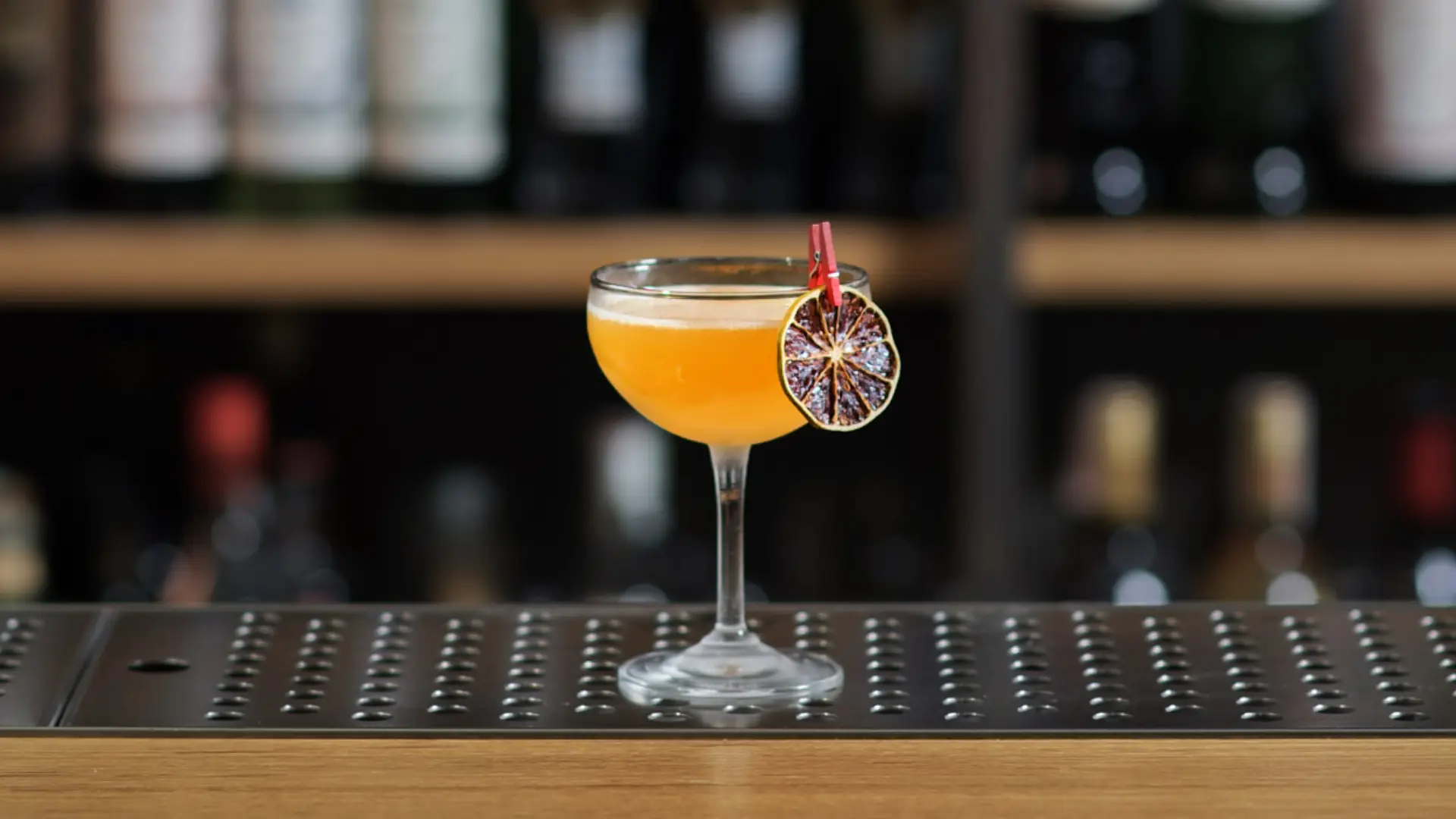
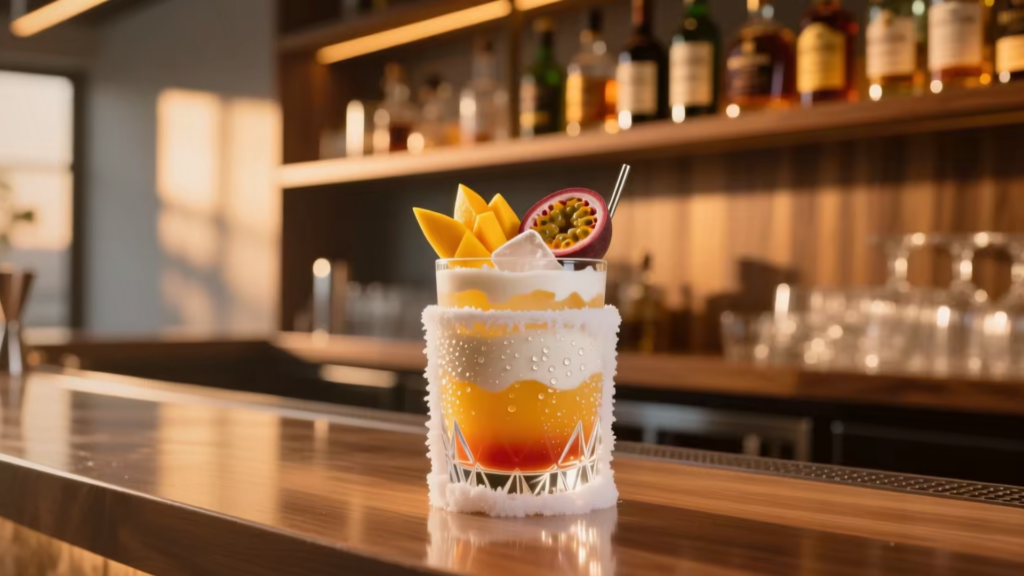
The classic Daiquiri, associated with Cuba in the late nineteenth and early twentieth centuries, is defined by restraint. Rum, fresh lime, and sugar create a precise equilibrium where each component is clearly legible. Donn Beach’s (known as Don’s Special Daiquiri)version begins with this structure but shifts its direction.
Passion fruit introduces a broader tropical acidity, less direct than lime yet more aromatic, while honey contributes texture and a slower perception of sweetness. This combination transforms the drink from a linear sour into something more dimensional. Instead of a single arc of acidity and sweetness, the cocktail unfolds in layers, creating the kind of multi-vector balance that would become central to tiki design.
The change is subtle in composition but significant in effect. It marks one of the early moments where a classic template is deliberately expanded rather than simply replicated.
Hollywood, 1934, and the Birth of Tiki Structure
After Donn Beach opened Don the Beachcomber in Hollywood at the end of Prohibition, the American cocktail landscape was still in transition. Ingredients were becoming more available, but technique and creativity were being rebuilt after years of legal restriction.
Beach’s approach diverged from both pre-Prohibition classics and the simplified drinks of the early repeal era. Drawing from Caribbean travel, rum knowledge, and exposure to diverse ingredients, he began building drinks that emphasised complexity through layering rather than quantity alone.
The Mona Daiquiri of 1934 reflects this philosophy, and Don’s Special Daiquiri later developed from that line of thinking. It retains the sour framework but introduces additional elements that interact rather than dominate. In doing so, it anticipates the multi-ingredient constructions that would define later tiki cocktails, yet remains anchored in the discipline of the Daiquiri.
Rum Selection and Structural Impact
The original Daiquiri relies on a relatively clean rum structure, but Donn Beach’s interpretation allows for broader rum expression. Don’s Special Daiquiri is closely tied to Beach’s belief that one rum could rarely do the work of several. The modern IBA version reflects this principle through a combination of gold Jamaican rum and Cuban rum.
Jamaican rum brings weight, depth, and ester-driven character, while Cuban-style rum contributes a cleaner and more linear base. This creates a layered foundation without removing the drink from the Daiquiri family.
This flexibility highlights a key transition in cocktail design. The base spirit is no longer just a neutral carrier of alcohol. It becomes a variable that shapes the drink’s identity, interacting with citrus and sweeteners to produce different outcomes within the same structure.
Honey and the Introduction of Texture
Honey plays a central role in Don’s Special Daiquiri. Unlike simple syrup, it contributes both sweetness and texture, effectively changing the way acidity and rum are perceived.
Its inclusion marks a turning point. Sweetness is no longer neutral. It becomes active, aromatic, and structurally influential, setting a precedent for future tropical formulations.
The interaction between honey and passion fruit is particularly important. Honey broadens the body of the drink, while passion fruit adds acidity and aroma. Together they extend the Daiquiri structure without making it unrecognisable.
Passion Fruit and the Expansion of Citrus Logic
Passion fruit gives Don’s Special Daiquiri its most distinctive movement away from the classic template. Its acidity is not the same as lime. It is more fragrant, more tropical, and more rounded in perception.
This shift expands the role of fruit in cocktail design. Rather than acting solely as a source of sharpness, fruit becomes a textural and aromatic component, capable of shaping the drink’s overall profile. The result is a cocktail that feels less immediate but more evolving, revealing different facets as it is consumed.
Lime remains essential because it keeps the drink connected to the Daiquiri family. Passion fruit expands the structure, but lime gives it discipline.
From Prototype to Influence
Don’s Special Daiquiri did not achieve the same level of recognition as later tiki icons, yet its influence is structural rather than iconic. It represents an experiment in layering that would inform drinks across the genre.
Its place in cocktail history is closely tied to Beach’s broader method of construction: rum blending, controlled sweetness, fruit acidity, and a refusal to treat tropical drinks as simple decoration. Modern tiki writing and historically focused bar programmes have helped return attention to drinks like this, not only as recipes, but as evidence of how Beach built flavour.
The drink’s legacy lies in its function as a bridge. It connects the precision of the Daiquiri to the complexity of tiki, demonstrating how one can evolve into the other without losing structural integrity.
Details Often Overlooked in Modern Interpretations
One of the less discussed aspects of Don’s Special Daiquiri is its balance of sweetness. Because honey and passion fruit both affect perceived sweetness, the structure must avoid becoming overly rich. This requires careful balance between acidity, texture, and rum weight.
Another nuance lies in dilution. Some published reconstructions treat the drink closer to a shaken Daiquiri, while the current IBA version places it within a crushed ice format. That difference matters because temperature and dilution change how honey, passion fruit, and rum are perceived.
Even its place in history is frequently understated. While not as widely known as the Zombie or Mai Tai, it represents one of the important steps toward the layered, fruit-driven and rum-focused cocktails that would define mid-century tropical drinking culture.

Renowned international hospitality consultant, founder of Barpartners, and IBA Vice President of Classic Mixology, bringing over 25 years of luxury hotel bar operations.

In partnership with International Bartenders Association
The International Bartenders’ Association stands at the crossroads of exchange between new and established generations of professionals.

Partnership
Dilution and the Hidden Structure of the Cocktail
Dilution begins as soon as ice and liquid exchange heat, but its importance extends far beyond the simple addition of water. It changes alcoholic strength, temperature, aroma, sweetness, bitterness and texture, helping separate ingredients become a coherent drink. Because the process is usually invisible, it can be mistaken for a side effect of chilling. In […]
August 4, 2026
Partnership
Alex Sánchez: Havana Doesn’t Teach You to Invent, It Teaches You to Hold the Line
In Havana, the environment Alex Sánchez came up in, cocktails are not rediscovered. They are remembered. Walk into El Floridita or La Bodeguita del Medio and you’re not entering a bar in the usual sense; you’re stepping into a system that has barely changed. The Daiquiri still follows its line. The Mojito still holds its […]
July 20, 2026
Partnership
Canchánchara Cocktail: Cuban Origins, Honey, and the Precursor to Modern Rum Sours
Long before the codification of classic cocktails in printed manuals or the emergence of international bar standards, there existed a drink in eastern Cuba that combined rum, honey, lime, and water in a form both practical and symbolic. The Canchánchara is not a product of bar culture in the conventional sense. It predates it. Its […]
July 16, 2026