
In the years immediately following World War II, vodka entered a new phase of industrial clarity. Distillation technology had already advanced to the point where spirit could be produced at high purity, often approaching 96 percent alcohol by volume. Yet purity alone did not define vodka’s emerging identity. The question facing producers in Eastern Europe and, increasingly, in Western markets was not how to distill ethanol, but how to refine it into a consistent, commercially viable product.
Charcoal filtration became the decisive step. After 1950, as vodka moved beyond regional consumption into global distribution, filtration shifted from a supplementary process to a defining one. It allowed producers to stabilize texture, reduce residual compounds, and present vodka as a controlled, repeatable spirit aligned with modern expectations of neutrality.
Early Filtration Practices and the Pre-1950 Context
Filtration in vodka production predates the 20th century. In Russia and Poland, distillers had long used charcoal, sand, and cloth filtration to improve clarity and remove impurities from grain-based spirits. These methods were often small-scale and inconsistent, relying on manual processes rather than standardized systems.
By the early twentieth century, rectification columns had already transformed distillation, producing highly neutral spirit at industrial scale. However, even highly rectified alcohol retained trace compounds that affected mouthfeel and perceived smoothness. Filtration remained necessary, but it lacked uniformity across producers.
The post-1950 period introduced something different. Filtration became engineered.
Industrial Charcoal Filtration and Process Standardization
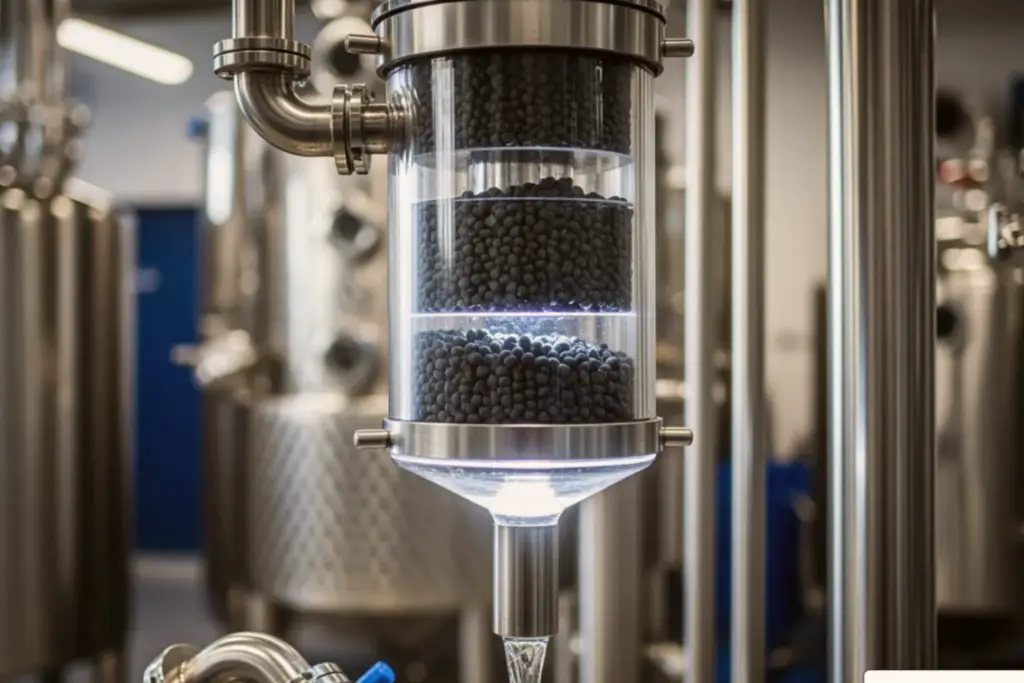
The expansion of vodka production after 1950, particularly in the Soviet Union and Poland, coincided with the development of continuous filtration systems. Activated charcoal, produced through controlled carbonization of wood or coconut shell, offered a consistent medium for adsorption.
At distilleries such as Polmos Żyrardów, filtration systems were designed to regulate contact time, flow rate, and charcoal density. Spirit passed through multiple filtration stages, each calibrated to remove specific compounds, including higher alcohols, aldehydes, and esters.
This was not a cosmetic process. It was chemical control. Activated charcoal binds unwanted compounds through adsorption, reducing harshness while preserving ethanol structure. The result is a spirit that appears neutral but is in fact highly engineered.
Western Expansion and the Redefinition of Vodka Purity
Vodka’s global expansion accelerated during the mid-twentieth century, particularly in the United States and Western Europe. Brands entering these markets emphasized smoothness and clarity as defining characteristics.
Absolut Company, established in its modern form in 1979 in Åhus, adopted continuous distillation combined with controlled filtration to produce a consistent wheat-based vodka. While Absolut emphasizes single-source production, its filtration stage remains critical in refining texture.
Similarly, Smirnoff, whose production moved westward during the twentieth century, built its identity around charcoal filtration, marketing it as a guarantee of purity. By the 1960s, filtration was no longer a background process. It had become a selling point. Purity was no longer defined solely by distillation strength. It was defined by post-distillation treatment.
Multiple Filtration Stages and the Rise of Premium Vodka
By the late twentieth century, the concept of multi-stage filtration became central to premium vodka positioning. Producers began specifying the number of filtration passes as an indicator of quality, often combining charcoal with other media such as quartz sand or silver.
Belvedere Vodka, launched in 1993 and produced in Poland using rye, employs controlled filtration while emphasizing raw material integrity. Grey Goose, introduced in 1997, integrates filtration with water sourced from limestone aquifers, reinforcing the relationship between filtration and texture.
In these systems, filtration is not infinite. Excessive filtration can strip structure, reducing viscosity and leaving the spirit thin. Insufficient filtration leaves residual harshness. The objective is to balance within a narrow operational window. Filtration becomes calibration rather than intensity.
The Chemistry of Charcoal and Perceived Smoothness
Activated charcoal functions through adsorption, a process in which molecules adhere to the surface of the carbon material. The effectiveness of this process depends on surface area, pore structure, and contact time. In vodka production, charcoal removes trace compounds that contribute to bitterness, sharpness, or off-aromas. However, it does not remove ethanol itself. The resulting spirit retains its alcoholic strength while presenting a smoother sensory profile.
This distinction is critical. Smoothness is not the absence of alcohol. It is the reduction of competing compounds that interfere with perception. The relationship between filtration and mouthfeel is therefore indirect but measurable. Reduced impurities lead to more seamless ethanol integration, producing the sensation described as softness.
Filtration as Identity Rather than Necessity
By the end of the twentieth century, charcoal filtration had moved beyond its functional role. It became part of the brand identity. Producers highlighted filtration methods in marketing, from traditional birch charcoal to proprietary multi-stage systems.
Yet the underlying principle remained consistent. Filtration exists to stabilize the spirit, not to define its flavor. Unlike aging in whiskey or brandy, filtration does not add character. It removes variability. In this sense, vodka production after 1950 reflects a broader shift in spirits. Control replaces expression as the primary objective.
Charcoal filtration in vodka production after 1950 represents the transition from craft variability to industrial precision. Distillation provided the foundation, but filtration completed the system, allowing producers to refine and stabilize spirit at scale.
Through controlled adsorption, vodka became a reproducible product, capable of maintaining consistency across markets and batches. The process did not eliminate the character. It reduced it to a controlled minimum. Modern vodka is therefore not defined by neutrality alone, but by the methods used to achieve it. Charcoal filtration stands at the center of that transformation, where chemistry, engineering, and market expectation converge into a single, repeatable outcome.


Distillery
The Absolut Company Distillery, nestled in the picturesque town of Åhus, Sweden, is renowned for producing one of…

Distillery
Smirnoff is renowned as the world's number one vodka brand, celebrated for its exceptional quality and smooth taste.…

Distillery
Polmos Żyrardów, situated in the picturesque town of Żyrardów, Poland, is a distinguished distillery known primarily for producing…
Spirit
Belvedere Premium Polish Vodka
Belvedere Premium Polish Vodka is a crafted spirit that epitomizes the Polish vodka-making tradition, cultivated over centuries. This…
Spirit
Grey Goose Altius Vodka represents a pinnacle of craftsmanship in ultra-premium vodka. This unique expression is designed to…
Distillery
The Absolut Company Distillery, nestled in the picturesque town of Åhus, Sweden, is renowned for producing one of…
Distillery
Smirnoff is renowned as the world's number one vodka brand, celebrated for its exceptional quality and smooth taste.…
Distillery
Polmos Żyrardów, situated in the picturesque town of Żyrardów, Poland, is a distinguished distillery known primarily for producing…
Spirit
Belvedere Premium Polish Vodka
Belvedere Premium Polish Vodka is a crafted spirit that epitomizes the Polish vodka-making tradition, cultivated over centuries. This…
Spirit
Grey Goose Altius Vodka represents a pinnacle of craftsmanship in ultra-premium vodka. This unique expression is designed to…

Barlist
What the 2026 Brand Champions Reveal: The New Geography of Spirits Volume
The old map of global spirits influence was drawn around familiar export categories. Scotch whisky, international vodka, Caribbean rum, Cognac, and American whiskey appeared to define scale because they travelled widely, occupied prominent back bars, and were supported by multinational distribution. The largest volume brands tell a different story. The 2026 edition of The Spirits […]
June 30, 2026

Bars and Cocktails
Why Modern Bars Are Moving Toward Laboratory Models
The transformation of the modern bar did not begin with centrifuges or laboratory glassware. It began earlier, when cocktail preparation first shifted from improvisation to standardization. By the mid-20th century, hotel bars such as the American Bar at the Savoy Hotel in London had already introduced repeatable methods for drinks like the Martini and the […]
April 8, 2026

Discovery and Education
How to Assess Vodka Neutrality and Texture Using Scientific Tasting Techniques
Vodka is frequently dismissed as neutral, as if neutrality were synonymous with absence. In practice, neutrality is a construction. It is the deliberate reduction of aroma, the integration of ethanol, and the calibration of texture into something restrained yet intact. Evaluating vodka demands attentiveness to what remains after distillation has removed almost everything else. Unlike […]
March 26, 2026