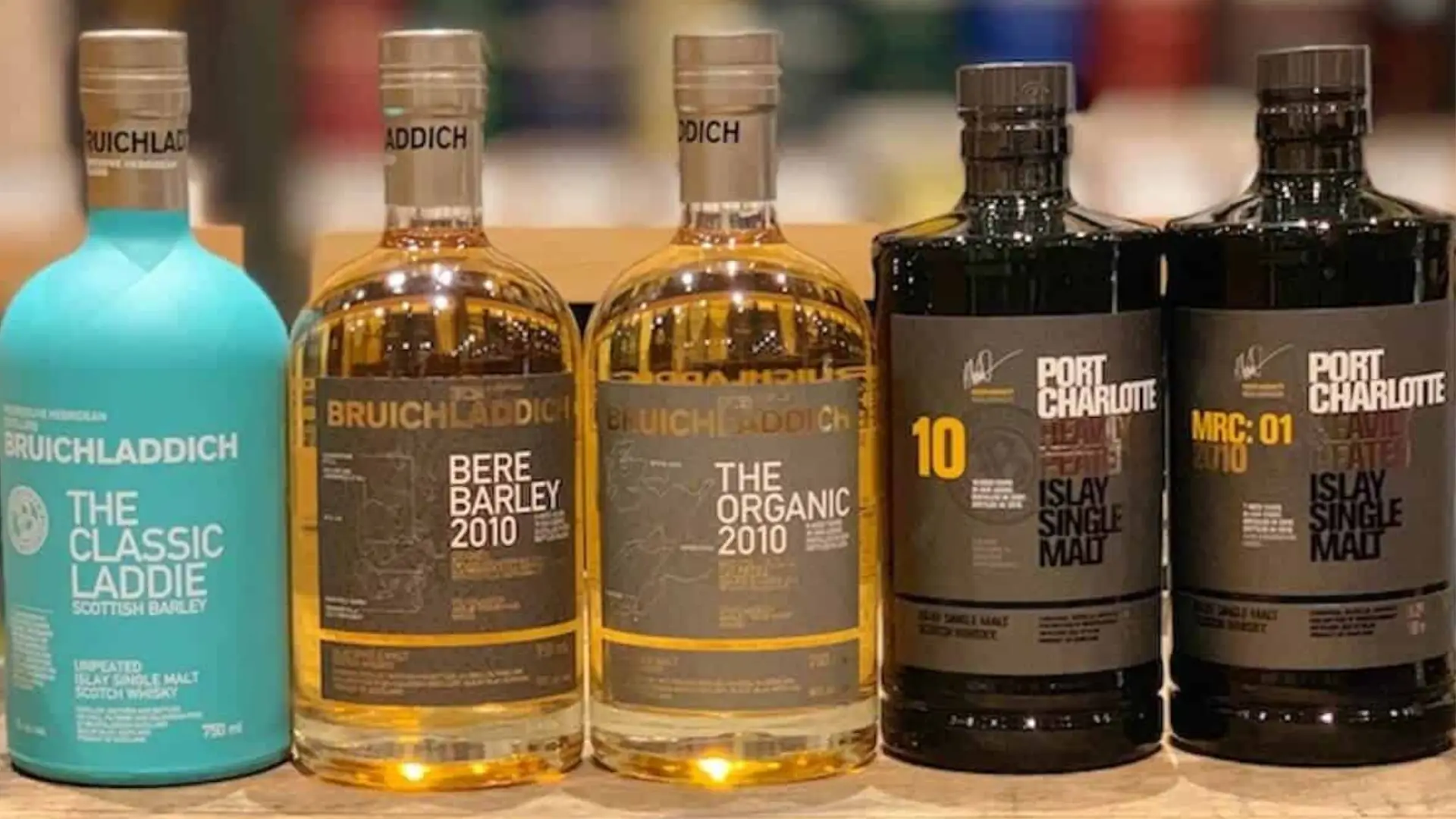
Founded during the golden age of Scotch whisky, Bruichladdich Distillery was established in 1881 by the Harvey brothers, a family of skilled distillers from Glasgow. Perched on the windswept western shores of Islay, the distillery’s location set it apart from its eastern neighbors. Where others embraced the island’s signature peat smoke, Bruichladdich charted its own path — crafting whisky that was lighter, floral, and remarkably refined.
The Early Legacy of Bruichladdich
When the Harvey brothers built Bruichladdich, they envisioned a distillery rooted in precision and innovation. Its design, with tall-necked stills and gravity-fed Victorian architecture, allowed for a cleaner, softer spirit — a stark contrast to Islay’s famously smoky whiskies from Laphroaig, Lagavulin, and Ardbeg. For decades, the distillery thrived under the Harveys, producing whisky that celebrated elegance over intensity.
However, like much of the Scotch industry, Bruichladdich faced hardship in the early 20th century. It fell silent in 1929, reopening briefly in 1936, only to endure decades of uncertainty, ownership changes, and closures. The most recent shutdown, between 1995 and 2001, seemed to signal the end. Yet, from that silence, a modern legend would rise.
The Renaissance of Bruichladdich
The turning point came in 2000, when a group of independent investors led by Mark Reynier purchased the mothballed distillery from Jim Beam Brands for £7.5 million. Rather than strip it of its past, they chose to restore it- preserving its original Victorian-era equipment and reviving the traditional, hands-on methods that once defined Islay whisky.
When production resumed in 2001, it was more than a reopening. It was a rebirth. Bruichladdich became a symbol of authenticity, combining heritage with modern sustainability. Today, the distillery employs more than fifty locals, the highest number of any distillery on Islay– reaffirming its role as both an economic and cultural cornerstone of the island.
Barley, Terroir, and Transparency at Bruichladdich
Unlike many large producers, Bruichladdich places terroir at the heart of its whisky-making philosophy. The distillery sources up to twelve varieties of barley, including locally grown grains used in its celebrated Local Barley series. Every element of the production process- from farm to bottle, is traceable and openly shared. This transparency reflects a deeper commitment to community and sustainability.
The distillery’s environmental efforts are equally notable. Through innovative measures such as anaerobic digestion systems that convert distillery waste into biogas and the reuse of waste heat for production, Bruichladdich continues to lead the way in green whisky production. Its sustainability strategy is not just operational, it’s philosophical, rooted in respect for both nature and the people of Islay.
The Three Faces of Bruichladdich
Bruichladdich’s modern identity is expressed through three distinct single malts, each showcasing a different interpretation of Islay character.
Bruichladdich: Unpeated, elegant, and floral, this whisky captures the natural purity of Islay barley. It represents the distillery’s original spirit- refined, honest, and full of coastal freshness.
Port Charlotte: Heavily peated yet balanced, Port Charlotte pays homage to Islay’s smoky traditions while remaining deeply complex and maritime in nature.
Octomore: The boldest expression, often recognized as the world’s most heavily peated whisky. Octomore embodies experimentation, pushing the boundaries of flavor and technique while maintaining surprising delicacy beneath its intensity.
Both Port Charlotte and Octomore take their names from long-closed Islay distilleries, ensuring that the island’s heritage lives on through each bottle. Together, the trio demonstrates Bruichladdich’s rare ability to balance innovation with respect for history.
A Distillery Shaping the Future of Islay
Today, Bruichladdich Distillery stands as one of the most forward-thinking producers in Scotland. With an annual output exceeding 460,000 liters of pure alcohol, and the potential to expand to two million, it continues to grow without sacrificing craftsmanship. Every detail- from its barley sourcing to its use of renewable energy- reflects a clear vision: to make whisky that connects land, community, and character.
For the Barlist community, Bruichladdich represents the future of Scotch whisky, a distillery that honors its past while redefining what sustainability and transparency mean in the modern spirits world.
More than a name on a bottle, Bruichladdich is a living testament to resilience, innovation, and the enduring magic of Islay.

Barlist
Grzegorz Nowicki: Where Control Turns Into Confidence
Not every bar scene announces itself when it starts changing. Sometimes it happens quietly. A few new venues open, standards begin to tighten, and suddenly the way drinks are made starts to feel different. Warsaw in the early 2010s moved like that. Nothing abrupt, but enough to shift expectations. Grzegorz Nowicki’s career developed right inside […]
September 28, 2026
Barlist
Pauline Le Berre: When Precision Becomes the Quietest Form of Control
Some bartenders build drinks that unfold. Others build drinks that settle. Pauline Le Berre’s work belongs to the second kind. Nothing in her approach pushes forward unnecessarily. The balance is already there, established before the drink reaches the glass, and held in place without adjustment. That way of working doesn’t come from experimentation alone. It […]
September 21, 2026
Barlist
Michael Moreni: Holding Italian Balance Under Pressure
There’s a point where simplicity stops being effortless and starts being precise. In Italy, that line is easy to miss. Aperitivo culture has always favoured clarity over complexity, drinks that don’t need explanation, only consistency. But translating that quiet balance into a competitive environment is something else entirely. That’s where Michael Moreni’s work sits. His […]
September 14, 2026