
Bottled in Bond for whiskey history begins with a problem that was larger than whiskey itself.
In the late 19th century, the American spirits market was difficult for ordinary consumers to trust. Bottles could carry respectable names while holding liquid that had been stretched, coloured, flavoured, blended beyond recognition, or presented as aged whiskey when it was something much cheaper and less transparent.
The Bottled in Bond Act of 1897 was created in response to that crisis of confidence. It did not appear as a luxury category or a romantic badge for collectors. It was a legal answer to fraud, adulteration, tax control, and consumer uncertainty.
That is what makes bottled in bond important for education and discovery. It shows how whiskey identity was shaped not only by grain, barrels, and distillers, but also by law, supervision, labelling, and the need to prove that a bottle meant what it claimed.
A Market Built on Uncertainty
American whiskey grew in a young country with scattered production, uneven transport, and limited national regulation.
Farm distillers, regional producers, merchants, wholesalers, rectifiers, grocers, saloons, and bottlers all played roles in moving whiskey from still to consumer. Some handled genuine aged whiskey. Others built businesses around modifying, stretching, colouring, or reselling spirits under more attractive names.
The problem was not that blending or rectifying existed. The problem was that the consumer often had no clear way to know what had been done to the whiskey before it reached the bottle.
A product could look dark, mature, and respectable without being honestly aged. Colour, flavour, sweetening, neutral spirit, and misleading presentation could create the appearance of quality without the substance behind it.
In that environment, trust became a commercial weapon. Distillers who made whiskey by traditional methods needed a way to separate their product from the less transparent market around them.
The Rise of the Rectifier
Rectifiers were central to the controversy.
A rectifier might buy spirit from distillers, combine it with other spirits, adjust it with flavouring or colouring, and sell the final product under a label that suggested age, origin, or quality. Some rectifiers operated within accepted commercial practice. Others helped create the confusion that honest distillers wanted to fight.
This conflict shaped American whiskey history because it was not only a moral argument. It was also an economic one.
Straight whiskey distillers had money tied up in time. Their whiskey needed grain, labour, fuel, barrels, warehouse space, evaporation loss, and years of ageing before sale. A less transparent competitor could create a bottle that looked similar without carrying the same production cost.
The result was an uneven market. Producers who invested in age and authenticity competed against products that borrowed the visual language of aged whiskey without always sharing its discipline. Bottled in bond emerged from that tension. It gave certain producers a legal way to say: this whiskey is not merely claiming identity; it is verified.
E. H. Taylor Jr. and the Politics of Trust
Edmund Haynes Taylor Jr., often referred to as E. H. Taylor Jr., became one of the figures most closely associated with the push for bottled in bond.
Taylor was a Kentucky whiskey businessman connected with important distilling interests, including the O.F.C. Distillery, a predecessor site associated with today’s Buffalo Trace history. He understood that whiskey needed both production discipline and public trust if it was to survive a market filled with imitation and manipulation.
He was not working alone. The movement behind bottled in bond also involved political support, including John G. Carlisle, the former Speaker of the House and Secretary of the Treasury. That Treasury connection was important because the law was about both consumer assurance and federal revenue.
The government had a direct interest in whiskey. Excise tax was a major issue, and bonded warehouses allowed the state to supervise stored spirits while giving distillers time before tax payment became due.
This made bottled in bond a rare meeting point between producer interest, consumer protection, and government accounting.
What the 1897 Act Changed
The Bottled in Bond Act became law in 1897.
Its purpose was to create a verified category of spirits held under federal supervision. For whiskey, the standard came to mean that a bonded product had to come from one distiller, at one distillery, in one distilling season, then age for at least four years in a federally bonded warehouse and be bottled at 100 proof.
The distilling season requirement mattered because it limited how broadly a producer could assemble the whiskey. A bottle could not simply be built from many unrelated sources while still carrying the bonded claim.
The warehouse requirement mattered because it placed the ageing period under government control. The state was not only trusting the producer’s word. It was supervising the stock. The 100 proof requirement gave the category a fixed bottling strength. That made the label more meaningful because the consumer could expect a defined standard rather than a vague promise.
One Distiller, One Distillery, One Season
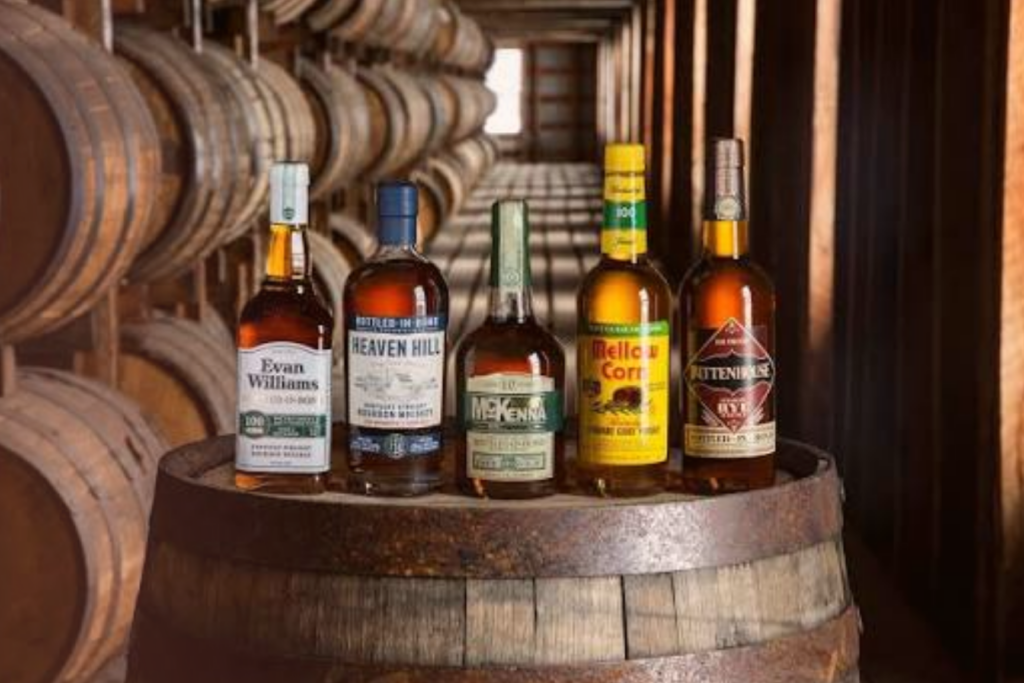
The phrase often associated with bottled in bond is simple: one distiller, one distillery, one distilling season. That language is powerful because it creates traceability. It narrows the identity of the whiskey and makes it harder to hide behind anonymous blending.
This does not mean bottled in bond is the same as single barrel whiskey. It can still come from multiple barrels. The point is that those barrels must belong to a controlled production identity within the requirements of the category.
The rule also differs from many ordinary whiskey labels. A straight whiskey may be legitimate and well made without being bottled in bond, but bottled in bond adds a more specific legal frame around origin, season, age, supervision, and proof.
That extra frame explains why the term still attracts attention. It gives the label a kind of documentary value.
Four Years in Bond
The four-year ageing rule is one of the most important parts of the standard.
American straight whiskey already has ageing requirements under federal standards, but bottled in bond sets a longer minimum than the basic straight whiskey threshold. The whiskey must spend at least four years under bond before it can carry the designation.
That period served several purposes. It helped distinguish bonded whiskey from products that only imitated maturity. It gave the spirit enough time to move beyond new make character. It also tied the category to federal warehouse supervision and tax control.
The law did not say that every four-year whiskey would be excellent. It said that a bottle carrying the bonded claim had passed a defined minimum standard. That distinction is important. Bottled in bond is not a guarantee of greatness. It is a guarantee of specific legal conditions.
The Meaning of 100 Proof
Bottled in bond whiskey must be bottled at 100 proof, or 50 per cent alcohol by volume.
That figure became part of the category’s identity. It gave consumers a clear and repeatable point of reference, and it prevented the bonded claim from being attached to weaker bottlings that might have been diluted more heavily after ageing.
The proof requirement also made bottled in bond stand apart on the shelf. It was not only a matter of age or origin. The bottle carried a fixed strength that connected the product to the law itself. In modern whiskey culture, 100 proof is sometimes treated as a sign of seriousness. Historically, its deeper meaning was standardisation.
A bonded whiskey did not ask the consumer to interpret vague language. It gave measurable information.
Government as Guarantor
One of the most unusual aspects of bottled in bond is the role of the federal government.
In effect, the state became part of the trust system. Government supervision of bonded warehouses helped ensure that whiskey was stored, accounted for, and taxed properly. The label then carried more weight because the claim was not only private marketing.
This did not remove commercial self-interest. Distillers benefited from the credibility of the standard and from tax arrangements that allowed payment to be delayed while whiskey matured. Yet the government also benefited. Bonding made it easier to monitor stored spirits and protect revenue.
The consumer sat at the visible end of this system. A bonded label told the buyer that the bottle had passed through a controlled legal structure, not only a producer’s promise.
Before the Pure Food Era
The Bottled in Bond Act arrived before the Pure Food and Drug Act of 1906. That timing matters. It places bottled in bond among the early federal attempts to solve problems of adulteration, misrepresentation, and consumer protection in American commerce.
Whiskey may seem like a narrow subject, but the issue was part of a larger national concern. Americans were increasingly aware that food, medicine, and drink could be altered, mislabelled, or sold under misleading claims.
Bottled in bond belongs to that broader history. It shows that spirits regulation was not only about morality or taxation. It was also about identity and proof. The law helped create a language in which a bottle could be trusted because its claim was defined by statute.
What Bottled in Bond Is Not
Bottled in bond is often misunderstood. It does not mean the whiskey is automatically better than every non bonded whiskey. It does not mean the bottle came from one barrel. It does not mean the producer is small, old fashioned, or more authentic by personality alone.
It means the whiskey met a precise legal standard.
That standard tells the consumer something useful: the product has a defined origin, a defined production window, a defined minimum age, a defined proof, and a connection to federal bonded storage.
A non bonded whiskey can still be excellent, transparent, and carefully made. A bonded whiskey can still vary in style, quality, and character from one producer to another. The value of bottled in bond is not magic. It is clarity.
Why the Standard Declined
Bottled in bond did not remain equally fashionable across every period of American whiskey history.
As the industry changed, producers found other ways to build trust. Brand names, age statements, advertising, national distribution, straight whiskey standards, and later premiumisation all gave companies different tools for explaining quality.
The mid and late twentieth century also brought changing drinking habits. American whiskey lost ground at times to lighter spirits, imported categories, and changing consumer preferences. In that environment, the old bonded language could appear technical or dated.
Some producers kept the designation alive, while others moved away from it. The phrase remained legal, but its cultural power faded for many consumers. That decline did not make the standard irrelevant. It simply waited for a market that once again cared about transparency.
Why It Returned
The renewed interest in bottled in bond belongs to a wider search for clear information.
Modern whiskey consumers often ask sharper questions about source, age, proof, mash bill, distillery ownership, blending, and transparency. In that environment, bottled in bond feels newly useful because it answers several questions at once.
It tells the consumer that the whiskey was not assembled from anonymous sources across broad production periods. It tells them the minimum age. It tells them the bottling strength. It tells them that the claim has legal meaning.
For newer producers, bottled in bond can also signal patience. A distillery cannot release its own bonded whiskey immediately. It must wait at least four years, which gives the designation a built in time requirement.
For older producers, it connects present bottlings to a regulatory tradition that helped define American whiskey at a moment of crisis.
Beyond Bourbon
Bottled in bond is often associated with bourbon, but the standard is not limited to bourbon.
Bonded rye whiskey, bonded corn whiskey, apple brandy, and other American spirits have also used the designation. In practice, whiskey remains the category where the phrase has the strongest public recognition.
This wider application is useful because it reminds us that bottled in bond was not created only as a bourbon marketing device. It was part of a broader legal system for spirits authenticity and tax supervision.
Still, bourbon became its most famous stage because bourbon carried many of the identity questions the law was designed to answer: grain, ageing, origin, colour, proof, and honesty in labelling. The association with bourbon is therefore understandable, but it should not narrow the meaning of the term too far.
Why Bottled in Bond Matters
Bottled in bond matters because it turns a whiskey label into a legal education.
The phrase teaches that authenticity is not only a matter of heritage claims or brand storytelling. It can also be built through enforceable definitions, production limits, government supervision, and transparent labelling. It also reminds us that American whiskey was shaped by conflict. Distillers, rectifiers, merchants, politicians, tax officials, and consumers all had different interests. The law emerged because those interests collided.
That collision created one of the most enduring standards in American spirits.
The modern appeal of bottled in bond comes from the same source that made it important in 1897. It reduces uncertainty in a market where consumers want to know what is inside the bottle and how it got there.
Bottled in Bond began as a response to fraud, but it became something larger. It gave American whiskey a language of trust at a time when the market needed proof. One distiller, one distillery, one season, four years in bond, and 100 proof created a standard that ordinary marketing could not easily imitate.
The Act also showed that spirits history is not only written by distillers and brands. It is written by lawmakers, tax systems, warehouses, labels, and public doubts about authenticity. That is why bottled in bond still feels relevant. It speaks to a modern concern through an old law: how can a consumer know that a bottle is what it claims to be?
The answer, in 1897, was supervision and standardisation. More than a century later, that answer still has force.


Distillery
Whisky Merchants Trading Ltd, based in Edinburgh, was a notable player in the Scotch whisky cask investment market…

Distillery
Buffalo Trace Distillery, located in Frankfort, Kentucky, is a venerable institution that has been committed to the art…

Distillery
Whisky Embassy embodies a passionate commitment to the art of whisky and specialty spirits, firmly established in the…
Spirit
Daddy Rack Single Barrel Cask Strength Tennessee Straight Whiskey
Daddy Rack Single Barrel Cask Strength Tennessee Straight Whiskey is a carefully crafted expression that embodies the spirit…
Spirit
Marcotte Naked Rye Straight Whiskey
Marcotte Naked Rye Straight Whiskey is a premium American whiskey that has received acclaim for its craftsmanship and…
Spirit
Whisky Agency Glen Keith 19 YO Single Malt Scotch Whisky
Whisky Agency Glen Keith 19 YO Single Malt Scotch Whisky represents a refined expression crafted from carefully selected…
Spirit
Whisky Agency 17 YO Island Single Malt Scotch Whisky
Whisky Agency 17 YO Island Single Malt Scotch Whisky showcases the exceptional craftsmanship that characterizes premium single malts…
Distilleries & Producers
How the Sazerac Company’s Distilleries Define Craft, Continuity, and Global Spirits Production
The story of modern American spirits is inseparable from the history of the Sazerac Company, a privately held producer whose distilleries have shaped bourbon, rye, Canadian whisky, and beyond. More than a portfolio of labels, Sazerac Company’s distilleries represent continuity of craft, adaptation to market conditions, and a willingness to preserve historic production while investing […]
April 9, 2026

Distilleries & Producers
Women in Spirits History: 7 Women Who Changed the World of Spirits
Spirits’ history is often framed as a lineage of male founders and master distillers. This narrative obscures a more accurate reality. Across categories and centuries, women shaped spirits through ownership, legal stewardship, technical decision-making, and long-term preservation of production systems. Their influence was rarely performative. It was structural. In moments of instability, women often became […]
March 10, 2026

Bars and Cocktails
Sazerac : How the 19th Century Shaped America’s First Cocktail
The Sazerac did not emerge as a novelty or a bartender’s invention chasing fashion. It took shape during the 19th century as American drinking culture moved away from medicinal dosing and toward structured ritual. The cocktail’s evolution mirrors the transformation of New Orleans, a city where European influence, port commerce, and apothecary practice converged. To […]
January 24, 2026