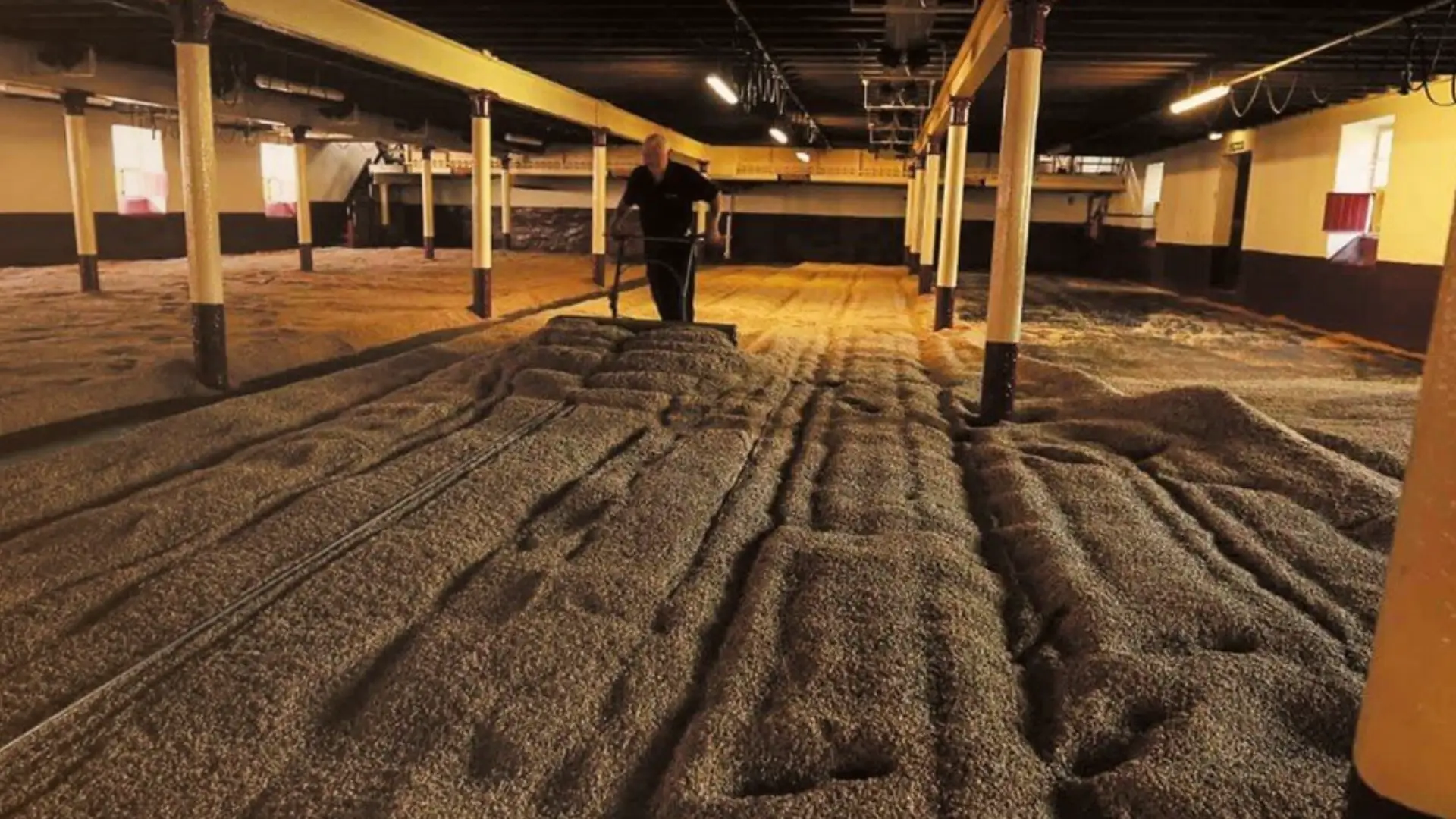
At Springbank Distillery, barley still arrives at one end of the production process and bottled whisky leaves at the other. Between those points, the grain is steeped, spread across malting floors, dried in the kiln, milled, mashed, fermented, and distilled. The resulting spirit is filled into casks, matured in Campbeltown, bottled, and labelled by the same company.
Very few Scotch whisky distilleries retain that degree of control. Most now work within a more specialised industry, where commercial maltings prepare barley at scale, mature spirit may be stored in central warehouses, and bottling facilities handle whisky from several distilleries or brands. These systems can be efficient, technically precise, and commercially sensible.
Springbank has chosen another path, though it would be misleading to describe the distillery as entirely self sufficient. It does not grow all its barley, manufacture its own casks, or produce the glass used for bottling. Its achievement is more exact: once the principal materials arrive, the stages that turn barley into bottled whisky remain connected through one site, one company, and one workforce.
That arrangement is demanding and difficult to expand. It requires a wide range of skills, limits the efficiencies available through external suppliers, and places unusual responsibility on the people working within the distillery. It also preserves something increasingly rare in Scotch whisky: a direct relationship between production, people, and place.
Campbeltown’s Whisky Economy
Springbank Distillery was officially founded in 1828 on a site associated with earlier illicit distillation by Archibald Mitchell. It became the fourteenth licensed distillery in Campbeltown, a town whose whisky industry was already expanding rapidly.
The location offered strong commercial advantages. The Kintyre Peninsula provided access to water, peat, fuel, labour, and coastal transport, while shipping connected Campbeltown with Glasgow, Ireland, and markets further afield.
Whisky soon shaped the town around it. Distilleries supported malt barns, warehouses, cooperages, merchants, shipping businesses, and generations of skilled workers. By the late 1800s, Campbeltown had become one of Scotland’s most concentrated distilling centres.
That concentration also made the town vulnerable when demand changed. During the early 1900s, its reputation weakened as some producers were accused of prioritising volume over consistency, while blenders increasingly looked towards other regions for malt whisky. Economic depression and the loss of important export markets added further pressure.
Closures followed across the town. When Rieclachan Distillery ceased production in 1934, only Springbank and Glen Scotia remained, leaving a fraction of the industry that had once defined Campbeltown’s economy.
Even Springbank’s survival was not a story of uninterrupted production. Distilling became sporadic during the difficult market conditions of the 1980s, although the company continued selling existing stocks, and regular production resumed in 1989. The distillery endured because it remained rooted in the town, not because it escaped the pressures surrounding it.
Family Ownership and Practical Continuity
In 1837, John Mitchell and William Mitchell, sons of Archibald Mitchell, took ownership of the distillery. John Mitchell later brought his own son into the business, leading to the company known as J&A Mitchell.
The long family connection is important, but family ownership alone does not explain the production system. Independent companies can outsource, consolidate, modernise, or sell just as readily as larger corporate groups.
The more revealing decision was to retain operational control over work that much of the industry had gradually transferred elsewhere. Malting remained connected with mashing and fermentation, distillation stayed close to cask filling and warehousing, and bottling continued within the same business rather than moving to a distant central facility.
That proximity allows experience to travel between departments. Changes in the malt can be understood by the people managing fermentation and distillation, while warehouse staff remain connected with the production history of the spirit entering their casks. The bottling team, in turn, works with whisky made and matured within the same organisation.
When long serving chairman Hedley G. Wright died in 2023, the company’s ownership was placed into three trust funds. A family representative joined the board, maintaining the connection with the Mitchell family under a different legal structure. The ownership arrangement evolved, but the operational principle remained intact.
The Work of Floor Malting
Floor malting is the most visible part of Springbank’s production model. Barley is steeped in water before being spread across the distillery’s malting floors, where it is turned regularly as germination begins.
The work requires attention to heat, moisture, and root growth. Maltsters must respond to the condition of the grain rather than rely entirely on an automated timetable, adjusting their work as the barley changes.
Manual labour does not automatically make malt superior. Large commercial maltings can produce highly consistent material to exact specifications, and most Scotch whisky distilleries depend on them successfully.
At Springbank, the value of floor malting lies in control and connection. The maltsters work for the distillery that will mill, mash, ferment, and distil the grain, rather than preparing a standardised product for an unknown customer. The barley can therefore be managed according to the requirements of the three whiskies made on the site.
After germination, the grain moves to the kiln. Peat smoke, hot air, or a combination of the two is used depending on whether the malt is intended for Springbank, Longrow, or Hazelburn. The maltings are not maintained as a historical display; they continue to shape the production schedule and the identity of each spirit.
Three Whiskies from One Distillery
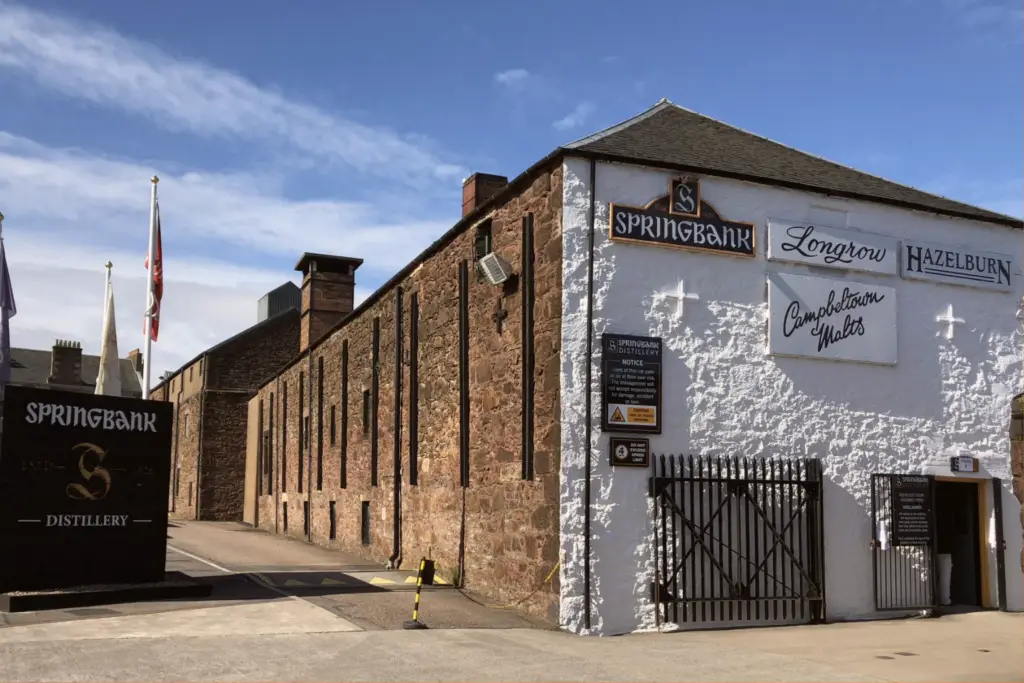
Springbank Distillery produces three distinct single malt Scotch whiskies using the same maltings, still house, and wider production site. Their differences begin before distillation and continue through separate production routines.
Springbank is made from lightly peated malt and follows an unusual two and a half times distillation process. Different portions of the spirit are routed through the stills in separate ways before the final new make spirit is collected.
Longrow, first distilled in 1973, uses more heavily peated malt and is distilled twice. Hazelburn, first produced in 1997, uses malt dried with hot air rather than peat smoke and is distilled three times.
Managing these systems requires careful scheduling. Kilning conditions must change, the still house must follow different spirit routes, and production cannot run through one fixed sequence throughout the year. The same equipment is shared, but the decisions surrounding it vary.
This is where an integrated site becomes particularly useful. The distinctions between the three whiskies can be managed from malting onwards rather than being created mainly through cask selection, packaging, or branding later in the process.
Old Machinery in a Working Distillery
The production areas contain equipment from several periods of Springbank’s history. Malt is ground in a Porteus mill dating from the 1940s, while the cast iron mash tun has served the distillery for generations. Fermentation takes place in wooden washbacks, and the wash continues to use direct firing.
None of this leaves Springbank untouched by modernisation. Machinery has been repaired, production has been adjusted, and the distillery operates within present legal, safety, and quality requirements.
The important point is that the older equipment remains in daily use. Long familiarity creates practical knowledge, as workers learn how a mill behaves, how fermentation develops in a particular washback, and how individual pieces of machinery respond to changes in production.
That knowledge carries value, but it also brings obligations. Repairs require specialist skill, replacement parts may be difficult to source, and capacity cannot always be increased without altering the entire system surrounding the equipment.
Springbank has generally chosen maintenance and adaptation rather than wholesale replacement. The machinery survives because it continues to perform a real function, not because it has been preserved as scenery.
Maturation in Campbeltown
After distillation, the new make spirit is filled into casks and moved into the company’s warehouses in Campbeltown. Scotch whisky law requires the spirit to mature in Scotland in oak casks for at least three years, but Springbank keeps this period connected with the site where the spirit was produced.
Warehouse conditions, cask performance, and future bottling decisions remain visible within one organisation. Staff can follow the whisky from filling through maturation without transferring responsibility to an unrelated storage company.
This arrangement has an economic effect as well as a production value. Warehousing requires stock management, maintenance, cask movement, inspection, and long term planning, all of which support employment and specialist knowledge.
When maturation moves elsewhere, those jobs and skills often move with it. By retaining its warehouses in Campbeltown, Springbank keeps another substantial part of the whisky economy within the town. Maturation may be quiet, but it is not passive.
Bottling Belongs to the Process
Bottling is often treated as a separate stage from whisky production. Across much of the industry, that separation is practical because large facilities can reduce, filter, bottle, label, and pack whisky efficiently for several brands.
Springbank bottles and labels its whisky at the distillery, keeping responsibility with the same company until the finished bottle leaves the site. The importance of this system is not that a smaller bottling line must produce a better result, but that accountability remains connected from production through packaging.
The distillery also states that its own malt whiskies are bottled without chill filtration or artificial colouring. These decisions remain part of its production policy rather than being handed to an outside contractor.
Keeping bottling in Campbeltown preserves jobs that could easily be moved elsewhere while the distillery itself remains open. A whisky can carry the name of a place even when much of the work surrounding it happens somewhere else, but Springbank’s system keeps that work closer to the name on the label.
The Cost of Remaining Integrated
There is nothing easy about keeping these stages together. Floor malting requires labour, older machinery needs regular attention, and three separate spirit styles complicate the production calendar. Warehousing uses space and capital, while bottling requires staff, equipment, storage, packaging, and quality control.
Specialist suppliers exist because they can perform many of these tasks more cheaply and at a greater scale. By retaining them, Springbank restricts how quickly it can expand, since production must remain within the practical limits of its buildings, equipment, warehouses, and workforce.
That constraint should not be romanticised. Labour intensive production can be tiring and expensive, and it places considerable responsibility on a relatively small group of people.
The same system, however, protects a continuity that outsourcing can weaken. The maltsters know where the barley will go next, the still workers remain connected with the casks filled from their spirit, and warehouse staff work within the same company as the people who will eventually bottle the whisky.
The process is slower and less flexible than a specialised industrial system. Its advantage is that the stages still inform one another rather than operating as separate contracted services.
What Springbank Has Preserved
The strongest case for Springbank’s production model is not that traditional methods always make better whisky. Such a claim would be impossible to prove and unfair to the many distilleries working successfully with specialist partners.
What Springbank preserves is connected knowledge. Malting is not separated from distillation, maturation is not detached from bottling, and decisions made in one department remain visible to people working elsewhere on the site.
This keeps a broad range of skills inside one distillery. Maltsters, engineers, still workers, warehouse teams, bottlers, and managers contribute to the same working culture, rather than performing isolated parts of a production chain.
It also makes the consequences of change harder to ignore. Altering one stage affects the others, so modernisation cannot be treated simply as the purchase of faster equipment or an external service.
That approach may slow decision making, but some resistance to speed can have practical value. Springbank shows that production control is not only a question of owning equipment; it is the ability to understand how each stage affects the next.
Springbank is often praised for preserving tradition, but tradition alone does not explain why the distillery matters. The company has survived periods of restricted production, introduced Longrow and Hazelburn, repaired old machinery, reorganised its ownership, and adapted to modern regulation.
What it has resisted is fragmentation. From floor maltings to bottling, the principal stages of production remain together in Campbeltown, even though the arrangement requires more labour, limits scale, and depends on skills that much of the industry now obtains through specialist suppliers.
The system keeps a remarkably complete chain of whisky knowledge within one place. It does not prove that every distillery should follow the same model, but it shows what can survive when production remains connected to the people and town responsible for it.
The importance of Springbank’s older methods is not simply that they are old. They matter because they still perform useful work within a living distillery.


Distillery
Nestled in the historic town of Campbeltown, Glen Scotia Distillery stands as a testament to the rich heritage…
Distillery
J and A Mitchell Distillery, based in Campbeltown, Scotland, is a storied producer known for its commitment to…

Distillery
Springbank Distillery, renowned for its unrivaled commitment to quality and tradition, is nestled in the picturesque town of…
Distilleries & Producers
The Last Days of Floor Maltings: When Scotch Distilleries Made Their Own Malt
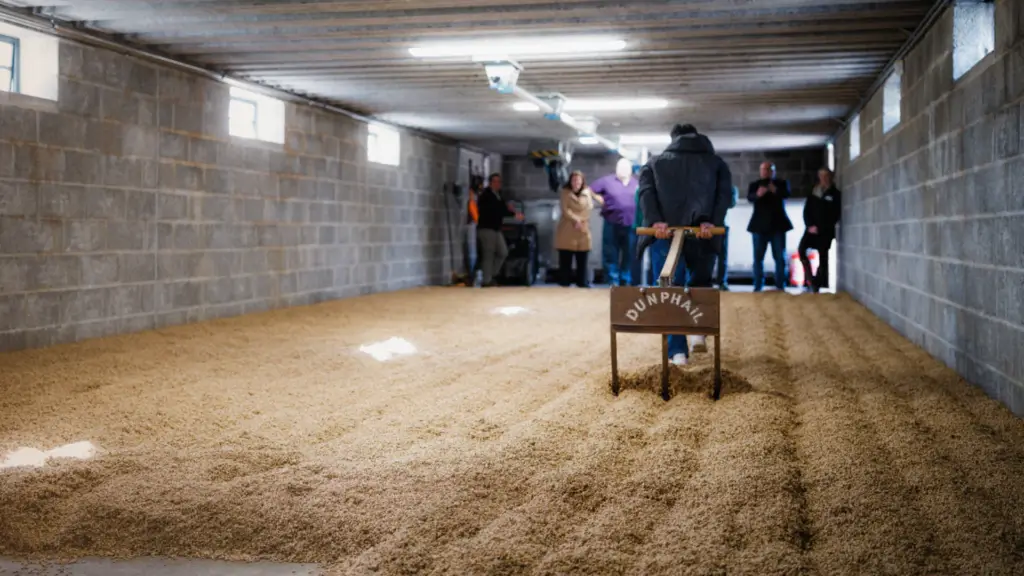
Floor Maltings History: Where Whisky Began Before stainless steel vessels, automated temperature control, and industrial malt plants, a Scotch whisky distillery often began its work on a stone or concrete floor. Barley was steeped in water, spread in a shallow layer, and turned repeatedly by hand as it germinated. The process demanded time, judgement, space, […]
June 18, 2026

Spirits
International Scotch Whisky Day 2026 and the Structure That Defined a National Spirit
International Scotch Whisky Day is not a celebration of flavour alone. It is an opportunity to examine how Scotch whisky became one of the most tightly structured and legally protected spirits in the world. Unlike many global categories shaped primarily by brand expansion, Scotch developed through regulation, geography, and institutional discipline that defined what the […]
February 8, 2026
History
Campbeltown distilleries : Why Campbeltown Once Had 34 Distilleries and Almost Lost Them All
For much of the 19th century, Campbeltown was not a marginal whisky town but the beating heart of Scotch production. At its peak, this small coastal settlement on the Kintyre peninsula supported 34 active distilleries, earning it recognition as the whisky capital of the world. That dominance was real, industrial, and globally influential. Within a […]
January 26, 2026