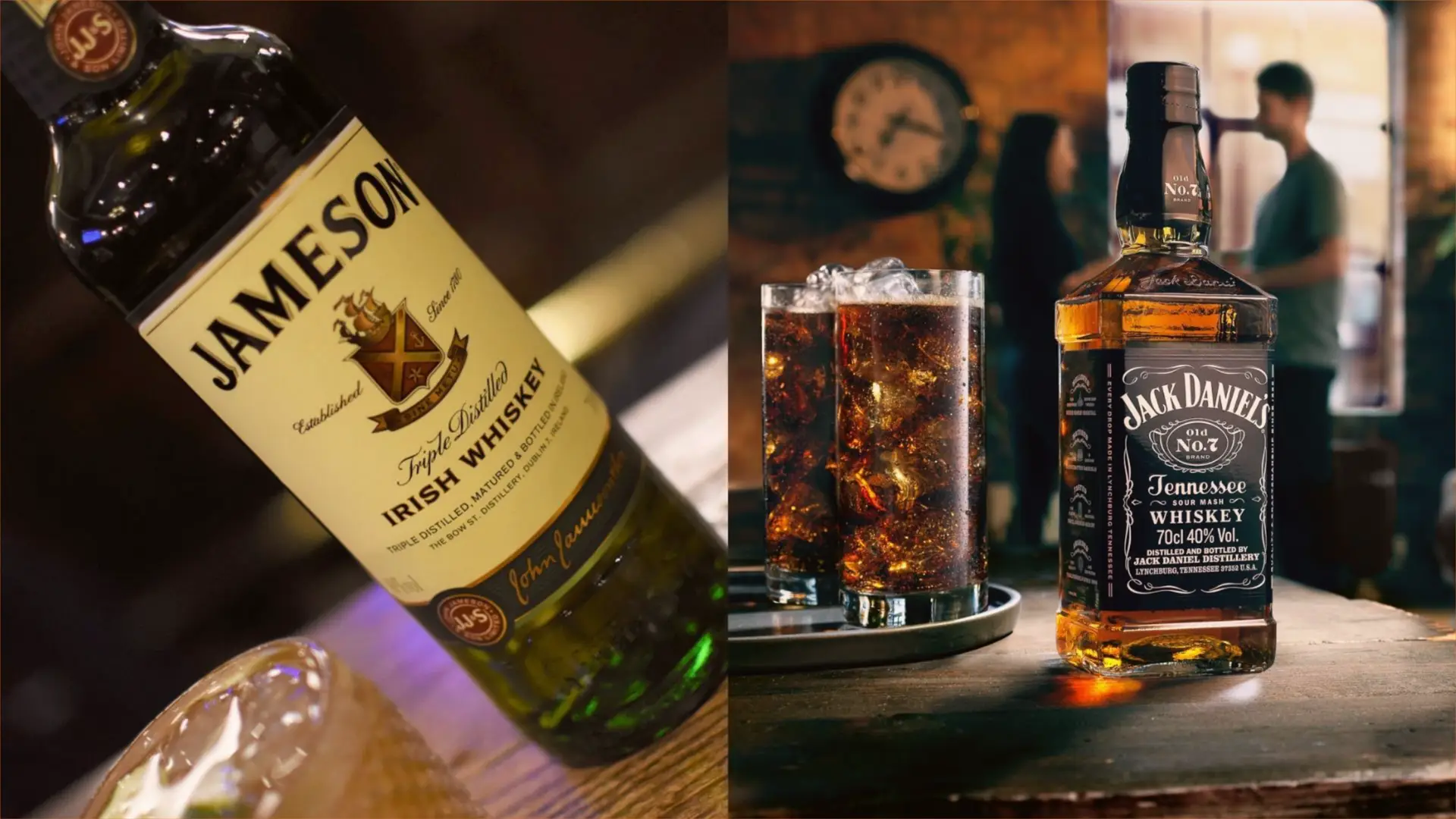
Speculation around a potential alignment between Pernod Ricard and Brown-Forman has surfaced not as a confirmed transaction, but as a revealing signal of where the spirits industry stands today. The idea itself reflects a deeper tension. When companies of this scale are hypothetically combined, the conversation is no longer about expansion. It is about how to stabilise a market that is no longer reliably growing.
A combined structure would bring together Jameson Irish Whiskey, distilled at the Midleton Distillery, Chivas Regal, The Glenlivet, Absolut Vodka produced in Åhus, and Jack Daniel’s Tennessee Whiskey from the Jack Daniel Distillery. It would represent one of the most concentrated portfolios in modern spirits. Yet the significance of that scale depends entirely on whether global demand continues to expand, or whether it has begun to level.
When Growth Stopped Being Assumed
The shift has been visible not through headlines, but through financial reporting and category data. Pernod Ricard reported an organic sales decline driven by two specific pressures: inventory destocking in China and reduced consumption momentum in the United States following post-pandemic normalisation. The contraction was most visible in premium segments such as cognac and Scotch whisky.
At the category level, the picture becomes sharper. Data from the Bureau National Interprofessionnel du Cognac shows a significant drop in global cognac shipments, reflecting reduced orders from distributors rather than a collapse in brand equity. The distinction is critical. The slowdown is not driven by rejection of the product, but by a recalibration of how much of it is required in the system.
A parallel adjustment can be observed at Brown-Forman, where declining sales and restructuring initiatives reflect a more cautious demand environment. The industry is no longer operating on the assumption of continuous growth.
China and the Weight of Inventory
In China, the mechanics of the slowdown are tied closely to distribution. Brands such as Chivas Regal and Martell Cognac, both central to the Pernod Ricard portfolio, expanded rapidly during years of strong demand driven by gifting culture and premium on-trade consumption.
What followed was accumulation. Distributors and importers built inventory in anticipation of continued growth. When demand slowed, those inventories became a constraint. The market entered a prolonged phase of destocking, where existing stock must be reduced before new orders can resume.
This dynamic creates a lag between consumption and reported sales. Even if drinking occasions remain stable, shipments decline until the system rebalances. The slowdown, therefore, is not only about demand. It is about timing within the supply chain.
The United States and the Repricing of Occasions
In the United States, the shift is less about inventory and more about behavior. Brands such as Jack Daniel’s and Woodford Reserve remain widely recognized and culturally embedded, yet consumption frequency is changing.
Several forces are shaping this adjustment. The increasing presence of GLP-1 medications such as Ozempic and Wegovy has, in early observations, coincided with reduced alcohol intake among certain consumer groups. Alongside this, broader movements toward moderation and the rise of non-alcoholic alternatives are redefining drinking occasions.
Equally important is the context of recent years. Elevated consumption during the pandemic created a temporary peak. The current phase represents a normalization from that baseline. The result is not the disappearance of demand, but a measurable decline in how often consumers engage with spirits.
Distribution Pressure and the Limits of Scale
Across both markets, one signal remains consistent. Distributors are not expanding aggressively. They are managing inventory. Both Pernod Ricard and Brown-Forman have highlighted that wholesalers are prioritizing stock reduction, which directly affects shipment volumes.
In this environment, scale becomes more complex. A larger portfolio increases exposure to multiple inventory cycles across regions. Operational efficiencies gained through consolidation remain valuable, but they do not accelerate demand recovery.
The assumption that size alone can drive growth becomes less reliable when the constraint is not market access, but the pace at which that market absorbs the product.
Premiumization at a Point of Maturity
Premiumization continues to shape how spirits are positioned. Brands such as The Glenlivet, Chivas Regal, and Absolut Vodka maintain a strong identity through quality, heritage, and packaging. In parallel, categories such as tequila continue to demonstrate strength at the ultra-premium level.
What has changed is frequency. Consumers still choose higher-quality products, but they do so less often. This creates a market where value per bottle remains stable while overall volume declines. The tension between these two forces defines the current phase of the industry.
Premiumization remains relevant, but it no longer guarantees expansion. It has reached a point where it sustains value rather than drives volume.
What Consolidation Cannot Change
A combined entity built from Pernod Ricard and Brown-Forman would hold significant advantages in distribution, negotiation, and global reach. The portfolios of Jameson, Jack Daniel’s, and Absolut would operate within a unified structure to optimize logistics and market presence.
What remains outside that structure is the central variable. Consumer behavior does not respond to ownership. The decision to drink, and the context in which that decision is made, is shaped by cultural, economic, and personal factors beyond corporate alignment.
The industry is not constrained by fragmentation. It is adjusting to a shift in how often and why people choose to drink.


Distillery
Brown-Forman Distillery stands as a pillar in the American spirits industry, recognized for its rich heritage and commitment…

Distillery
Nestled in the heart of Versailles, Kentucky, the Woodford Reserve Distillery stands as a beacon of tradition and…

Distillery
Jack Daniel's Distillery, the oldest registered distillery in the United States, is a storied landmark nestled in Lynchburg,…
Distillery
The Glenlivet Distillery is an iconic Scottish whisky producer situated in the picturesque region of Speyside, near Ballindalloch…
Distillery
Pernod Ricard stands as a celebrated titan in the global spirits landscape, embodying the phrase "Créateurs de Convivialité,"…
Spirit
Jack Daniel's After Mellowing Tennessee Whiskey
Jack Daniel's After Mellowing Tennessee Whiskey represents a hallmark of craftsmanship, steeped in rich history and characterized by…
Spirit
Absolut Vodka is a distinguished Swedish vodka produced in Åhus, a town in southern Sweden that has a…
Distilleries & Producers
Nathan Nearest Green: The Forgotten Father of American Whiskey
Long before Tennessee whiskey became an internationally recognised category, the hills around Lynchburg, Tennessee, were home to a network of farms, mills and small distilling operations where whiskey-making knowledge was passed from one generation to another. Among the distillers working in this community was Nathan “Nearest” Green, an African American whiskey maker whose name would […]
August 11, 2026
Distilleries & Producers
The Revival of Irish Whiskey: How Cooley Distillery Challenged an Industry in Decline
By the late 1980s, Irish whiskey carried a celebrated past but supported very little competition. An industry that had once included dozens of distilleries had contracted to two working production sites controlled by the same company. Historic distilleries had closed, regional distinctions had weakened, and the possibility of establishing an independent Irish whiskey producer appeared […]
June 10, 2026
Distilleries & Producers
George Smith and The Glenlivet: The License That Changed Scotch Whisky
In the early 1800s, the Livet valley already had a reputation for whisky before it had legal certainty. Small Highland stills operated through geography, local protection, taxation pressure, and rural necessity. Whisky from the Glenlivet area was known beyond the valley, but much of the system that produced it remained outside formal law. The turning […]
June 6, 2026