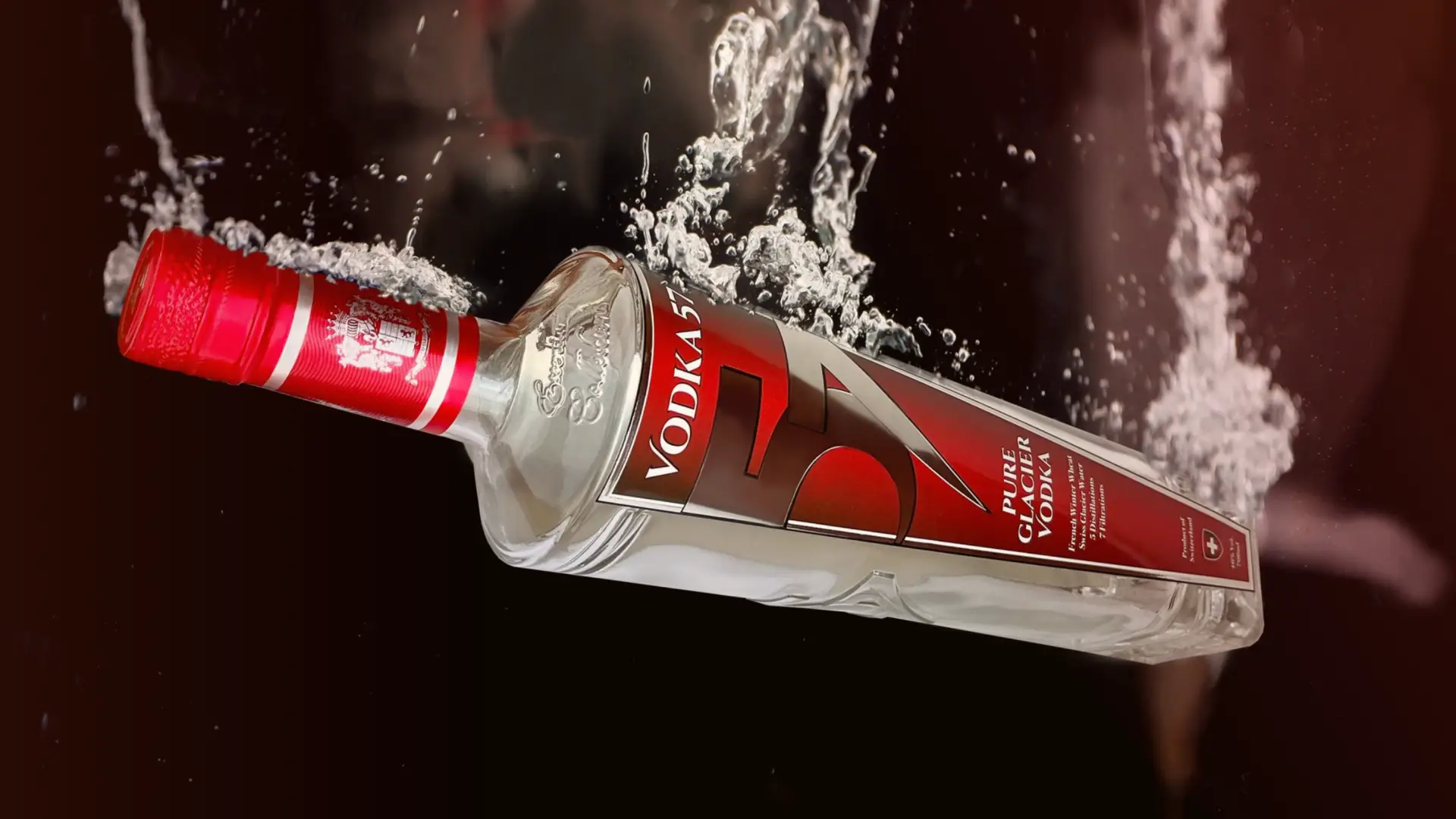
Neutrality in vodka is often misunderstood. It is not emptiness, nor is it the absence of craft. It is the outcome of restraint. In the modern European vodka category, precision has replaced folklore as the defining value. Vodka 57 Pure Glacier Vodka sits firmly within this disciplined framework, where every stage of production exists to narrow variables rather than amplify personality. Its identity is built not on myth but on calibration.
Premium vodka underwent a structural transformation in the late twentieth century. Producers such as The Absolut Company in Åhus and Belvedere Vodka by The Polmos Żyrardów distillery in Żyrardów established a modern template: controlled grain sourcing, high rectification distillation, mineral stable water, and rigorous filtration. In this model, consistency defines excellence. Vodka 57 Pure Glacier Vodka aligns with that lineage, positioning neutrality as an engineered outcome rather than a marketing abstraction.
Alpine Glacier Water as Structural Foundation
Water in vodka is not the background. It is architecture. Vodka 57 Pure Glacier Vodka uses Alpine glacier water sourced in Switzerland, where natural filtration through rock and ice over extended periods produces chemical stability and low biological variability. In high precision vodka systems, water composition directly affects dilution behavior, ethanol integration, and final mouthfeel.
Cold climate glacier water is valued less for romance and more for predictability. Stable mineral composition supports even integration at bottling strength. The role of water here is structural cohesion. It softens ethanol edges without introducing competing aromatic signals. This approach reflects the broader Northern and Central European production logic, where water is calibrated input rather than a storytelling device.
French Winter Wheat and Fermentation Control
The base material is French winter wheat, selected for its reliable starch yield and controlled fermentation behavior. In contemporary vodka production, grain choice is not intended to create flavor complexity. It is selected to reduce volatility at the earliest stage of production.
Winter wheat converts cleanly to fermentable sugars and generates a predictable fermentation curve. This reduces the formation of unwanted congeners before distillation. The philosophy mirrors established cereal-based vodka systems across Poland and Sweden, where cereal uniformity supports process stability.
By beginning with a raw material defined by reliability rather than character, Vodka 57 Pure Glacier Vodka reinforces its reduction-focused production approach. The objective is clean conversion, not expressive grain personality.
Distillation and Filtration as Sequential Refinement
Vodka 57 Pure Glacier is distilled five times and filtered seven times. In the premium vodka category, these stages are not theatrical claims but sequential refinement tools. Distillation in vodka production is eliminative. Each pass narrows the chemical profile, separating ethanol from heavier congeners.
The critical decision lies in defining the stopping point. Excessive rectification can thin the texture. Insufficient distillation can leave residual sharpness. The five-stage distillation process used here aims to preserve structural integrity while achieving neutrality.
Filtration follows as controlled polishing. Seven-stage filtration removes trace oils and particulates while maintaining viscosity. Over-filtration risks stripping the body. Under filtration risks instability. In disciplined systems, filtration is calibrated to maintain tactile balance. The result in Vodka 57 Pure Glacier Vodka is a clean, linear profile supported by a soft, even mouthfeel.
Texture Over Aroma
Vodka’s quality is most accurately assessed through structure rather than aroma intensity. Vodka 57 Pure Glacier Vodka presents a smooth entry and controlled mid-palate weight. Subtle notes described as floral, pear, citrus, pepper, and mineral are not positioned as dominant flavors but as residual signals of grain, fermentation discipline, and water composition.
Professional evaluation of vodka prioritizes integration. Ethanol should feel seamless. The finish should be clean, without metallic bitterness or aggressive heat. Neutrality here is defined by coherence. The spirit remains stable when chilled, diluted, or applied in cocktails, reflecting balance rather than expressiveness.
Awards and Contemporary Positioning
Vodka 57 Pure Glacier Vodka has been recognized as Europe’s Vodka of the Year 2024 and Switzerland’s Vodka of the Year 2025. These distinctions align with modern judging criteria emphasizing clarity, texture, and technical execution.
The bottle design reinforces contemporary identity. Its tall, slender form draws inspiration from a Medieval sword, emphasizing verticality and precision. Integrated LED lighting functions as a visual signature. Unlike heritage-driven branding common in whisky or Cognac, this design language aligns with modern premium vodka aesthetics built around minimalism and engineered sophistication.
Vodka as a System of Control
Modern vodka quality depends on repetition. Structural integrity across batches, stability under temperature variation, and consistency in dilution behavior define technical success. Vodka 57 Pure Glacier Vodka reflects this systemic discipline. Grain selection, water chemistry, distillation intensity, and filtration sequencing operate together as calibrated components within a controlled European framework.
Neutrality, when approached rigorously, becomes visible as restraint. It is the result of decisions not to introduce excess variables.
Vodka deserves evaluation beyond decorative luxury narratives. By documenting raw material sourcing, water chemistry, distillation logic, and filtration calibration, Barlist frames vodka as a production system rather than a blank canvas. Vodka 57 Pure Glacier Vodka exemplifies this approach, demonstrating how neutrality is constructed through deliberate engineering.
In a category defined by control rather than flourish, quality resides in precision. The measure of modern vodka is not what it adds, but what it refuses to exaggerate.


Distillery
Polmos Żyrardów, situated in the picturesque town of Żyrardów, Poland, is a distinguished distillery known primarily for producing…
Distillery
Vodka 57 Pte, Ltd, headquartered in the picturesque region of Escholzmatt, Switzerland, is renowned for its exceptional craftsmanship…

Spirit
Belvedere Intense Vodka is a premium, high-proof vodka that stands out not only for its strength but also…
Spirit
Vodka 57 Pure Glacier Vodka is a remarkable spirit that embodies the essence of Swiss craftsmanship. Created using…

Discovery and Education
Charcoal Filtration in Vodka Production After 1950
In the years immediately following World War II, vodka entered a new phase of industrial clarity. Distillation technology had already advanced to the point where spirit could be produced at high purity, often approaching 96 percent alcohol by volume. Yet purity alone did not define vodka’s emerging identity. The question facing producers in Eastern Europe […]
April 3, 2026
Spirits
7 Vodkas That Define Modern Precision in 2026
Vodka has always carried a paradox. It is expected to vanish in the glass, yet achieving that clarity requires meticulous engineering. Modern vodka is not about flamboyance, but about subtraction, repetition, and structural control. Its identity emerges not from what it expresses, but from what it deliberately removes. Across Europe, distilleries have refined vodka into […]
February 15, 2026

Spirits
The Best 10 Scotch Whiskies Every Collector Should Try
Scotch whiskies collection is no longer simply about finding the oldest bottle or the most expensive name. A serious collection should tell a story about the spirit itself: where it comes from, how it is made, how oak changes it, how peat shapes it and why particular distilleries have earned lasting reputations. That makes choosing […]
August 21, 2026